Showing posts with label food. Show all posts

Friday, April 08, 2011

Busan e-FM Week 8: Korean Food and Pizza

About 'Open Mike in Busan'

Introduction

There’s no avoiding it – I’m finally going to talk about some of my food experiences in Korea. So today’s topic is Korean food... and pizza.

Pizza

While I’ve been here I might have eaten Korean food, but I’ve also been on a quest to find good pizza – and it’s difficult. Basically pizza is meant to be like the three colours of the Italian flag – white cheese, red sauce, and green herbs. Most of the pizzas I seem to get are just the white cheese with toppings – the sauce is this millimetre thick layer of watery liquid, if it exists at all, and forget about the herbs.

My wife explained to me that this is how Koreans like it, but it’s a shame for me. It’s like garlic bread from shops – it’s not really real garlic bread, but the Korean version of it – which is always sweet and surgery. I think for some foreigners like me pizza is quite important – it’s our equivalent of kimchi. Well, my equivalent anyway.

Kimchi

I’m going to be honest about this, even if they take my visa away. I don’t really like kimchi. I’ll tell you what it is. When I was really young, we had school dinners. Times were pretty hard – the UK had just had an IMF bailout and people were only working three days a week. So they fed us a lot of cabbage, which I guess was cheap. I got really sick of it, and the smell. Now I know that kimchi made with cabbage is only one type, but every time I see it, it reminds me of those awful lunches at school.

In fact I find Korean food smells radically different to what I’m used to in England. Sometimes I just hide in my room. The first time my wife bought kimchi back in England from a Korean store... well, I opened the fridge the next day and it just hit me – I was so shocked. I couldn’t believe anything could smell that strongly. That was my first introduction to Korean food. But I learned that, compared to food in England, people in Korea like strong smells and flavours.

Versus bland English food

English food is traditionally blander, but food in England has become quite multicultural, especially in the last thirty years. We have a lot of Italian influences in our diet such as pizza, pasta and risotto, Chinese food is very common, and the city where I grew up is famous for its curries because of the large South Asian population. Not all of it is bland, but often it’s about appreciating more subtle flavours.

I’ve found that when a lot of Koreans try that sort of food, they say it has no taste at all. I think that’s why almost every pizza restaurant I’ve ever been to in Korea feels the need to have Tobasco Sauce on their tables. I love ham and pineapple pizza, but when my brother-in-law tried it he said it had no taste. There are some Korean noodles in a packet, and they are just about the hottest things I can eat, but my brother-in-law says they aren’t hot or spicy at all.

Versus Mike

I eat some Korean food. I think that for me it’s an acquired taste, and I’m still acquiring it. But in one way Korean food is always going to be difficult for me, because I have a medical condition – Meniere’s Disease – which means I have to eat a low-sodium diet. In other words, I can’t really eat too many salty foods.

I just read in the 조선일보 [Chosun Ilbo] the other day that according to the Ministry of Health and Welfare, Koreans consume three times more salt in their diets than is recommended. Of course, you have to have some salt in your diet, but if I were eating that much, the chances are I’d be really unwell a lot of the time. So the reality is, I’ll never really have a typical Korean diet, if that means eating a lot of salt.

So what I eat here is a fusion of Western, Korean, Chinese and other food. When we go out I’ll usually eat at one of those large foreign restaurant chains, American fast-food places, Korean 식당 [small diners/restaurants] like Gimbab Nara, Chinese and Japanese restaurants, that sort of thing - but not so much those big Korean family restaurants, which serve more traditional food, because I still find those difficult.

Eating culture

The eating culture here is quite different from England. I was quite surprised at first by the shared dishes in the middle of the table, because it didn’t seem that hygienic. As a foreigner, I’m more used to just having my food on one plate in front of me. And I find there’s a lot of etiquette involved with food too. For example, once I made a terrible cultural mistake with chicken.

You see, English people really value chicken breasts – the darker meat on the legs and elsewhere is less valued. So when I was eating chicken with friends a few months after I came here, I kept picking out the legs thinking I was leaving the best meat for everyone else. Then, afterwards, I found out that it’s the other way round with Koreans. So there I was, taking all the best meat, which must have seemed very rude. It’s a shame I didn’t become a vegetarian before coming here, which I was thinking of, but it just seems impossible in Korea.

Fish heads and live food

I’m not really a big fan of eating meat these days, and like a lot of English people I don’t really like food that looks obviously dead either, and really not things that are so fresh they are still moving on the table. Actually, even if there are just fish-heads staring at me on the table, or a food smell I find unpleasant, I find it difficult to eat my own food, which is a problem here.

I find dead fish staring at me all the time – in the sink, in pans, in the freezer. Once I even found them in some nuts I was eating in the dark. I was pretty horrified that I’d been eating them. I thought now that we’ve got lots of pet fish it might be different, but when I asked my wife about the little dead fish on the dinner table and their similarity to the the contents of our aqariums she was horrified - “But this is food and those are pets!” she said. I’m kind of surprised at the ethical side of eating food here.

You see, a lot of people – like my wife and mother-in-law – are Buddhists. I suppose I was strong, but I always believed that meant not harming living things. But, for example, when my brother-in-law caught a big fish and brought it home, my mother-in-law was going to cook it alive, and I can’t understand that. As it happens, she eventually decided not to because she was going to a big temple the next day, so she just let it died in the bowl instead. I suppose that’s better, but it’s not what I expected of Buddhists when I came here. I see these fish and crabs packed into these little bowls or tanks on the street, and that makes me sad, although at least I’ve seen the crabs defend themselves.

The food fights back

I haven’t been the victim of an aggressive crab attack. But my mother-in-law had bought crabs so fresh that they were still moving in the sink as she was pulling them apart. Then she shouted for me in a panic – one of the crabs bit her finger and wouldn’t let go. I’m afraid I looked at her as if to say “Well, what do you expect me to do about it?”; I have no experience with crabs. She managed to get it off and the cut wasn’t too bad, but yes, I learned in Korea you have to be careful, because sometimes the food fights back...

Links
Busan e-FM
Inside Out Busan

Air date: 2010-12-15 @ ~19:30

Tuesday, January 25, 2011

Poisoned

Korea has a lot of '빵집', or bakeries - so many in fact that one franchise owner recently felt motivated to go to extraordinary lengths to fight back against a rival located nearby.

It wasn't 'rat bread' that finally gave me my first bout of food poisoning in Korea, but it was bread-related. Korean Mother brought home a bag of various products from a nearby shop. When she does this it usually sets of a frenzy of bread-eating for a couple of days, not particularly because of some desperate desire to eat more Westernised food on my part, but more because she buys so much of it that it's very easy for some of it to go to waste otherwise.

I find the products available in Korean bakeries a constant source of interest - they regularly change and are always inventive. In England, no-one would think to bake peas into an otherwise sickly sweet cream cake, or put tomatoes on top of a birthday cake, but in their apparent never-ending battle to push the boundaries of something new, these are just some of the surprising innovations brought to you by the local bread and pastry researchers here.

The problem with Korean Mother bringing bakery products home with her, aside from the sheer quantity, is the identification issue. Namely, that the products are often placed in anonymous bags which renders the contents on the product contained within a mystery. Usually though, it's fair to bet that anything which seems to be savoury and have contents will have some variation of vegetables, crab and darker mystery-meat.

So when I decided to heat up one of those doughy products with its mystery contents, I thought little of it. But I became sick shortly afterwards, which was surprising because if anything I'd overcooked it due to lingering at my trading desk for a little too long while the microwave was on. That's just the way it goes sometimes, I figured.

What I'd forgotten about in the subsequent fog of illness which enveloped me was that after eating it I'd followed it with half of some sweet bread, which I'd also heated up - though not so much. When I returned to complete the second half of the latter product the morning after I got better, I discovered - with the advantage of daylight - that mixed in with the sweet bean paste and slightly sugary coating were small bits of meat, which I'd merely heated up to room temperature the night I became ill.

Sometimes my struggles with the contents of our fridge and food cupboards come down to my failure to understand the Korean language, but getting food poisoning from a bread-based product has made me realise that there are some things in Korea which are always going to exist to challenge me... although I should also know better by now than to eat my food in the dark here.

Tuesday, July 13, 2010

Sex & Sushi

These days Korean Brother is working his apprenticeship towards becoming a sushi chef in a large restaurant. Raw seafood of all kinds is popular in Korea, perhaps particularly in port cities such as Busan where it's possible to sit in a tent on the sea-front eating live 'sea penis' while waves wash in beneath you. In fact fish, and the smell of fish, can seem ever-present. Mixed with the frequent back-drafts from the sewage systems, it can be quite a heady mix. Sushi restaurants, are of course, everywhere.

Recently we went to a large Japanese restaurant to celebrate a family birthday, where he was not happy to discover that the resident sushi chef was a woman. “Women's hands are too warm to prepare sushi” he informed us with deep conviction. It wasn't the first time he'd said this, in fact, much like fan death, a lot of people seem to accept the notion that ideally women shouldn't be allowed anywhere near raw fish as 'common knowledge'. Dubious, I thought I would have to do some research.

It transpires that this is not merely a belief limited to the rather conservative city of Busan, because the notion appears to be shared as far away as Japanese restaurants in Canada, which probably imported it from their homeland. Warm hands and menstruation are said to be among the primary reasons.

In fact, there seems to be quite a bit of discussion on sushi preparation and warm hands, but while I was looking into the subject I discovered that despite my logical expectations, men and women's hands may indeed not generally be the same temperature. The only problem with this revelation - for male sushi-chef warm-hand theorists everywhere, is that it's actually men's hands that might be warmer.

In itself, this revelation is unlikely to shake the foundations of the Korean sushi industry, since it's a cultural feature here that well-established local urban legends almost always beat foreign scientific research for perceived factuality. However, what may be less easily dismissed, is finding a respectable Korean scientist with a paper in The Lancet stating that "women are more likely to have cold hands than men".

Sadly, my Korean language skills are not sufficient to explain to Korean Brother that, on the logic of the warm hands theory he supports, all male sushi chefs must now be replaced by women, although I don't really expect this country's poor OECD gender discrimination statistics to be challenged; after all, there's still the menstruation issue.

Monday, April 26, 2010

Quarantine

When I spend time with our Korean friends, we share experiences, but not often thoughts or conversation; they can't speak much English and I can't speak much Korean. When they laugh, I don't get the joke, when they suddenly decide to do something, I usually don't vote, only follow. The language barrier separates us and it's easy to fall into an isolation of my own thoughts and my own world. It's a frustrating reminder that the time I've spent studying has not yielded adequate results, and while I try to follow what those around me are saying, it requires a sustained level of concentration which my mind seems ill-equipped for after all the hundreds of ups and downs of fifty-five hour trading week. It was with some trepidation then, that I opted to extend the experience from a few hours to an entire weekend spent at the summer house of one of our group, two hours north of Busan in Hapcheon County ('합천군'), West of Daegu.

Recently Korea has suffered from an outbreak of foot-and-mouth disease, and once we left the highway one of the realities of this became evident as our stuffed minivan was quickly subjected to decontaminating spray at a checkpoint. It wasn't the last; shortly before we reached the isolated valley in the mountains that was our destination, we had to repeat the experience. It may only be a matter of time before movement is prevented entirely as it had to be in the UK in 2001.


When we drove down the final mountain the valley that emerged before us comprised of six or seven small dwellings clustered amongst the fields. It was the type of place which was so small and dispersed you had to wonder whether it could even be called a village. I'd expected our weekend home to be a rather ramshackle building in keeping with the vast majority of Korean rural architecture and my experiences in Namhae, but the rather smart metal gates we pulled up at suggested otherwise, and these were opened to reveal an entirely modern single-story house beyond, which in turn opened up to reveal a modest but functional three room dwelling comprising of a bedroom, kitchen/living area, and a bathroom.

Our friend, the owner, has a full-time job in Busan. I'd been told he grew vegetables here, but the variety of crops visible, along with the size of the plot of land - which even included a pond - made it evident that this was no mere side operation but a serious commitment. It seemed he was leading a double life as a farmer at the weekends.

Namhae hadn't prepared me for this. The nearest road was a thin strip visible in the far distance, and even then it wasn't well traversed. In-between the bird song it wasn't just quiet, there was an actual absence of noise. I couldn't remember the last time I'd experienced anything like it. It was breathtaking - and perhaps because Meniere's Disease has left me with mild Hyperacusis, enormously relieving. People always seem surprised when they read of traders who give up their lives in the city to become farmers - moving from the frenetic pace of the city to the perceived tranquillity of a job which seems right at the other end of the career spectrum as far as one's environment is concerned. While I'd always sympathised with the sentiment, at that moment I understand it perfectly.


After a barbecue, to which every fly in Hapcheon County had been invited, the plan was for the group to go 'night fishing'. It had been warm in the sun but as we'd eaten and dusk had fallen, the temperature had become surprisingly cold, promising to turn the experience not so much into a battle against the fish, as a battle against the elements. But once again language and cultural barriers highlighted the difference between my English understanding of the act of going out 'fishing' and the Korean definition. We drove out to a river near an isolated love hotel, getting sprayed for foot-and-mouth disease again on our way in and out, where nets were prepared on a low concrete bridge in very little light. Once prepared, the nets were tied to the bridge supports. And that was it - no rods, no braving the near freezing conditions, no waiting around in vain for hours - just drop your nets in and leave. Two hours later the nets were collected - two fish had been caught.


We were all up the next morning at 7am because we'd come here with a purpose of sorts - to help dig foundations for a new outbuilding and harvest some of the vegetables. An early mist hung in the valley but it wasn't long before a surprisingly strong sun burnt it off. I also got burnt - I'd spent an hour clearing stones from the fields to be used around the pond, and while I put on sun-cream when I went in for breakfast, the damage had already been done.


At 9am my image of the idyllic rural scene was somewhat shattered by the sound of a disembodied voice echoing around the valley. I realised later there were speakers on some of the telegraph poles, and the authorities weren't afraid to use them. A foot-and-mouth warning was read out. It repeated every couple of hours, and at one point a car broadcasting a similar message even made its way down the valley. Now that I've worked out in the fields while loudspeakers broadcast government warnings I feel I've had a little taste of the North Korean experience. On the whole, it seems strange that such a potential invasion of privacy would be put up with, no matter what the 'public good' arguments are, but given that our apartment back in Busan has a similar loudspeaker which 'important' messages are broadcast through - with no way of turning it off - perhaps people here are conditioned to be used to disembodied voices of authority speaking to them in their private moments.


I suppose it's not as though they are used to urge people to work harder in the fields - not that it would perhaps be needed - who needs Big Brother when you have your dead ancestors watching over you in the fields from their graves in the hills?


We completed collecting stones from the land and the 'Oriental Fire-Bellied Toads' ('Bombina orientalis') now had a more interesting environment to live in. The toads, as their name suggests, have rather spectacular orange undersides to warn of their toxicity, but they weren't easy subjects to photograph.


The foundations began to take shape, but digging was hard work as the ground was full of stones and rocks. The building was being referred to as a summer house, which appeared to make it a summer house for the summer house. There seemed to be a Russian doll thing going on here. From the haphazard nature of our work, I harboured a suspicion that in Korea, if you wake up one morning and decide to build a new building on your land you just go ahead and do it - there's little if anything in the way of planning permission to resolve. Or at least, there didn't seem to be anything other than an ad-hoc plan.

Later I helped harvest some vegetables before lunch, and in the afternoon sawed some wood - my wife wanted to make a traditional wooden object which is meant to usher in good harvests - it's basically a wooden base with a small vertical branch connected to horizontal, vertical and then horizontal branch, all progressively smaller. The alleged effect is that of a bird perched on a branch.

We'd been on a tight schedule all weekend, in fact there was an actual schedule printed out in some detail, and our time was almost at an end. We left our brief rural life and returned to the city, where the 'Meowi'/'머위' vegetables (or Meogu/머구 as they are called in the Busan dialect) were a big hit with Korean Mother. Apparently they are really hard to find or buy in Busan because not many people eat it here, even though many people like Korean Mother are ultimately immigrants from more rural places. I'm told it tasted especially delicious. When I closed my eyes, I could still see dozens of black dots flying around. I can only imagine this place is mosquito hell in summer.

During the trip I seriously began to wonder how I was perceived by my Korean friends. My wife, who normally acts as my translator, was elsewhere most of the time, and unlike at social gatherings I found myself in situations where I needed to coordinate with others or follow instructions, but it was hard to do. I felt that if I were a Korean, I'd probably be regarded as having a rather low IQ, but then this is the reality of my Korean existence so perhaps for the purposes of defining my Korean life, I am thus mentally challenged. At one point I was asked if I knew how to use a spade. I don't know how it is that the deeper I get into Korean life the more isolated I feel, and can only hope this is an inverse Bell-Curve of which I will one day find myself on the opposite, ascending side. I never expected my experiences to get worse as time went on, and that's the surprise and disappointment.

I tried to work very hard to compensate, but I was sorry that between this and the tight schedule I never had the chance to leave the compound and walk around the area. Life in rural Korea is radically different to life in the cities, and I thought there must be much to discover. I also really needed that elusive perfect moment of tranquillity that was hinted at, and the faintest promise of some enlightenment it might carry with it, but instead it seemed we exported our city lives into the countryside, changed one form of work for another, and kept the same urban pace that is so much a part of our existence.

Friday, April 09, 2010

Mr. Bean

One of the great things about my wife's pregnancy is that she's been getting cravings for Western food, which normally she can happily live without. This prompted her to start searching for Heinz beans, or 'Beanz' as they prefer to call them these days for the benefit of Generation-Y.

Here, far out in the uncharted backwaters of the unfashionable end of the western spiral arm of Busan, I've only seen an actual can of baked beans once - it was allegedly the product of an Italian brand I'd never heard of, and it was too salty. So I didn't think my wife's quest specifically for Heinz beans was going to be successful, but she found some on the Internet. Considering that, as far as I recall, a pack of four tins of 'Heinz Beanz' in the UK used to sell for around £1.40 (2,402 won/$2.13), at 13,660 won for six (£8/$12) delivered, the Korean price was not cheap, although since they were not quite the classic product but instead 'ham sauce' and 'sweet chilli' flavour, it wasn't exactly comparing like with like. Clearly though, it was very expensive, but for the sake of the craving and that little reminder of home, we ordered them.

This being Korea, the beans turned up the next day, by which time my wife's few-day old craving had passed. The spiciness of the sweet chilli beans made wonder how they hadn't yet caught on in modern-day Korea, given that Koreans actually eat a lot of beans of the non-baked variety. Then again, the red beans which are so popular in Korea are believed to cast out bad spirits, but I don't believe Heinz Beanz have the same effect.

Later, friends of ours reported discovering the same product in the Busan branch of Costco, which unfortunately is too far away from us to shop at. The cost there is 9,990 won (£6/$9). They bought some for us and we gave them a tin of the sweet chilli beans guessing that these would be best suited to the spice-craving Korean palate. It proved to be a hit.

Friday, February 19, 2010

Guess Who's Coming to Dinner

Korea's Lunar New Year holiday ('설날') occurred over the weekend. It's a time of year that involves families gathering together, and all the inevitable responsibilities that go along with this, both subtle and overt. This year it clashed with Valentine's Day, leaving people with a choice of which to celebrate. With family being so important the New Year invariably won, although once again, ever-evasive Korean Brother managed to avoid any such obligations. As the eldest in her family, and with both parents having passed away many years ago, it is Korean Mother's responsibility to host to her young siblings for New Year's meals, and it's not an event without its tensions; with a sister who works as a Buddhist psychic and a brother who works as a Christian pastor, they are a microcosm of the religious differences which can sometimes bubble away uneasily in Korean society.

Pastor Uncle stipulated that he would only eat food which hadn't been in any way involved in any kind of Buddhist blessings or rituals, which theoretically required Korean Mother to spend the whole day preparing the dishes for the meal. This was unfortunate because Korean Mother was extremely tired having just returned from two days of New Year family duties in Namhae, and Psychic Aunt provides a steady supply of religiously-tainted food and dishes to our apartment. Thus a moral dilemma was created of whether to pander to someone's religious objections - or take the easy path of claiming an incorrect provenance. I was not keen on the latter but my limited experience in the murky world of Korean religion is that neither faction necessarily affords the other much reverence.

Korean Mother and Psychic Aunt wanted Makgeolli ('막걸리') - Korean rice wine whose popularity is rocketing - to drink with their meal, and phoned Pastor Uncle to ask him to buy some on his way to the apartment with his family. He was completely taken aback - he couldn't possibly be seen by his children buying alcohol (despite the fact that Jesus was well known drinker). Perhaps he's one of these people who've made up their own version of the Bible. So the two Buddhists had to go out and buy their own booze.

When Pastor Uncle arrived, our borderline-insane dog tried his best to feign a case of rabies and scare him into leaving. But Pastor Uncle had evidently been drinking the Biblical Kool-Aid and persisted in holding out his hand repeating "I love you, I love you", in English - oddly enough; our dog doesn't speak English nor does he have the gift of tongues. As usual, almost all the hospitals were closed for the holiday, so it wasn't clear where Pastor Uncle intended to have his finger sewn back on, but perhaps he felt that God would provide. He explained that the power of love could conquer any animal, which makes one wonder how these missionaries keep getting themselves killed overseas.

His children performed their 'big bows' to Korean Mother - a ritual at this time of year. It's extremely important partly because it confers respect on ones' elders, and affords them a formal opportunity to impart wisdom and/or lecture their juniors, but mostly because - from the point of view of the juniors - they are given gift money in return. We'd already done our bows earlier and made our profit, and while Korean Brother had to go, he'd somehow managed to stay long enough to get his pay-off too.

Before long the collected family factions were sitting on the floor around a long low table reminiscent of some medieval European banquet - if Europeans ate copious amounts of crab, noodles, rice and plants. But before we could eat, Pastor Uncle had to say Grace, and his faction put on their most serious looks as they bowed their heads while the rest of us waited. Once he'd finished, Psychic Aunt decided to immediately follow it with a Buddhist prayer, which is not normal and very much felt as though it was designed to make a point. I believe this was obvious to everyone and the atmosphere seemed to have become very uncomfortable. It looked set to be a long evening.

But if there's one thing that can unify Koreans it's food - so it wasn't long before animosities were buried in favour of devouring the feast of potentially questionable provenance. Bits of crab flew through the air amidst this fine social scene, with Psychic Aunt pausing at one point to pull a piece out of the hair of Pastor Uncle's wife. Perhaps there could be peace in our time.

I was not faring so well. The soup tasted of seawater, the meat was of the don't-ask-don't-tell variety so popular in this country, and by the time I'd finished I felt like I'd been sucking on a metal bar for fifteen minutes. Five minutes into my re-acquaintance with authentic Korean food the Makgeolli had started to look like a good way of conducting a mercy killing of my taste buds, but it seemed rude to ask the two older Buddhists for a glass of their hard-won liquor. Unfortunately, I'm not usually offered alcohol since I'm possessed by the evil spirit which is Meniere's Disease, and for my sins I go through much of life having the balance of a drunk while actually being stone-cold sober. So it was just me, the seawater soup, and the misery of being all alone behind the language barrier with only the partially-obstructed view of the South Korea v. Japan Asia Cup game for company.

But an interesting thing happened. The Christian wants to know how work is going and the truth is I'm growing fed up with it. My wife and trading partner doesn't want the stress while pregnant, leaving me to work alone, and I've finally realised that if there's one thing I really can't stand about trading, it's the people. So what about teaching he asks - after all, one of my wife's degrees is in English Literature which has to be good for something, and in my abortive attempt to teach English in Japan post-graduation I'd acquired a TESOL qualification, although the more I learned about teaching English the more underqualified I felt - and the more I didn't want to do it. The upshot of that was we may have agreed to a potential career change somewhere on the horizon, though unfortunately I can't blame it on the non-existent alcohol.

While the Christian enthused about all the potential clients he could gather - and he's a very well connected person - his equal and opposite sat in silence, making no offer to network for us. On this evidence, I'm not sure how Buddhists intend to win hearts and minds in this country against the onslaught of a group who so rabidly want to help.

Thursday, January 07, 2010

What's Cookin'?

When I was asked if I wanted to attend a 'non-verbal' performance vaguely themed around the idea of cooking for a Korean wedding, it didn't exactly sell me on the idea although I agreed to go. As I gathered it might involve - amongst other activities - drumming with kitchen equipment, my interest was piqued; I'd been to a taiko performance in England and really enjoyed it.

What I didn't appreciate at the time was that the performance, called 'Nanta', is practically a Korean institution - having premiered in 1997 the show is still running twelve years later, and was apparently at some point designated as one of the top ten tourist attractions in Seoul. More than that, it's expanded - there are currently four Nanta troupes, one of which has been on Broadway since 2004. There are regular tours outside Korea - where it's often called Cookin' rather than Nanta. Clearly, it's run so long that individual performers come and go, and the show is its own mini-industry. Described as a combination of samul nori drumming and music mixed with comedy, pantomime and audience participation. But it isn't without controversy - with at least one Korean samul nori artist considered a national treasure in this country denouncing it as something of an affront to tradition.

Not particularly wishing to end up on the stage at some point, we'd carefully chosen seats a little further back from the front in the middle which proved to be a wise move. I'd counted three other foreigners in the audience near the front, and two of them ended up in front of everyone before the end. I've noticed that Koreans really like audience participation - and it features in a lot of these types of event. I couldn't help but wonder if the jokes were the same every time though.

In spite of the supposedly 'non-verbal' nature of the show, it actually did have some speaking - a mix of English, Korean and nonsense. It didn't greatly impact on the enjoyment, but a little of the meaning at certain points was lost due on me to the language difference. In the end, I'm not sure anyone's really there for the story though, it's all about the spectacle, and there's none greater than when the performers frantically drum on a variety of surfaces with a variety of implements - at times it really is a sight to behold as the noise thunders around the auditorium.

Photos are not allowed, but below is the promotional video on Youtube. While it tends to concentrate on the drumming parts of the show, this probably only represents about half of the performance, the remainder being a mix of non-verbal comedy and audience participation.

Friday, October 23, 2009

Roman Candles

I left the apartment early this morning to find a cake for my wife's birthday before she woke up, and discovered that my favourite local bakery didn't open until 9am. I'm used to Koreans working very long hours, and since many British bakeries are open much earlier in the day, I'd assumed the same would be true here, but it isn't.

Avoiding the Paris Baguette chain as being too manufactured and clichéd, I located an alternative that was open, and for once was rather glad to have a staff member hover over me while I made a selection from a large array of choices. My new best friend ventured to tell me the ingredients which met with my approval, and after telling her "I'd like to buy this one", we proceeded to the checkout.

Which is where this thus-far smooth transaction went off the rails. As the cake was being packed, the assistant said something in Korean to me the only part of which I understood was "cho" (초) which means a 'second' (of time). It crossed my mind that I was being told that she would 'just be a second', which if you're British is the kind of thing a person packing something in a shop for you would be likely to say, but in retrospect probably deviates outside the norm of the Korean language on the principle that it is too casual. I apologised, said I didn't understand, and contrary to any impression I might have thus far created, didn't speak Korean. I'd considered explaining that it was my wife's birthday, but I wasn't sure it added anything to the situation. I paid and left.

Back at home, it quickly became clear that "cho" is also the Korean word for 'candles' as well as 'second' - and despite these having been included with every cake I'd ever witnessed being purchased before, my failure to grasp the other meaning of this word coupled with the assistant not trying to clarify her question had led to me, or rather my wife, not having any with her cake. I was kicking myself for not having thought to look up the word for candles before I'd left the apartment, but this is the problem with only having a smattering of usable Korean - once any conversation strays outside my 700-word vocabulary I'm very quickly lost.

Korean Mother announced that she had one we could use, and promptly returned with the kind Buddhist worshippers take to temples - which in other words was not so much a candle as a blunt object.

Next year, I'll remember the Korean word for 'candles' - and I'll probably visit a different store.

Monday, October 19, 2009

Fast Food

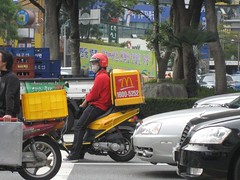
Delivery bikes are a fact of life in Korea - and not just on the streets - apparently being the owner of such a vehicle entitles you to ride on the pavements/sidewalks at speed weaving your way in and out of pedestrians, which by some miracle, you usually manage to miss. Although not quite always, as I finally found out a couple of weeks ago when a wing mirror connected solidly with my arm.

But in all my time here I was never aware that McDonald's had got into the local delivery business, so perhaps this was a new development while I was away. The bike even has "McDelivery" written on its side, in case there was any doubt. Personally I don't quite picture myself perusing their menu to pick out a cheap burger and fries, but to be fair, it's no different from the kind of food local Korean outlets would happily bring to the door, usually at much lower prices, and quite possibly, profit margins. A couple of days after taking this shot, another McDelivery bike shot by me at around 20mph as I walked down the street, missing me by a finely calculated couple of inches and doing nothing for their corporate image with me. Branding your delivery vehicles here can be a double-edged sword.

Sunday, October 11, 2009

A Piece of Cake

I had only my second birthday in Korea recently, but while the first offered few surprises, and while I thought I understood the essentials of Korean cake design from the large number of small bakeries that exist here, I was not ready to discover that the large cherry-like objects sitting in the cream atop this example are in fact... tomatoes. I know, to the unseasoned observer the size should probably have given this away, but during my time in this country I have become accustomed to its suspiciously-oversized fruit, so it didn't immediately set the alarm bells ringing.

I'd marked the occasion earlier in the day with a return to my old haunt, Ijaemo (이재모 aka Lee Jaemo - it's a name) Pizza since I was already in the Nampodong district of Busan at a computer store buying a new power unit for my desktop PC. Sadly their ham-and-pineapple pizza with raisins - which had approached levels of near greatness - was no longer on the menu, so I had to settle for a much duller chicken pizza which the waitress assured us was "not hot". It's not that I necessarily mind hot food, but to my mind there are times and places for it, and all too often food is so hot here it kills the taste of dishes which have much more to offer - if they aren't wiped out in a nuclear fire of peppers or tobasco sauce. Unfortunately it seems so much the norm here that trusting the waitresses' assurances was my undoing - maybe it wasn't for her, but by the time I'd had one slice, my taste buds were already numbing. The loss of my favoured Ijaemo menu item means that I will have to renew my quest for Busan's best pizza again in the near future, although Mr. Pizza's (bizarre slogans - "pizza for women!" and "love for women!") ham and pineapple may come close. It actually seems to feature identifiable ham and actual sauce.


Mr. Pizza have also, in my absence, apparently developed the intriguing Shrimp Nude and even more inexplicable Beselo ("Bestseller & Best Lover") varieties, in addition to curry pizzas. It's ironic that coming from a city which has often vied for the title of "Curry Capital of Britain", and where the vast majority of independent pizza takeaways only use حلال (halal) meat as ingredients, I've never actually seen these two types of food merged except in Korea, and although the idea hadn't occurred to me before, now it's left me wondering why.


I've also discovered that a local bakery and café has hit upon the idea of combining the themes of pizza and dessert, to bring us pineapple and walnut pizza-slices. Those with an eye for fine detail will note the herb-effect on top of the central pineapples. Expect more research to follow.

Monday, October 05, 2009

Event Horizon

"Chuseok is one of Korea’s most largely celebrated holidays. It is a time when families and friends gather to share food and enjoy their time together, giving thanks to their ancestors for the year's bountiful harvests." - Korea Tourism Organization

But there was no bountiful harvest for me on Saturday - except of misfortune; Chuseok will now also be known as the day I caused the Great Internet Blackout in our apartment, after the setting up of our intranet-based trading webserver went horribly wrong and stopped our self-sabotaging router talking to the outside world. So while I spent the the holiday trying to get us back online, Korean Mother, Brother and Wife whiled away the hours playing our other British import - the Nintendo Wii. I wondered if I should care; it didn't feel like a holiday to me - I've spent much of the thirteen days since my return working to set up our new lives here and I don't particularly want to stop until everything is done.

The next day, we are in a taxi taking a Chuseok gift of several bunches of very large and heavy grapes to Korean Best Friend. "Is he American?" asked the driver. Our eyes meet through the rear-view mirror. "No - British" replies my wife. This is usually the point at which the tension in the air dissipates and we have a good-humoured conversation or I listen to criticisms aimed at my cousins from across the pond - instead this time there was something of a complaint heading in my direction. "I had three British people in the back of my taxi not so long ago, and they ate!" - "Burgers!" he added with some disgust. I'm guessing this isn't the done thing in Korea. "Do people eat in taxis in the UK?" Well, not as far as I know - but then maybe that's just because I don't know the kind of people who do.

I considered making an effort to apologise on my compatriots' behalves, but if I'm not on the their side, and I'm certainly not on the Koreans', where does this leave me? "Whose side are you on here?" I asked myself as I exited the taxi. "Mine". Or at least, I think I am.

So here's my plan: Best Friend's house, gift, leave, lunch at Gimbab Nara, home, watch the Japanese Grand Prix while continuing to work on setting up our computer network and attempting to fix the monitor which failed earlier in the week. I never watched Formula 1 in Korea despite it being on Korean ESPN, but started again when I was in the UK and I just haven't kicked the bad habit again yet. The plan advances as far as the Friend's house, where Friend's Mother is very happy to see us again. "You look well". So I try to reply in Korean "Listen, if I don't get some proper sleep soon in this noisy country of yours, I'm going to have a psychotic episode" but it comes out slightly differently as "It's the weather". "Ah well, yes, Korea has four seasons you know" - I attempt a swift riposte "Oh come on, we are not going through this bovine excrement again are we? We get four seasons in a day in my former homeland", which I mistranslate as "Ah yes, the FOUR seasons" - and nodding my head for effect. And then the food starts coming out. And I know what this means - there comes a moment when you cross the event horizon of a Korean social black hole, and you don't necessarily see it happen but after that your fate is sealed - there's no way out until you're put through the process and can possibly emerge as Hawking radiation.

So here's their plan. At 1pm 4th Daughter will arrive with her boyfriend - who hasn't yet been formally introduced to her parents. This is, therefore, a major occasion in Korean culture; parental approval can make or break a potential marriage, and it's clear from the anecdotal evidence I've already been witness to that this is no mere rubber stamping exercise, but a real opportunity to make superficial, prejudicial and ultimately condemning judgements on the potential match for any unfathomable reason whatsoever. At 2pm Korean Best Friend and 3rd Daughter's soon-to-be husband will arrive and while that match is a foregone conclusion it's still suit-and-tie affair for the groom-to-be. At 3pm 2nd Daughter will arrive with her new boyfriend, who will also be formally introduced for the first time. So if we don't get out by 1pm we're going to get sucked into this.

At 1pm 4th Daughter's new boyfriend arrives in his suit looking jumpy. "I'm so nervous, I'm sweating!" And he really was - if you could bottle agitation he could have cornered the market. The pictures of the potential father-in-law hanging on the wall, showing him so proudly in his uniform with acres of medal ribbons across his chest, would no doubt have done little to calm his fears. And I thought I had it bad marrying the police inspector's daughter. Maybe not so much. After he settles down at the table Best Friend's Mother complains that 4th Daughter hasn't said much about him beforehand. "Then ask me anything about myself" he says. The first question is "What do your parents do?"

At 2pm Best Friend's future husband turns up. "I actually got here 15 minutes ago - so I had to wait at the end of the street." he jokes - or does he? Best Friend's father is very particular about punctuality, which between that, and his background, may account for the afternoon's precision planning. I eat some rice cake but pass on the abalone which I'm not a fan of - despite some insistence from the groom-to-be; I've played this game before and my go-to-hell smile is well practised. Except last time I played I was here as a prolonged visitor, this time I'm here with the intention of staying, so the game has changed, and not to my advantage. I turn to my wife and ask if I should eat it just to shock him. She thinks not, but I know the day is coming when I'm going to have to dive into this kind of Korean cuisine with gusto rather than picking at a dish here and there. In fact, while I may always be afforded some latitude, I know I have to become more Korean, and the terrible thing is that sitting there on the floor at that table, wondering if my aching out-of-condition Korean sitting muscles will ever let me stand up again, I knew that I'd already crossed the event horizon when I got on that plane and came out here two weeks ago. It was always going to be this way, but this is when I really felt the full horror of it - surrounded by seafood with my dead legs, rusty language skills and a fading smile.

Best Friend's Mother is friendly and familiar and she's really making an effort, which only serves to emphasise that I am the problem here. Or maybe she's getting too familiar - "Hands in my space! And... now... you have your arm around me." Did I mention I was British and in my culture... oh never mind. There is much laughter as my body language is unconsciously signalling my intention to escape. We're sitting on a bench by the table at this point, and Korean Wife seizes the opportunity of a distracted moment to grab hold of the top of my jeans pockets and belt and use them to discreetly slide me away across the bench from the ajumma's immediate sphere of influence.

More food is on the table now - because it's coming in never-ending waves from the women in the kitchen - and this time Best Friend's Mother insists I try some decorated Korean sweet rice cakes before her. It's a trap, and not one I fall for - you should eat first - I tell her. She claps her hands in delight at this indicator of my growing assimilation.

Despite my protestations the Japanese Grand Prix had been put on the TV. I couldn't watch it without appearing rude and I couldn't not watch it without also appearing rude at the gesture. Shortly after 2nd Daughter's new boyfriend appeared at 3pm and he had been introduced and settled down at the table he asked those assembled "Why are you watching this when there's no Korean playing?" So there you go Bernie Ecclestone, you can hold your Korean Grand Prix next year, but until a Korean driver gets put in one of those cockpits, don't count on anyone here really giving a damn.

My wife confided in me that she was sorry she didn't come from a large family to have this kind of gathering, and as though Best Friend's Mother read her mind as she counted off her daughters and their partners, she went on to indicate my spouse as her 'honorary' 5th daughter and therefore myself as her 'honorary' 5th son-in-law, offering the justification that "even though he's a foreigner, he seems nice." Everyone laughs at the joke.

There were threats that a round of 'Go Stop' was going to break out, which as well as being the Korean driving style, is also a popular card game. This was finally our chance to escape; Korean Wife was tired and while she may have harboured wishes of being part of a bigger family, her stamina for it was about as strong as my Korean sitting muscles.

By the time I left two Korean men had past their event horizons; if approved their futures were now locked into the gravitational influence of another Korean family. And one English man had realised he was finally locked into the gravitational influence of an entire society.

Thursday, October 01, 2009

Confessions of a Mask

So where are all the Koreans who were supposedly panicking about Swine Flu? If anything, there seem to be even fewer people roaming the streets wearing masks than I recall there being in normal times. I fully expected everyone to be wearing them at the stations - because that's what we had been led to believe - but I only saw one person in total. There were heat cameras at Incheon Airport like the ones they had during the Bird Flu scare, but otherwise there were few visible signs that anything had changed. Korean Brother, whose odd schedule finally intersected with ours in the early hours of one morning, clearly was concerned enough to talk to us about it and ask about life in the UK under the pandemic, and some other friends have discussed the subject with us in somewhat hushed tones over meals which are often shared from central dishes.

I must admit, when I was back in the UK I began to feel a certain nervousness about coughing in public, feeling as though the moment I did a dozen sets of eyes would immediately fixate on me with suspicion - but when I came through Incheon Airport last week that nervousness had escalated into the outright fear that the mere clearing of my throat might trigger an audio alarm and my immediate burial beneath a pile of Korean biomedical experts in hazmat suits. That fear never receded too far from the surface once I'd entered into the country proper, and I felt if I walked around the streets with a mask on I'd be given a particularly wide berth. Maybe the Koreans feel the same way.

Which is not to say everything is exactly the same. When Korean Mother went shopping for a new TV two years ago I noted most stores would have drinks and snacks laid out for their customers, presumably in an attempt to weaken their resolve to haggle. Now my wife and I are out shopping for a TV, the food and drinks are still there, but often alongside a bottle of hand gel of some description, and when I was in the Nampodong area of Busan a few days ago, there was a woman in the street brandishing liquid soap, offering to clean the hands of people passing by. But in the five minutes I happened to be stood there, only one person took up the offer. So it looks as though life here goes on as normal, with a few additional features.

Wednesday, September 23, 2009

Homecoming

On the deserted platform of Busan station I held my arms aloft to claim my victory. I was home, having endured yet another 27-hour Meniere's-fuelled travel-odyssey, this time with a large and apparently useless side-order of Valium, and now I could finally rest after five intensive weeks of disposing of all my possession back in England. I should have been exhausted, but instead I was filled with an inexplicable energy.

Friends met us at the station, and before long we were in a car playing the Korean version of Grand Theft Auto – I counted three near misses in the first five minutes. You have to remember that this is just the way people drive here. One day someone will make a fortune in this country by inventing a device which enables the local drivers to keep their cars in the same lane for more than five seconds.

Evil Korean Dog, which I parted from 15 months earlier – giving him the finger as I left as I recall – held no animosity towards me and inexplicably was my best friend all evening. In his excitement Korean Father had ordered an unwanted pizza which gave us another task to get through before we could take the showers we felt we desperately needed. I ended up sharing my shower with a mosquito – reminding me of something else I hadn't missed. It was 7pm Korean time and I'd decided that I might as well try and tough things out by going to bed two hours later and maybe getting straight back onto local time after our 31-hour day. But my body had other ideas, waking me up at 2am Korean time and leaving me to spend the rest of the night writing.

My wife couldn't sleep either – we got hungry and raided the fridge for something to drink. “Would you like milk? It's Korean milk though.” The words hung in the air for a moment before my mind connected the facts from my memory. “Oh of course, Korean milk is foul isn't it.” It wasn't really a question. I was, of course though, destined to drink it.

Sunday, March 29, 2009

The Restaurant at the End of the Universe

While it may be a few months since I wrote anything here, to put it into context I've been meaning to get around posting this entry for two-and-a-half years. The problem was that it's a video which I took so soon after I'd arrived, when Korean Mother hadn't yet learned that if she didn't want to become famous it was probably best not to talk when I was trying to take clips with my camera, and it's taken me this long to figure out how to strip out the audio so she doesn't have to share her innermost thoughts with the world.

It was a mere three weeks after I arrived in Korea that Korean Mother and my girlfriend decided to take me to the Songdo area of Busan to "eat fresh seafood", which as it turned out was an important hint which strictly speaking didn't tell the entire story, but then that's Korea for you. Whatever visions I had of a nice restaurant a few floors up one of the buildings, overlooking a bay glittering in the sunshine, were quickly dispensed with as we hurried through the rain and wind from our taxi, into a large tent that was so close to the angry waves crashing over the seafront that surges of water were regularly breaching one end of it and lapping around the tables and chairs. Apparently I was the only one in any way concerned by this, which as it transpired was another aspect of living in Korea I was going to have to get used to.

Before we'd entered the tent, Korean Mother had briefly paused to inspect some of the crates of sea life stacked outside, paying particular attention to a species I didn't recognise which resembled some kind of waterborne slug. This proved to be another important clue. Ten minutes later, these 'slugs' - possibly minus their insides - were sitting on a plate on our table, but evidently the loss of any vital parts of their anatomy was not something that the slugs were going to let get in the way of their attempts to escape back to the sea. So there I was, transfixed by a dish of rapidly wriggling creatures which for all the world looked like it would be more at home in an episode of Star Trek. This was the exact moment it dawned on me that dating a Korean girl in England might somehow have unknowingly set me onto the path of marrying into a Klingon family. As Klingon Mother began chasing her food around the plate, which only seemed to make these sea slugs angrier, I braced myself for my 'when in Rome' moment of initiation, which fortunately never came. I can't recall having much of an appetite, and had I known that the this creature also goes by the name of - and I kid you not - the 'Sea Penis' I doubt it would have done anything to improve the image. In fact, the Koreans call this 'gaebul' (개불 - 'gae' meaning dog, and 'bul' a colloquial name for the shape of testicles). Don't ask me how something approximating 'dogs testicles' became known as 'sea penis' even if the latter name seems more appropriate than the Korean entomology. Either way, they are regarded as an aphrodisiac.

I watched the uneven battle unfold - chopsticks would pick out a gaebul, and it would get dipped in sauce before its lively disappearance into Korean Mother's mouth. Sometimes they would get split apart, but it really didn't seem to discourage them - I'm told that they can often live for up to thirty minutes after their vivisections. Sadly it was some time before I remembered that my new camera could take videos - by which point a lot of the activity had died down - if you'll excuse the pun. There is still some movement though:


I didn't mean to cause trouble but as the last few gaebul cowered in a corner of the plate I voiced my thoughts to Korean Mother that these creatures would still be moving around in her stomach, and for some reason she reacted to this as though it was the first time the idea had crossed her mind as well. After this she pressed on with what was left of her meal, but without, I fear, the same level of enthusiasm. I felt quite bad about this because as I recall she didn't feel very well the next day and as far as I know she's never eaten gaebul since.

Saturday, December 29, 2007

Bad Hair Day

So Christmas Day found us in the Nampodong district again, and we went to a pasta restaurant, but I can't say which one because as I understand it the law in Korea is very much tilted towards businesses rather than individuals, especially where foreigners are concerned, which means that if I mentioned their name in the context of relating what happened next, I might find myself getting sued... ironically.

The ambience inside Unnamed Pasta Restaurant was nice and even if the dishes were a little expensive the meal promised to be a pleasant one and a perfect end to Christmas Day. It was busy, but we didn't have to wait long for a table. My wife ordered pasta but I opted for pizza as most of the pasta dishes seemed to be very hot and I wasn't in the mood to test my stomach's levels of tolerance. Her dish arrived but there seemed little hope for mine after we overheard a waiter telling another customer offering excuses to another customer nearby who was complaining. Predictably then, my wife had finished her meal by the time mine arrived, and while she registered her unhappiness about the situation with the waiter, the best he could offer in his employer's defence was that it was Christmas and it was busy. As this was now the second complaint which had emerged from our corner of the restaurant, an us-versus-them spirit of camaraderie was showing its first dangerous signs of emerging - a voice drifted up from the next table as he left, 'What does Christmas have to do with not cooking the pizzas quickly enough?' But he was already well into beating a hasty retreat in the direction of the kitchen.

The pasta was hot and a little too overcooked, the garlic cheese pizza (with zero sauce) was better but they evidently couldn't help but bake chillies into it so it was also quite hot. But that wasn't the only surprise ingredient. Waiter, there's a hair in my pizza. And obviously it's not mine, because it's silky black, which my hair isn't, and in any case it appears to be baked into the pizza between the cheese and the base in the area that would normally be occupied by the sauce, if this weren't Korea.

We attracted the attention of a passing waitress but she didn't know what to make of it, and shortly afterwards our waiter arrived. He didn't look too sure either, but by now my wife was asking what they were going to do about it. We didn't want the pizza replaced - I'd eaten most of it and it wasn't really that nice even without the hair, and so what followed was one of those unfortunate three-way conversations that my wife has to put up with in Korea. Her negotiating with the waiter, and me telling her what the protocol would be back home for dealing with this situation - which I thought in this case largely involved refusing to pay for the pizza, paying the rest of the bill and walking out immediately - and that's only if the restaurant didn't do the right thing by offering to do the same first or more. Now I didn't know what Korean protocol was for such situations, but given all my experiences here, I rather thought it might sometimes involve the restaurant descending into something akin to a scene from a Jackie Chan movie.

The manager came over and in a voice so hushed and mumbled it resembled a Dick Cheney apology, he offered us free wine or a free pizza to go. My wife chose the latter - if I'd have spoken Korean I wouldn't have accepted anything more from them - I just wanted out. But in retrospect, I can't have been completely angry because even though I'd quickly worked out the Korean for "there's a black hair in my pizza and obviously it isn't mine" to share with our neighbours, I'd elected not to share our experience with them, even though they were clearly curious. So there was a another more audible apology from the manager as we paid, presumably because it was out of the earshot of the comrades we were leaving behind, and an assurance that this really never happens but that, you know 'it is Christmas'. Ah, perhaps it was meant as a gift then.

There's a second part to this Christmas story. The one where my wife, consumed with guilt over the question of whether she'd gone too far or not far enough, polled her mother and friends to gauge what the proper reaction should have been. And the result surprised me, because the answer demonstrated some sympathy with the restaurant. 'Well, these things happen' was a common response. In fact, our friend who's antagonism towards the retail industry have sunk to such lows that she's attempted to stage re-enactments of the Cold War in Paris Baguette, told us that it often happens in really cheap places and because this restaurant wasn't cheap at least the hair was probably clean... In other words, the conclusion was that we got a good result with our free pizza. Personally, I think I'm going to be a little wary of eating out for a while.

We did eventually eat our free sweetcorn pizza. A combination of a lack of food, an unwillingness to go out, and hunger got the better of any fears I had that the cook might have spat on it out of spite. I'm told that's almost unthinkable here, unlike where I come from. But it wasn't nice - once again there was absolutely no sauce at all and not even a hint that the thin dough and cheese had ever even seen anything resembling a tomato, so really, it's just slightly elaborate cheese-on-toast as far as I'm concerned.

Korean tags: 식사, 레스토랑, 피자, 머리, 성탄절

Monday, December 24, 2007

Fast Food

I've mentioned Lotteria ('롯데리아') in passing during my time in Korea. In fact, it was the scene of one of my worst experiences here and is part of the Lotte group which I've already experienced elsewhere in the form of the Lotte Giants baseball team and of course, more recently, Lotte World in Seoul. But it's really not fair to relegate this fast-food chain to a footnote because despite its Japanese origins it is ubiquitous here - to the point at which I think most locals believe it to be Korean.

While in some respects it's clearly modelled on a McDonald's-style restaurant right down to the similarly-coloured external signs, this is no mere copy. Lotteria has differentiated itself by creating products such as the shrimp-burger and more recently, introducing the chestnut and sweet potato 'lattes', although I'd already experienced the latter from a branded refreshment bar at a hospital, of all places. The sweet potato lattes are great so I'm really pleased I can get my fix from somewhere more convenient now, although the chestnut latte is even better so that may turn into my regular drink. You can have Lotteria's cheese fries and kimchi products otherwise it's basically the same type of food as you'd expect from their American rival, or at least, McDonald's Korea.

One area in which Lotteria has not been influence by McDonald's, at least, not recently, is in the area of décor. I'm not sure at what point they decided that the 1950s-retro look was a good idea, but their otherwise often slightly drab-looking restaurants might give the impression that perhaps they'd actually always looked like this, save for the fact that the first Korean branch opened in 1979, and the original Japanese only came into existence seven years earlier than that. But then again, perhaps the 1950s look was fashionable in Seoul back in those days. So there is lots of chrome and red plastic-covered seating, providing a rather harsh and garish ambience, which may be a good reason why the look generally stayed in the 1950s, and future decades depicted in science-fiction movies made in the 1950s.

But the 1950s look may be passing. At the Lotteria opposite Busan station there's no sign of chrome at all. Instead, think pastels. I assumed that this must be part of a gradual rebranding exercise which would leave all their restaurants with an updated design era stereotype - 1990s I'd say. Maybe it's intentional.

So it was with much excitement that our local Lotteria suddenly closed and the workmen moved in, and this being Korea I didn't have to wait more than a few days to see the result of the refit. And the result is... a clothing store. Lotteria is gone, and now my nearest is over a mile away opposite a McDonald's where, it seems, business must be better. I know a mile might not sound much, but it's a huge psychological distance in Korea as far as convenience food is concerned, where within 200 metres there are no less than four Kimbab (or Gimbab) Nara's and Kimbab Chungugs, serving the Korean equivalent of functional-fast-food - namely rice, sushi, noodles, and the like. So, there is no Western-style junk food outlet anywhere within our busy area any more, given that Lotteria was its only representative, and I guess that means more rice in my diet, and fewer shrimp burgers.

Korean tags: 식사

Tuesday, December 11, 2007

Full Metal Village

When I walk into an apartment block these days very little surprises me; I've become used to seeing various items of refuse, used plates from take-aways awaiting collection, bikes (both secured and unsecured), hiking gear and the like sitting outside people's doors. But piles of agricultural produce can still raise an eyebrow. Korea is of course, a very food-centred country, and it seems that some people in their apartment blocks are still processing food in quantities one would have thought more suited to a rural setting.


You'd think that with people here so keen on climbing mountains this desire to climb might extend to utilising the stairs in apartment blocks, but when taking to them in the interests of fitness, all I get from the residents are strange looks - or perhaps that's just always going to be my lot as a foreigner in Korea whenever I do something remotely out of the ordinary. Judging from the alternate uses of some stairwells, the locals are not expecting them to be used - and while the Chinese cabbages above were nicely stacked outside a door (probably for a winter's supply of kimchi/김치) - the garlic in the stairwell can prove more of an obstacle.


I guess this all goes to show that you can take the farmer out of Namhae but if you can't necessarily take Namhae out of the farmer. Somehow though, I don't picture the younger generations dumping cabbages outside their door in future - Korea is changing.

While Korean Mother isn't running some sort of farming operation from her apartment, she has been known to use the aircon unit outside her window as a convenient place to dry dates and other foodstuffs. Unfortunately though, whether out in the countryside or in the heart of the city some problems are just the same - today's fish from her airing spot - birds took it.

Korean tags: 음식, 아파트, 김치

Tuesday, December 04, 2007

Two Guys, a Girl and a Pizza Place

I haven't seen my wife's brother since January - in fact nobody has - he's been working away and I guess, working pretty hard. He actually trained as a cook a couple of years ago and had the notion of opening up a kebab take-away, although I'm told this particular fad has now been and gone in Korea. Maybe it's just as well, urban legend had it that there were so many discarded food sticks on the streets of Busan a few years ago that vendors used to collect and reuse them. OK - everyone knows that just can't be true, but then if people can believe in fan death... Pizza on the other hand, is a type of food which is very much still with us, and the news of his return had us collectively thinking about what type of of place he might open instead, with near-inevitable results.

I have a radical idea for this new establishment's menu. They should make some pizzas with sauce. Yes, once upon a time the Italians invented a food which along with its dough base heavily featured cheese and tomatoes, but you wouldn't know it in Korea, where the local pizza appears to be more of a cheese-on-toast derivative than anything connected with the red fruit (or vegetable depending on where you stand on that particular debate). "Show me the sauce!" I cry regularly in my best Jerry Maguire voice.

Strictly in the interest of scientific research, I have carefully dissected several local pizzas and I can tell you that while they often feature enough layers of cheese to keep an archaeologist happy for several years, what sauce I have seen appears so watery in nature I swear they must be squeezing it from a bottle, possibly the Tabasco one which invariably appears on your table to encourage acts of sacrilege. But given that Korean pizzas appear to have drawn heavily from nanoscience to produce a layer of pseudo-sauce one molecule thick where it exists at all, there simply isn't enough material to conduct a chemical analysis.

So what should we call this new pizza establishment? Yonggug ('영국' - UK) Pizza was a name that quickly fell by the wayside, partly because Ask, Enquired has the British nationalism market wrapped up here, but mostly because after the way my Government has treated me in the last year I'm not sure why I want to be promoting my country in any way, even if it is home to a take-away which makes the best pizzas I've ever tasted anywhere (only 200 meters away from my house - coincidence? You decide.) Pizza With Sauce seems like an obvious and suitably literal title but I'm sure if we put our mind to it we'll come up with something better. But perhaps it will turn out that Koreans like their cheese on toast variety of pizza rather than made with tomatoes.


It is really odd - it's not simply that Korean pizza places are skimping on the ingredients. I've seen some pretty extravagant creations here, pizzas with potatoes on top, sausages in the crust, on the crust, in crusts turned into mini-hotdogs, toppings of kimchi (of course), bulgogi beef, peaches, raisins and pizzas with so much Tabasco sauce you can almost drink it off the top. Not to mention the infamous 'combo pizza' with it's don't-ask-don't-tell meat. And of course, there's always plenty of cheese - which is actually a bit of a national crisis here now since China's voracious appetite for it is pushing commodity prices up and squeezing out the Korean pizza makers. Disaster.


Maybe I've been unlucky but so I've only found one place that seems to know how to use tomatoes - and that's Ijaemo (이재모) Pizza in the Nampodong district of Busan. And for that I can almost forgive Ijaemo their ham and pineapple pizza sans ham but with raisins which is therefore just the wrong side of achieving greatness.

If my Government make my exile official on December 19th and I have to live in Korea for the foreseeable future, I need to find an apartment as close to Ijaemo as possible, as it's probably too much to hope for that Korean Brother will eventually see my dream of pizza with sauce realised near where I am now.

And did I mention the lack of herbs? Let's not even go there.

Korean tags: 양식, 식사, 피자

Sunday, November 18, 2007

Spam

A couple of days after Korean Thanksgiving the remains of the frenzy of gift buying were in evidence, even at one of our local mini-marts. I suppose in a culture like this one, where eating is often so central to family functions, it's no surprise that readily-packaged food would be available to purchase. But while a box of tuna might seem somewhat mundane, it was the Spam that really caught my attention. Maybe there's a difference in perception between Korea and my country, where I'm afraid Spam is seen as something of a lowest-common denominator type of meat. Evidently, not here. But even so, I'm not sure I could ever bring myself to give the gift of Spam.


Korean tags: 추석, 휴가, 음식, 선물

Wednesday, October 17, 2007

Leftovers

Before coming to Korea, I never really associated this country with the idea of recycling - perhaps it was the simultaneous images of heavy industry and a rampant consumer society - not, one would think, a natural home for lots of environmental activists concerned about saving the planet.

In fact, not only does Korea have recycling laws, they are extensive, requiring each household to sort their rubbish in a variety of ways pre-disposal. But it's not so much the green lobby which drives the recycling culture, as the lack of land-fills. I always meant to write more about this, but actually there's an excellent blog post on it here.

Of all the different types of waste that need separating, in many ways it's the leftover food which is the most problematic, attracting flies in the heat and humidity of a Korean summer and generating the kind of combined smells that you would think impossible to be composed of anything edible. Let me tell you, things have been created in the bottom of the bin in our apartment which are probably in breach of the Geneva Convention.

So this being Korea, there is, almost inevitably, a high-tech solution to the organic waste problem. Behold the 음식물처리기/'food waste processor' (to approximately translate) - a innocuous looking electrically-powered box which discarded organic leftovers are placed into.


In itself, this would be nothing remarkable, but the clever bit is that within the space of a few hours the machine works its wonders leaving previously soggy food remnants completely dry and fairly odour-free, while the filter ensures that your apartment isn't filled with smell of the effort in-between. What smell does remain if anything can be pleasant in a potpourri sort of way, as opposed to the aroma associated with rotting. So what remains in the box can be placed with the rest of the dried leftovers without bothering anyone.

Of course, while it solves a certain waste problem it's probably not very green considering the amount of energy involved in processing let alone that involved in manufacturing the device in the first place, but then that's not really the point. This 190,000 won unit (about £101) solves the problem of decaying food smells and for some Koreans, that's a price worth paying. In fact, as some units are several times more expensive than this basic model, for some it must either be a problem worthy of considerable expenditure, or it's another example of high-tech consumer culture gone mad.

Korean tags: 쓰레기통, 음식, 쓰레기