Showing posts with label embassy. Show all posts

Monday, March 31, 2008

Vox Populi

"Any sufficiently advanced incompetence is indistinguishable from malice." - Grey's Law

After I've finished my time in Korea, there'll be one aspect to my stay here which I'll always remember, but which was completely unexpected - namely, the way my Government tried to stop my wife and I from returning home to live there.

I've written what I could about this case as it has unfolded over the months, but now that it is over I'm able to reveal the details of it. There's too much to this story to do it justice in any summarised form, but I want to explain what has happened quickly and effectively, so I've taken the liberty of re-imagining my legal case as three conversations; it seems to be the best way of summarising it in a brief way. I'm told the result has a rather Kafka-esque feel to it, and if people see that in this then I truly have captured the essence of what we've been through. After the 'conversations', I've written a more conventional, and inevitably longer, explanation. But before we begin, the story so far...

Previously, on Busan Mike
A Summary

Pre Hearing
HMGovt: We're refusing your wife's spouse visa application.
Busan Mike: I don't understand. Why?
HMGovt: We don't believe you intend to return to live in the UK permanently.
Busan Mike: What do you mean by 'permanent'?
HMGovt: The Government has no standardised definition of the word 'permanent'.
Busan Mike: Then what does it mean in this case, exactly?
HMGovt: Whatever we want it to.
Busan Mike: Well, you can't make me promise to live in the UK for the rest of my life, that's an infringement of my civil liberties.
HMGovt: OK, bye.
Busan Mike: No, wait a minute, Britain's still my home.
HMGovt: Actually, we note that you're planning to sell your house.
Busan Mike: Yes - I want to move to a city centre apartment.
HMGovt: Well you haven't convinced us about that.
Busan Mike: So, are you calling me a liar?
HMGovt: Yes.
Busan Mike: Oh. Surely it's none of your business anyway?
HMGovt: Your entire private life is our business if we decide it is.
Busan Mike: But how can you decide what my intentions are?
HMGovt: We're the Government, we do that sort of thing all the time.
Busan Mike: You've absolutely no evidence to support your assertions.
HMGovt: We don't have to prove anything. As far as we're concerned, you're guilty until you can prove that you're not.
Busan Mike: Didn't that used to be the other way round?
HMGovt: Yes, but we're quietly moving over to the new system.
Busan Mike: But how can I prove something I haven't done yet, isn't that impossible?
HMGovt: Not our problem.
Busan Mike: Hmmm. Anyway, I'm still a British citizen.
HMGovt: And?
Busan Mike: Don't you have to let me live in my own country with my wife?
HMGovt: No.
Busan Mike: What about the European Convention on Human Rights?
HMGovt: [laughs]

At the Hearing
Govt Lawyer: This man admits he isn't going to promise to live in the UK permanently.
Busan Mike Lawyer: He doesn't have to make such a promise, it's against his Human Rights.
Govt Lawyer: That's irrelevant.
Judge: [laughs]


Post Hearing
Judge: The Government's decision is not in accordance with the law and the immigration rules.
Judge: You are of course, entitled to appeal.
Govt Lawyer: Er, no thanks.


The Longer Explanation

"The object in life is not to be on the side of the majority, but to escape finding oneself in the ranks of the insane." - Marcus Aurelius

The House

I've called this case 'my case', because more or less from the beginning, it was really all about me. My wife has no great desire to return to the UK, but I do need to return, and if she wasn't granted entry I would be the one living the rest of my life exiled to a foreign land, not her. But more than this, it transpired that my decision to sell my house before coming to Korea had probably set in motion this chain of events long before I'd even set foot in this country, let alone the British Embassy compound in Seoul. Yes, the big reveal is that, in the end, this case was all about a house.

My reasons for wanting to sell my house are numerous, personal and ultimately irrelevant to this case. Suffice it to say that I left my job and began suffering from Meniere's Disease in 2004, and these are two good reasons not to have a car, and a house in the suburbs with stairs to navigate on the bad days. So when I returned home from Korea, I intended to buy a city centre apartment. And that was still my plan, even though the agreed house sale fell through before leaving, which led to me ending up being stuck with it for reasons which in themselves are a long story.

The Policy Change

"Bureaucracy, the rule of no one, has become the modern form of despotism". - Mary McCarthy

Most people I've talked to in detail about what happened have been incredulous at what happened, and the reason put forward by the Government. So how could this happen? I can offer a possible explanation.

A number of immigration lawyers I have spoken to or heard from have said that during the latter part of last year they witnessed a sudden influx of cases where visa applicants had been rejected for reasons which the Government would never previously have tried to use. This seemed to be borne out by anecdotal accounts posted on Internet forums. A picture began to emerge which suggested there had been a policy change of some sort. My own research into the issue led me to the following conclusion: about a month before we arrived at the Embassy, someone in the British Home Office issued a directive to Entry Clearance Officers (ECOs) telling them to make life harder for visa applicants. In short, someone in the Government initiated a tightening up, or 'get-tough' policy.

The good news is that as the months progressed, these previously trivial cases clogged up the appeals process, possibly annoying all those concerned with them. Eventually this led to someone in Government realising that the policy was counter-productive, and the situation returned to the status quo ante by some method.

Like many directives and policies within the corridors of power, the Government never admitted to a changing any 'policy', 'guideline', 'directive' or rule, and certainly will never now that it looks like it had unfortunate results. By their nature Governments tend to manipulate facts to suit them, and it would be easy to say that their denials in this matter are lies, but to be fair I honestly don't think it's as simple as that. I believe an effective policy change happened, but I'm not convinced the Government as a whole had any idea that it had, or if it did know, had no idea what the consequences of that policy was in reality. It's a rather depressing picture, and personally, I'd prefer to think that my case was an aberration, but the evidence of other cases does not bear this out.

Indeed, my Member of Parliament (MP), who also happens to be a Government Minister, supported my case and I am grateful for the help I had from his office, but I think it safe to say they were not happy when I put it to them my effective exile was the result of Government policy, and suggested this might be a line I would develop in the media, where I had some options to take my story public.

But as much as I can blame what's happened to myself and others in the last few months on the ignorance or incompetence of Government, at an individual level there were clearly people who knew they were doing the wrong thing, and breaking the rules. Were they powerless to prevent it? I think not, and they did not raise their voices in opposition to bad policy, but instead went along with its implementation, quite possibly in their need to chase internal targets for rejections.

The Balance of Probabilities or Possibilities?

There's a lot I could write about the outrageous decisions I've read about being applied to other people, but what it comes down to is this - ECOs are directed to make decisions on 'the balance of probabilities', and I have no doubt that what they started doing was making decisions on 'the balance of possibilities'. This of course is a huge difference, because what we all ended up with was a group of unelected and largely unaccountable people indulging in any kind of baseless speculation about applicants' personal circumstances on the grounds that 'anything is possible'.

In our case my wife's interview was hostile from the beginning, and despite the British Diplomatic Services Procedures stipulations on how interviews should be conducted - for example by not steering answers - this is exactly what our ECO did as far as I'm concerned - when she wasn't sighing as my wife was trying to answer questions. I say 'trying', because it's a bit difficult to give any kind of account of yourself when you are constantly being interrupted.

Along the way of course, my wife mentioned that I wanted to sell my house when I returned home, and while that statement seemed innocuous enough at the time, it later transpired that the ECO had seized on this as 'proof' that I wasn't intending to remain in the UK. I always thought this to be an intellectual leap of epic proportions - there was no evidence to support this at all - and fortunately so did the judge, though his opinion would take several more months to arrive on the scene. In the meantime, the ECOs judgement was law, and she was judge, jury and executioner to our fate.

But perhaps mindful of the tenuousness of the case, there was originally not just one but three dubious reasons put forward for the rejection, although the two below were never cited to us again after the original letter - but I raise them here for completeness.

The Wedding Dates

One of the most curious aspects to this entire affair - that of the date of my marriage, was also raised in our rejection decision - or maybe it wasn't. Confused? Well I certainly was.

Asked when our wedding was my wife replied in the interview that it was in January 2007. The ECO seized upon the marriage certificate and wanted to know why that said December 2006. Because that's when we signed the papers and became legally married in Korea - the actual wedding ceremony was in January though this has no legal status in this country.

You'd think that would have cleared up the issue, but apparently it didn't; the point about the inconsistent dates was later raised in the rejection decision, though it didn't elaborate further on exactly what point the ECO was trying to make, and seemed to be little more than an underhand attempt to cast doubt on the veracity of the rest of my wife's testimony.

But where this particular point takes an even more surreal turn, is that when we obtained a copy of the Interview Record (a tip to anyone else in such a dispute - you are entitled to it, always get a copy), it clearly showed the relevant documents had been seen, the question about dates asked, and the explanation of my wife given, surely to the satisfaction of the ECO. But the issue was detailed in the rejection decision as though no documents had been seen, and no answer had been given. It raises a lot of questions in my mind about what is entered into the official record, and how one person can enter contradictory statements and documents into it. I can look at a lot of what happened in our case, and see it as ignorance and incompetence run amok, but when it comes to the issue raised over marriage and wedding dates, I can't help seeing it as more than this.

It's also difficult to understand because an ECO in Korea should surely be aware of a basic fact of Korean marriage - namely that civil paperwork and wedding ceremonies are not normally done on the same day. Why was this raised, when it was - by any standard - a complete non-issue which only served to make the Embassy look foolish and vindictive?

The Visa

Somewhere amidst the chaos of the last few years, my then girlfriend's education visa expiry date went unnoticed. This was clearly a mistake, but when life seems to be going from one crisis to the next, and you have doctors mentioning the possibility that you could have a brain tumour, it does distract you away from other things. Precedent said this shouldn't be grounds for refusing a spousal visa, but it's no excuse, and if the Government had told us that my wife's visa had been rejected on this basis, I doubt I would have fought the decision.

They didn't and of course the issue wasn't even raised in the legal hearing, but I accept it may have provided further motivation to build a case around my house. I have wondered whether our application would have originally been rejected without this factor, but without knowing the specific details and motivations of what lay behind the policy shift last year, I can't know. My suspicion is, based on other cases which emerged in the latter half of last year, that we would still have been rejected because the Government evidently thought it had a reasonable case on the house alone, even if no-one else did.

The Ignored Appeal

There was an appeal, allegedly, to the ECO's manager, predictably entitled the Entry Clearance Manager (ECM). To this day, I'm not entirely clear on the process. Suffice it to say that I wrote a letter taking issue with the rejection decision and stipulating that I intended to return to reside in the UK, and that even though I was not regarded as 'present and settled' by virtue of having been out of the country for more than six months by this point in time, their own Diplomatic Service Procedures stipulated that if I made this assertion I should be treated as 'present and settled' in the UK for the purposes of visa applications. I thought that was pretty clear cut - but it was probably completely rejected. I say probably, because we never received a reply to our appeal from the ECM, and we only realised the initial appeal had been rejected when we received papers for an Asylums & Immigration Tribual (AIT) Hearing in the UK - a final appeal in front of a judge. Later, my MP's office phoned the ECM and confirmed that they had actually looked at our case.

Beyond this, to this day I have no idea what the ECM's justification for apparently ignoring pre-written Home Office rules and siding with their junior's decision was, but I think it quite telling. You see, one person can make a mistake, but when a superior endorses it, it suggests it is not error but policy. The Government wants to say that there was no change in policy but it simply doesn't square with what we experienced. When you have established rules governing ECO decisions which are available for anyone to read on a Government website, and not one person but two or more up the chain of command make decisions contrary to those rules, then it seems to me that someone has quietly changed the rules and not told the public. The alternative explanation is a lack of awareness of the rules, and tempting as it is, I simply don't believe they are that ignorant.

The Definition of 'Permanent'

The Government's lawyers later argued that my assertions were not strong enough and that I'd left open the possibility of returning to Korea. I had indeed questioned the whole meaning of what 'permanent' meant in relation to a requirement to promise I was intending to return to live in the UK on a permanent basis, because the British Government seemed to lack a definition but a dictionary would tell you that 'forever' would be a literal interpretation of this, which would clearly be unreasonable.

I never intended to enter into a semantic debate with them about it, but I'd questioned their definition in a letter to my MP, which I'd written after receiving the original visa rejection. Unfortunately it appeared that the letter was subsequently sent to the Embassy with a letter of support from my MP's office, which I hadn't foreseen happening, and everything in that letter became part of the official case. By the time I wrote the official appeal letter, my arguments were more honed and concentrated on the failures of fact and procedure which I felt the ECO had made. But that letter to the MP left me open to the semantic issues. That was unfortunate, and unbeknown to me over the months that followed, the Government were building part of their case around that.

The Lawyers

I had approached lawyers and was quoted figures of around £2,000 for submitting a visa appeal, so I wrote my own. It's easy to call it a mistake in retrospect, but it's a lot of money to spend when you think you have justice and the facts on your side.

Losing the appeal to the ECM was a bit of a shock, to say the least. After this, I certainly wasn't going to turn up at the AIT Hearing without legal support and I contacted respected London law firms specialising in immigration cases, along with local lawyers back home who were approved for immigration work. The only ones who replied to my emails were the London lawyers and I was quoted minimum figures (i.e. excluding 'disbursements') of between £3,000 and £8,000, and if we lost at the AIT Hearing and needed to appeal further, those costs could easily escalate well into five figures.

I agonised about these potential costs because they would have put me in a difficult financial position. In the end, I found a lawyer who's total costs were around £1,000, and while I found the process frustrating, she got the job done. The practice's web site has since disappeared, so in principle there's something to be said for employing the expensive lawyers, but maybe you get what you pay for and run the risks accordingly.

The Reason For Fighting

In fact, I have to admit now that given the potential costs in money, time and stress, I wasn't sure whether I could commit myself to the fight at all, but in the end I told myself I needed to, and that even if it were not for myself I should fight for principle and precedent so that others after me would not be treated in the same way.

In the small hours of the morning, when I was tired and ill, and could no longer research and write what I needed to for myself, I pushed myself on for those I perceived to be in a less fortunate position - people with stories like mine who didn't have my campaigning background and didn't have the money to get legal help.

I was somewhat shocked to discover that by living outside the UK for more than six months I was regarded as non-resident and that this designation meant my wife's case was judged weaker - in other words I'd become a second-class citizen. I was infuriated by the material inconsistencies in the original visa rejection judgement and the interview notes, both of which were written by the same person within a few hours of each other, and am still perplexed at how such contradictory statements were entered into the official record and seemingly not queried by the ECM before the case went in front of a judge.

I'm amazed at what I can only conclude to be the wilful disregard for the European Convention on Human Rights within the system in the UK - which seems to operate on the principle that human rights are not in fact universal but rather something to be applied to individual cases when directed to do so by the European Court. In fact, I'm not at all clear on what basis the British Government can effectively exile its citizens to non-European countries and claim that this does not breach their European Human Rights, when they clearly can not guarantee that said non-European countries operate legal systems which protect a British Citizen's Human Rights as enshrined within the EU. I can tell you that Korea does not - I have fewer rights here and not just because I'm a foreigner.

But my hope on making this a principled stand all began to go wrong, and as our legal case dragged on it morphed from a highly principled legal battle into a personal campaign that I decided had to be won at all costs because the Government's increasing intransigence had to be defeated at all costs. The details became personal and my father's deteriorating Alzheimer's, the health of my mother and my own issues with Meniere's began to become significant 'human rights' factors.

The result is that I can not cite my case as a clear cut precedent when it comes to the issue of proving an intention to 'permanently reside', because I fear the personal circumstances are too entangled as supporting evidence in the judgement, which in the end covered just about every angle of the affair imaginable, which in fairness I expect it had to do to deter further appeals by the Government.

The Conclusion

I say that we won this case, but when I look back at everything we went through, I'd have to say that really we lost. There's the cost in time, money, and emotional distress, and I've come out of this with a different view of my country than when I went into it. I'm fairly certain that nothing is going to bring that back. My Government made it fairly clear, despite a considerable history of being a significant net contributor to society, that it doesn't want me in it, nor my wife, and that knowledge - and the methods they employed to try and realise their goal, has left me deeply unhappy about the place I am supposed to call home, and I am no longer sure if I have a long term future in it. Perhaps then, this is not really the end of this story, but merely the end of the beginning.

But after all the stress, the financial costs, and the legal ruling that they acted 'contrary to law' or 'broke it' to put it plainly, at least the British Government apologised to me. Oh no, wait, they didn't. It tells you a lot about the society we live in that when a citizen is found guilty of acting 'contrary to law' they can expect a financial or custodial penalty, but when the Government is found guilty of acting 'contrary to law', it's the citizen that still bears the financial penalty, and the Government walks away unpunished.

"Results are what you expect - but consequences are what you really get." - Anon

Monday, March 24, 2008

Jennings & Rall

.-- . / .-- .. .-.. .-.. / .-. . - ..- .-. -.

I've long since resigned myself to the idea that any dealings I have with the British Embassy in Seoul operate on the principle that whatever can go wrong, will go wrong. My experience suggests they are a somewhat dysfunctional organisation, but what is truly disheartening is that much of the dysfunction appears to be the consequence of design, rather than accident. Unfortunately though, it probably merely reflects the wider reality of British bureaucracy.

After winning our legal case against them at the end of January, the Embassy staff finally caught up with my wife three weeks ago via email, and bluntly explained that they had been trying to contact her by phone, but our number was unreachable. Indeed, we have moved, and we had sent an email informing them of this (since this is the only free way of contacting them given that phone calls cost $6 a time), but evidently they either failed to read it or failed to alter their records. So we called and they, or at least, their dysfunctionally outsourced representatives, VFS Global, got another $6 out of us in the end. The upshot of the phone call, seemingly with a non-Korean and non-British foreigner speaking bad Korean, was that my wife should go to the Embassy as soon as possible to get her UK entry visa.

We needed to get back to Busan and couldn't stay overnight in Seoul, so we spent about £90 (187,000 Won) to travel up there on the following Monday via the KTX high-speed train, three hours to Seoul, and three hours back. At the Embassy the guard let us through the gate, and while my wife's phone had to go in a locker, this time I got to keep my camera, which was odd. But not as odd as finding the Embassy deserted when we got in. It also happened to be a Monday morning when we infamously had our lives irrevocably changed by an Entry Clearance Officer, and I distinctly remember how the building was full of increasingly dehumanised visa applicants swimming against the tide of the bureaucratic process. This Monday morning there was no-one at all. In fact, the staff seemed rather surprised to see us, and apparently phoned 'The Gate' to try and ascertain on what basis we'd actually been let into the compound.

They took our paperwork and sent us away, which made me think that we could have submitted them by post and not dragged ourselves from one end of the country to the other just to slide some papers under a shock-proof glass partition to a Korean staff member. They told us they would post my wife's passport back to her once it was processed. So what does the Embassy do now that Jennings & Rall actually run the visa application operation as a blatantly commercial enterprise? Adding to the slight fall of Saigon feeling in the air the Ambassador's car zoomed out of the gates before we did, although we made our escape by foot rather than in a Jaguar. We passed the nearby Canadian Embassy on our way to a bank, where we withdrew some money and headed home.

Two days later my wife received her visa with her UK entry stamp, and I suppose we should at least appreciate that this final task was done quickly. Once again though, we had to pay for the postage on delivery, because despite the £500 application fee (i.e. tax), the British Government can't afford stamps.

So we are now returning to England. The country fought hard to keep me out, stripped me of my civil rights while putting my life on hold for six months, caused me considerable legal expenses and an incalculable amount of time and unhappiness, so it seems hard to call it 'home' under the circumstances.

I know that during the course of this fight against my Government a number of people have followed the story and posted advice and support along the way. I'd like to thank you all for your support and insights. I'd particularly like to thank those who emailed me privately with specific advice as I formulated my case. As you helped me I am in turn passing on the benefit of my experiences now behind the scenes to others in the hope that others can avoid what I have been through or fight any injustices done to them. I should have written this entry sooner to put the good news on record but I'm afraid that after everything we've gone through it feels like an empty victory, and one which has left me disillusioned and demotivated. Winning doesn't pay my legal bills and more to the point, it doesn't give me back the eight months of my life I've lived with, and worked on, this case.

Along the way there's been a fuller story to tell, the specific details of which I've not been at liberty to discuss while the legal process was ongoing. Now that my wife finally has that entry visa in her hands, I plan for one more post on the Embassy experience which I now need to write up, the end of season revelation if you will, and I hope that after this episode this is one series which never gets renewed.

Monday, March 03, 2008

Our Man in Havana

A few months ago I happened to be standing on my own taking some photographs in the vicinity of the Nurimaru building in Haeundae, where the APEC summit was held in 2005. Because I was distracted, I didn't realise an ajeossi was talking to me until he'd repeated his introduction a second time, and after my blank, if not suspicious look elicited a third attempt which I struggled to understand, he finally asked me 'Do you speak English?'

Perhaps it's more of a pertinent question than my ajeossi imagined, because after living here for almost 18 months, the strictly correct answer may well be 'actually, not much any more', and certainly never to strangers who approach me in public. Now that's not to say people don't register my presence when I'm on the streets, and I do get a number of 'hello's, 'how are you?'s and 'hey man's - the latter presumably on the incorrect assumption that I am American - I'm not and a young alcohol-fuelled Korean's best Californian 'hey man' is normally about as understandable as whale-song, and can sound about the same. There is also, it has to be said, a great deal of discrete, and sometimes not so discrete, pointing. I suppose this is what you get for living in areas where you can walk around for days without seeing another foreigner.

I apologised and explained that I wasn't used to people speaking English to me, and then the second surprise came - 'You are British?' - but it was more of a statement than a question, and he'd evidently picked it up from my accent rather than the tired look in my eyes and my vaguely ill-at-ease posture. So it transpires that he's had dinner with the British Ambassador, and he tells me how he really likes my country while I stand there grinding my teeth because it apparently doesn't like me very much. I wonder whether to play along or let rip with what I really think about my experiences with the British Embassy and my country in general, and what he can tell the Ambassador to do next time he sees him. But instead I find myself muttering a diplomatically gracious 'thank you', promising myself it will be the last time I play ambassador to my country, even though it's a role which in reality I have little choice in fulfilling here, one way or another.

My new friend then goes on to explain how he's the boss of an import/export company and he hands me his business card. No, unfortunately I don't recognise the name. Do I teach here? No, I'm a stock market trader. Who do I work for? Myself - and that seemed to catch him out, even though I gather that there are quite a few private Korean traders too. But he's really interested, and wants me to tell him more about trading, even though by now his wife has emerged from a loitering position and is doing what a lot of wives do in such situations, which is turn into a human clock. Unperturbed, he presses me into an explanation of some basic trading principles, before asking for my phone number and when he could call me to talk more.

Well, at the time I mistakenly thought I'd probably be leaving Korea one way or another within the month, and I was a little bored, so I threw caution to the wind, and gave him the number before his wife pulled him away. It was certainly one of the stranger public encounters I've had here. He never did call which didn't particularly surprise me, and I didn't think much more about it; I'm always extremely busy and getting into a commitment of this kind could be bad.

Still, if I were the sort of person that happily settled into a routine I probably wouldn't have uprooted myself and come to live in Korea - recently I got bored with my work again and remembered the meeting with the company boss while I was figuring out reasons for getting out of the apartment, which I've been spending too long stuck inside of late. Retrospectively, knowing a little more about Korean culture now, I wondered whether I was actually supposed to call him, since I suppose I am his junior. He had made a quite a bit of fuss about his contact number on the business card after all, when I reflected on it. I guess I'll never know though.

Monday, February 11, 2008

Phoenix Rising

On Thursday 19th July 2007 my wife received a letter that was to have a profound impact on our lives. Her application for a spousal visa from the British Embassy in Seoul was refused, and during the following six months of fighting back against my Government while my father's health gradually failed, we expended considerable quantities of time and energy, and underwent a great deal of stress, to fight for a right which I had previously assumed was mine to begin with as a British citizen - namely, to live with my wife in my country.

Our battle culminated in a Hearing at the end of January, and we have now received the result. The judge ruled that the Embassy's decision was 'contrary to law' so we've won... for now. The Government have two weeks to lodge an appeal, but the thinking is from the judge's determination that they won't have any grounds to do so.

I would not describe it as a victory, because legal battles are like wars - the only way to really win is not to start them in the first place. It's cost us a lot, financially and in time we didn't have, and it's left me completely alienated from my Government and possibly the country it represents. Having your own Government fight to keep you out of your own country can have that kind of effect I suppose.

So, it looks like I might finally be heading home, but we're not breaking out the metaphorical champagne until my wife has that visa in her hands...

Monday, December 24, 2007

Pushing the Envelope

The Hearing for my wife's visa case was supposed to be held on the 19th, and in line with procedures we've been waiting for a document pack arriving from the Embassy detailing their decision, which in turn allows us to properly prepare our case. It never came, which I suppose given our previous experience with them is not completely surprising, as they've long since set the precedent for not sending us things which they are obliged to. It seems it wasn't the only thing we were let down with either.

So we had to ask a judge for an adjournment the day before. This was successful and now our Hearing will be in late January. It would have been better if we could have spent Christmas without this hanging over us, one way or another, but my lawyer needs to be able to present the best case possible, and that wasn't the position we were put in this week.

Friday, December 14, 2007

Failure to Launch

'As I stood at the counter of my local library, I asked the librarian what the Government would think of me if they saw the records of which books I'd borrowed. "Anything they like" she replied.' - Anon.

It seems to me that I've had a lot of things I wanted to write about in the last few months, but what I've ended up with instead is a long list of subjects and a hopelessly backed up series of photos and videos which perhaps one day I'll get around to uploading. The fact is I go through phases with Meniere's and the last three months have not been good. Maybe all the stress of fighting my own Government through the courts is taking its toll, maybe it's just the way things were always going to be. Anyway, the upshot is that I've been out of the apartment three times in the last two weeks, and I spent almost all of last weekend in bed. While this at least means there's nothing new to write about, it's not conducive to my Korean language studies or anything else - not that there's been any formal study at all for four weeks due to all the other work I've been doing.

I was supposed to fly back to England yesterday, but after agonising over the decision for several days I finally listened to the people who were telling me it was reckless and admitted to myself that I'm not up to it. And while I really want to be at the Hearing on the 19th to watch my Government legally formalise its decision to exclude my wife and therefore myself from the UK for the rest of our lives, it's questionable whether my actual presence there would make any difference. The Government doesn't actually need me there to stab me in the back. It can do it from a distance and by proxy, which is, after all, exactly what Governments are good at.

There's still a chance that if the situation somehow changes I may yet jump (or stagger more likely) onto a plane at a moment's notice. Otherwise, if I am here for the next few weeks, at least I will be with my wife for Christmas and our first wedding anniversary, something which the Hearing's proximity to Christmas had promised to deny us.

Korean tags: 정부, 대사관, 망명자, 영국

Monday, November 05, 2007

Home Alone

"By definition, a government has no conscience. Sometimes it has a policy, but nothing more." - Albert Camus

There will now be an Asylums and Immigration Tribunal Hearing in England on December 19th. My wife can not attend since her entry into the UK is barred, and I will have to travel back alone - an potentially difficult thing with Meniere's Disease. In a hopelessly mismatched David and Goliath battle, I will face the Government's lawyers in this Hearing and I do not expect to win.

So the last few days have been tough. We've gone out to try and take our minds off things, and rather than sit in our apartment thinking endlessly about this situation I've sat in Bennigan's, stood by the sea in Haeundae and walked around parks thinking about it endlessly instead.

My wife cried when we received the letter because if I am to sell my house, my possessions and close down all the aspects of my British life with a view to living permanently in Korea, then I will probably not be back for several months. We will spend Christmas apart and if she is never allowed to return there will be no more Christmas dinners with my family, and given that my mother is not in the best of health with increasing difficulties travelling, it's questionable whether she will ever see her again. She certainly won't see my father again - he's confined to a nursing home in the advanced stages of Alzheimer's Disease, which perhaps means it doesn't matter - to him at least - but then even at his stage, sometimes you get that sudden sign of recognition, disconcerting half-laughter in response to a joke, so who knows?

I have visions of us setting up camp in future in Calais to do family visits. Even though I've had some weeks now to consider the possibility that I will not be able to live in England again in my lifetime, I still haven't come to terms with the idea of losing my home.

We went to the Busan Immigration Office on Thursday, where we picked up my extended F-2-1 visa. There were no queries and no fuss. It was just after I phoned the British Embassy to discover that they'd now outsourced their UK Visa Application Service to VFS Global. The machine on the phone told me that each call 'costs the equivalent of $6.60 charged to your credit card'. Yes, the UK now charges you to ask even the most general of questions about visa applications - in US dollars, ironically.

I've often reflected on the experiences of foreigners in Korean society - the stories are not always happy ones and the word 'xenophobia' comes up regularly. There's no denying there are social difficulties here and occasional run-ins with officialdom, but every encounter I've had with Korean bureaucracy so far has been efficient and painless. We Westerners on the other hand like to congratulate ourselves on the long histories of our liberal democracies, our tolerance, our multiculturalism and our justice. We write documents like the European Convention on Human Rights, taking pride in our belief in citizens' rights - while working to ensure those rights don't apply to people individually, Britain's overseas embassies treat foreigners like dirt, we charge them non-refundable £500 fees for visa applications and $6.60 every time they have a question. Is this just some manifestation of late stage capitalism or is it systematic racism - Britain's message to foreigners that they are not welcome, and that their applications are discouraged? So which country really is xenophobic?

One day, in the not too distant future, British Members of Parliament will visit Korea or will play host to Koreans in the UK, and they'll talk great talks of co-operation, business, trade and mutual understanding, as politicians are given to do from time to time, and Britain will hope that the world's 13th largest economy will look favourably on its goods and services, that it will allow HSBC to buy Korea Exchange Bank or whatever the issue of the day happens to be. There will be hard work to try and promote Britain's image in the world. Meanwhile, in the British Embassy's treatment of Koreans applying to enter the UK it is sending out the opposite message, and I have read the stories of applicants on Naver and elsewhere. Perhaps the day may come when Britain reaps what it sows with its attitude towards the Korean people, and whoever else in the world it treats in this way. Certainly, '영국' ('Britain') is dirty word in my extended Korean network, and after the way my wife and I have been treated, there's no going back from that. Perhaps there's no going back from this for me either.

Korean tags: 관료, 자유, 영국, 대사관, 정부

Friday, November 02, 2007

Doomed to Failure

The Entry Clearance Manager at the British Embassy in Seoul has decided to uphold the decision of the Entry Clearance Officer to deny my wife a spousal visa which would allow us to return home to live in the UK.

Friday, October 05, 2007

Alien

While I've tried to relate my experiences in Korea as fully as possible, I don't always find the time and some significant events got lost along the way. Almost ten months ago, after the official signing of marriage paperwork but before our actual wedding, my partner and I went to the Ministry of Justice's Immigration Office in Busan to see about converting my standard three month entry visa into something a little more permanent.

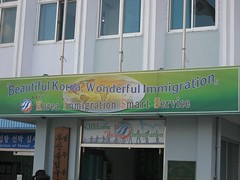
We filled out some paperwork, paid a 60,000 won (about £32.20) fee, and I left my documents with them for evaluation. They warned us that sometimes they carry out further investigations, but a few weeks later I got my F-2-1 Alien Registration Card dated to October 13th - exactly a year after my original entry. Simple, cheap, and with the hindsight of the monumental and expensive screwing we would be on the receiving end of by the British Embassy eight months later, incredibly painless. The sign above the immigration office reads "Beautiful Korea, Wonderful Immigration", and it really did feel like it, even if a location next to Busan docks somewhat stretches the first assertion. By comparison, if the British Embassy had to put a sign up above its gate, it would probably be "Superior Britain, Feck Off".

Now effectively exiled in Korea, I unexpectedly found myself needing to extend my stay well beyond its originally intended duration, so we went back to the Wonderful Immigration offices today, filled in a very short form, waited fifteen minutes, and paid 20,000 won (about £10.73) for an extension. Initially the immigration officer intended to extend it for three years, but when he noticed that my passport expires next August he said he could only date my card that far for now, which is fair enough. That was it, and it's one of those occasions that I'm glad there's no more story to tell. Whereas Britain wanted to know every last detail of my (and my wife's) income, net worth, living arrangements, future plans and so on, Korea isn't interested in anything beyond my address. What I do with my life here is my own business, which to my mind is how it should be.

Is it fate that I'm persecuted by my own Embassy and yet just about every interaction I've had with Korea's officialdom has been the model of ease and efficiency? My wife made the observation that had I been from a non-Western country I may well have had a harsher ride here and I suspect that's true, though to what extent dealing with bureaucracy would have been harder I don't know, and I know some foreigners have had problems here. On the flip-side of this, perhaps if my wife had been from a Western country rather than an Asian one it might have been easier to get back into the UK, though I tend to think that British bureaucrats despise everyone - including their fellow citizens - equally.

The bottom line is that through experience being in Korea has taught me that contrary to all previous experiences, bureaucracies don't have to model themselves on 1930s Germany to get their jobs done.

Korean tags: 정부, 대사관, 영국, 외국인

Saturday, August 11, 2007

The Exercise of Vital Powers

"The care of human life and happiness, and not their destruction, is the first and only legitimate object of good government." - Thomas Jefferson

Well we've certainly come a long way since then. It's been almost a month since my government prevented me from returning to live in my own country, therefore exiling me to Korea, a story I've repeated to friends and anyone else who cared to listen to a mix of disbelief, indignation and the special kind of nervous laughter emitted when you realise that those who try to control every aspect of our lives have lost the plot to such an extent that truly anything is now possible.

It would be nice if I could treat the decision with the sense of absurdity that it rightly deserves, but in truth the enormity of it has made the last few weeks pretty miserable. So it's been heartening to receive words of support from people, and some help behind the scenes as well. Even though I know it to be illusory, it's reminded me that - even if we're not American - good democratic government is of the people, for the people and by the people, not against them, and 'we the people' can still tell right from wrong, even if those who would presume to govern us no longer can.

After a lot of work, in less than ideal circumstances, and with some last minute rushing around, we submitted our appeal against the ruling on Thursday morning. We may get a quick decision but most cases seem to drag on for several months and culminate in a British Court hearing. There is much more of a story to tell and perhaps one day I will, because it's certainly been an eye-opening experience.

It's been my first experience dealing with an Embassy in a foreign country, and I don't know whether my recent experiences are exceptional or more common than we might suspect, but from my perspective right now the moral of the story is to know the rules in detail before beginning to deal with these people, and as ridiculous as it may sound, make sure you can come back to live in your country before leaving it, even if, like me, you're a citizen.

Korean tags: 관료, 자유, 대사관, 정부

Saturday, August 04, 2007

Office Space

"Bureaucracy is the death of all sound work." - Albert Einstein

Since the Seoul trip and the British Embassy's rejection of my wife's visa application I've spent most of my available time during the last two weeks dealing with the fallout from this, reading laws, reading rules, talking to lawyers and a lot of other people, and generally preparing our appeal against the decision. It's a process sufficiently complex that I've taken to modelling it FreeMind.

Back in the UK I used to work from home sometimes and had a small office set up, but in Korea we aren't equipped to deal with the bureaucracy which develops from dealing with the bureaucracy of others - so as the need to print, photocopy and scan certain documents has emerged we've found ourselves begging from friends or improvising solutions at short notice. Yesterday we needed some documentation from the British Embassy, but they don't answer enquiries over the phone. Emails take "up to three weeks" to answer (or possibly longer in our experience), and if you want a question or request dealt with more quickly you have to send a fax. We tried phoning anyway but got the usual response, so part of our morning was spent going to the only local PC Bang that can print things out and then a local post office where domestic-only faxes can be sent. Because the Embassy may reply by fax (or maybe they'll post it to us postage-paid-on-delivery by the addressee which is what they've done with some other documents) we had to find a friend with a fax machine who could receive any response for us.

With finally a bit more time on our hands this weekend, we'll probably look into buying what we need, even if there's really nowhere to put any additional equipment in our one room apartment. But with a full appeals process taking several months, during which there will no doubt be an ongoing administrative requirement on our part, it increasingly looks like something which has to be done. Meanwhile, all this additional work means I've hardly studied Korean in the last two weeks and I feel my language skills are going backwards again.

Korean keywords: 관료, 아파트, 대사관

Thursday, July 19, 2007

Severed Dreams

"I have also taken account of the provisions of Article 8 of the Human Rights Act. I consider that refusing this application is justified and proportionate in the exercise of the immigration control. I note that refusing this application will not interfere with family life, for the purposes of Article 8 (1), which you can enjoy in Korea".

-
British Embassy, Seoul

And just like that my wife was refused entry to the UK and the British Government effectively exiled me to Korea for the rest of my life. No, you don't know the full story - there's just too much of this farce to tell here - but when I tell you that one of the reasons for refusal was that the officer making the decision concluded that we didn't intend to settle in the UK (what?!), then you may gain an insight into the utter absurdity with which my entire life has been turned on its head. Not that I played any part in it because I was not part of the process. I thought as a British citizen I had the right to reside in my own country with my wife and come and go as I pleased. Well I don't.

Earlier in the day we'd dropped by Korean Mother's apartment and discovered that she was with Psychic Aunt, preparing food for offerings in an afternoon prayer session which they'd hired a special room for at a temple. They were praying that we would receive a favourable judgement from the Embassy, which was pretty selfless of them since all other things being equal they would much prefer that my wife stays in Korea. Of course, they want her to be happy, and they want me to be happy, and they know it can't be very pleasant getting told by your own government that you have to live in a different country. The fact is I've been pretty down since returning from Seoul because when I heard how the interview was conducted I had a strong sense of where this was going,
no matter how hard it was to believe. So for once, Psychic Aunt's attempts to cheer me up with her bizarre and simply indescribable dancing met with nothing more than a forced smile from me.

We got the letter by courier late afternoon - can you believe that after the non-refundable 950,000 won (about £506 - yes over five hundred pounds - say it slowly and let it sink in) application fee (
for a form and my wife's twenty minute interview) they actually made the 3,000 won courier charge payable cash on delivery by us. (edit: the next day, they sent the passports which turned out to be missing from the first envelope, pay-on-delivery, costing us another 3,000 won). Then we had to phone Korean Mother and tell her to stop praying because it hadn't worked.

So with the monsoon rains fitting my mood this evening, I'll sit here reading stories of foreigners attacking Koreans, and Koreans attacking foreigners, contemplating the wider world's growing propensity towards nationalism and wondering what my future - a future stuck in Korea - holds. It's not that Korea is a terrible place - I've had fun here - but I want to be able to go home. I'm still not sure the enormity of this situation has sunk in.

Korean keywords: 정부, 대사관, 망명자, 불교, 영국

Tuesday, July 17, 2007

A Race Through Dark Places

Saturday - Deoksugung, Seoul Plaza, Cheonggyecheon, Namdaemun

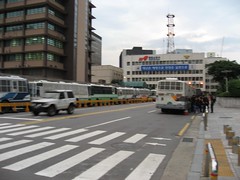
We left Busan early Saturday morning with the wind and rain from the periphery of Typhoon Man-yi battering us, and travelled up to Seoul in almost deathly silence at speeds approaching 300kph on Korea's equivalent of the bullet train, the KTX. The weather improved and then it was bright sunshine all the way to our destination. From Seoul Station we took one stop on the underground to the City Hall (Jung-gu) area where the British Embassy is located. Once we'd found it, we looked for a motel - our searches beforehand on the Internet had not yielded any results. But while there were motels to be found beyond the plush hotels of the main road running by City Hall itself, their shabby appearance and locations - down narrow back streets amidst massage parlours - eventually saw us checking in to the New Kukje Hotel next to the tall 'Seoul Finance Center' (SFC) building at 120,000 won a night. We'd been trudging around for well over an hour in the heat and the moral of the story is to plan things out beforehand. People we stopped to ask directions were nervous, cold or just downright unhelpful, and I missed what I perceived as Busan's friendliness.

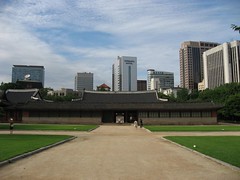
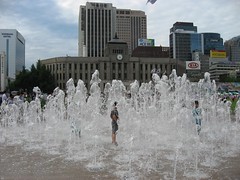
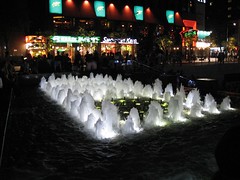
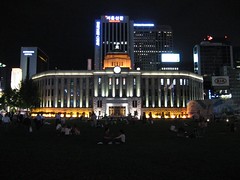
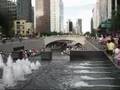
The SFC makes a virtue out of the two floors of underground restaurants beneath it, but with prices (by Korean standards) to match the yuppie aspirations of those who worked above it we found a KFC across the road instead; by this time our desire to eat was entirely functional and the expensive meals could wait until they'd be more appreciated. I think I've become used to paying Busan prices. After lunch, we visited Deoksu Palace (Deoksugung) (entry cost: 1,000 won - not everything here is expensive) next to the British Embassy before crossing the road to Seoul Plaza in front of City Hall where an event was taking place, people enjoyed the weather on the grass and children sought relief from the heat in the fountains.


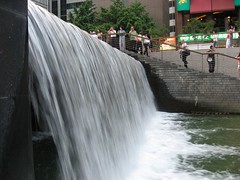
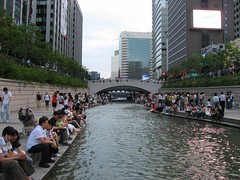
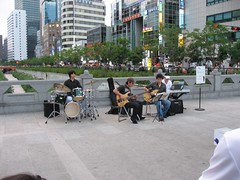
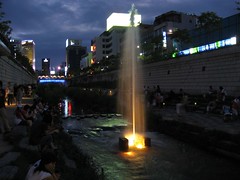
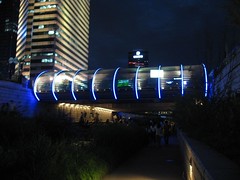
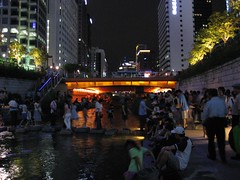
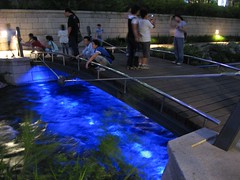
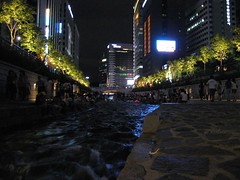
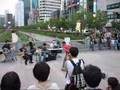
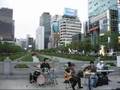
A short walk down the road took us to the famous Cheonggye Stream (Cheonggyecheon). While the project has been controversial, it is also clearly popular judging by the considerable crowds it was attracting. We walked some distance down it as the daylight faded, before turning around and walking back in the dark. Along the way were a mix of old and new bridges, one with an art exhibition underneath, a jazz band on a bridge, fountains, waterfalls and artwork. Many of the locals whiled away their evening sitting on the banks with their feet in the water, and underneath the Citigroup building we joined them, finally finding some relief for ourselves as well.


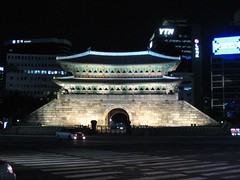
From the stream we sought out the equally famous 'South Gate' Sungnyemun (aka Namdaemun). While using the nearby subway we also discovered something that isn't on the tourist maps - a cardboard city of homeless people bedding down for the night - shocking in itself and perhaps all the more so for its proximity to City Hall and the many embassies located in the area. I snatched a quick photo, but we were not of course welcome and needed to leave quickly.


We'd planned to have a nice meal under the Finance Center Mall, but the sight of the homeless made me lose my appetite for such indulgences. Inexplicably, all the small restaurants and diners along the road back seemed to close at ten or eleven so with midnight approaching we retired to our hotel with no more than a bag of crisps and a can of beer.

Sunday - Insa-dong, Tapgol Park, Unhyeongung,
Cheonggyecheon, Seoul Finance Center

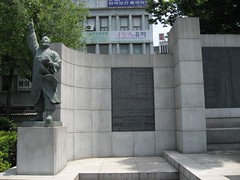
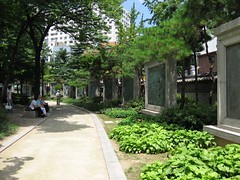
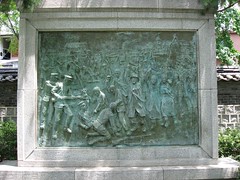
After breakfast in at a reasonably-priced Singaporean toast place in the Seoul Finance Center, we headed towards a traditional Korean craft area in Insa-dong, first stopping by Tapgol Park (free entry) which is famous for being the origin of the 1919 'March 1st Movement' calling for Korean independence from Japanese occupation. Various monuments in the park tell of the struggle against the Japanese. The Park seems to act as a focal point for those old enough to remember the occupation, and they gather here to talk or simply to sit. The Park also contains National Treasure No.2 and Tangible Cultural Property No. 73.


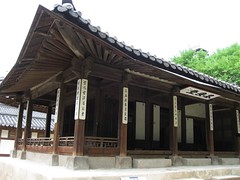
Later we went to the Japanese Cultural Center next to another palace, Unhyeongung, to get their side of the story but it was closed. I didn't care for the
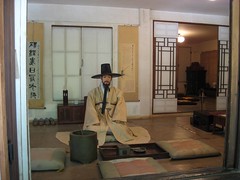
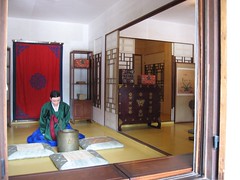
architecture at Unhyeongung but the insides of some of the buildings were set out to show what life was like for the privileged in its day. A photography club armed with digital SLRs and a model made it a little difficult to negotiate.


At what point is a place no longer real but instead it becomes a theme-park version of itself? The Korean craft area at Insa-dong crossed that line for me. Predictably full of tourists (ourselves included), and enough Korean trinkets to satisfy all your friends and family back home - or if you're feeling more extravagant, there's an old map hanging on the stairway of one establishment for a mere 18,000,000 won (about £9,700). We bought ice-cream from a Turkish ice-cream vendor - a task not quite as straightforward as it might seem in Korea. Yes, our experience was pretty similar.


Somewhere back near the Seoul Finance Center we encountered a protest against political interference by the Korean equivalent of the National Security Agency in the political process. It seemed from the elderly demographic of the protesters they were right-wingers, though we could be wrong... If the Korean security agencies are trying to get left-wingers elected they must be just about the one in the Western world. Then again, whether you class someone as left or right-wing very much depends on where you're coming from yourself - which in this context is a sobering thought. A photographer - who may or may not have been with them - took photographs of the seated protesters who, in the quest to take good shots myself, I found myself standing amongst. As he raised his camera very deliberately in my direction it was hard to imagine that he wasn't taking a shot at me, so I pointed my camera back at him in return. A little further along the road there was a heavy police presence with patrols and multiple buses. At first it wasn't immediately clear why, but we'd stumbled upon the US Embassy. By contrast the British Embassy had one police car sat at the end of the road.


We'd debated whether to take a ferry along the Han River, but it was getting late and it started to rain, so for a second evening we sat with our feet in
Cheonggye Stream, but under a bridge this time.

As I'd walked around today, I'd noticed more and more apparently homeless people - in the subways and the parks, slumped up against buildings and asleep on benches in the open spaces. If Seoul had any glitz or glamour, the sight of the bedraggled and psychologically defeated underclass gave it a sinister edge, and although we had our 'expensive', and as it turned out, very nice meal in the end in the Finance Center, it was at one of the cheapest places with a bill totalling 26,400 won. What life is like here is beyond my control but it doesn't lessen the sense of frustration.


I took a lot of photographs over the weekend and a number of videos, and spent time looking out for an electrical store where I could buy another SD card, to no avail - in Seoul. There seemed to be a Dunkin' Donuts on every block though.


Monday - The British Embassy

I dare say whatever its problems Seoul is a vibrant and colourful place, and I fear I may have been remiss in my descriptions of its people and places. There was much more to say but if what I have written seems soulless, it is because I had what soul I had left ripped from me by the unseen officials lurking in the Embassy building, and everything else that happened this weekend seems like a black and white film in comparison. There is a problem with my wife's visa application and it is not at all clear that there will be a satisfactory resolution to this story, so today I am facing up to the reality of being made a de facto exile by my own government if I am to live with my wife.

Koreans on the Net have quite a lot to say about their experiences with the British Embassy so perhaps it shouldn't come as a complete surprise, but when it becomes personal and you realise just how high the stakes can be it really hits home.

Perhaps this will all blow over, perhaps it won't. In the meantime, there is considerable emotional distress and much time, like yesterday evening, spent reading Acts of Parliament, the European Convention on Human Rights and legal precedents, because it was not my plan to never be able to return to live in my own country.

Korean keywords: 기차, 여행, , 공원, 호텔, 대사관