Showing posts with label customer service. Show all posts

Monday, August 13, 2012

Bananaman

When I started writing about my experiences here there were only two other foreigners writing blogs in Busan as far as I'm aware and so it enjoyed a level of mild popularity by virtue of absence of choice. This led to a few invitations to appear on Korean TV and radio shows, and I was also asked to write, but always for airline magazines - perhaps their editors had correctly surmised that I work best with a captive audience.

I always turned these offers down - even though I was invariably assured it would 'help promote my blog' - on the sound logic that I actually didn't want to promote my blog, and I have a face for radio and a voice for writing. Yes, perhaps with enough plastic surgery I too could look like one of those K-pop boy band members which women who are into the whole non-threatening-male-look would like, but it would represent the modern-day equivalent of The Six Million Dollar Man project, and cost about the same.

The other reason for turning down 'a great chance to be on TV/radio/write for people trapped on a plane' is that the offers invariably came in from bizarre addresses at Korea's equivalent of Hotmail such as 'ilikegoats', 'bananaman', 'pussy80' and 'bkmhbdmukkk' with subject lines such as 'This is Arirang TV' to make sure you know it's authentic. So you end up in a situation where Bananaman invites you to some part of the city to appear on a TV or radio programme. You could run a background check on Bananaman but it's time consuming.

It was once explained to me - and it's entirely logical - that since most people here share about seven surnames and most of them are in fact called Kim - it's almost impossible to get anything resembling a sensible email address from your employer because someone's already taken it. The problem is though, I don't think they're even trying. Take the Korea Times for example. It can't have more than a few hundred staff so it shouldn't be anywhere near as difficult to choose an email address, but someone still elects to be 'foolsdie' at their domain name, and that means sooner or later they end up writing a piece about a plane crash where pilot error is suspected and signing it 'foolsdie' at the bottom.

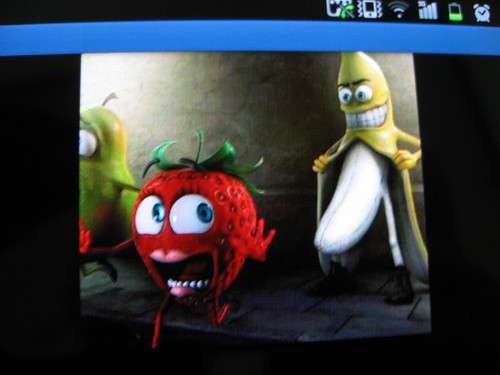
But mostly, Koreans seem to use their personal email addresses for work purposes - and this blurring of the lines extends to phones now, and chat systems such as Kakao Talk. This provides whole new opportunities for sexual innuendo because you can now not only expose your quirky textual inner thoughts but give the Freudians something much more graphic and substantial to sink their teeth into - such as the image below - the Kakao Talk avatar of a male bank employee who contacted my wife to tell her that her new credit card was ready:

Bank Employee's Avatar


Thursday, June 14, 2012

Under Siege: Come On! Come On!

I’m alone in the apartment and receive a call from an unknown number on my mobile. I don’t answer it because my son has only slept 30 minutes all morning, he’s just woken up, and I’m desperate to get him back to sleep again so I can do something productive in the little time this will afford me. To this end, I’m walking circles around our lounge with him in a sling on my back, which is the only way of getting him to sleep, at all, ever.

The same number phones again exactly one minute later. This time I answer it, because it's entirely possible that it might be important.

Allegedly it’s Kookmin Bank - KB - and I say allegedly because of the number of phishing frauds which are perpetrated on Koreans from both within Korean and beyond, by which I mean China. The woman launches into a long sentence about something or other but it doesn’t sound like a sales call because it doesn’t sound like she’s just ingested helium, and she doesn’t make the well-practised corporate giggle like the kind of 18 year-old girl normally given that kind of job. I know what you’re thinking - is there such a thing as a corporate giggle in Korea? Yes, there is.

She tells me my name - badly - but it’s vaguely recognisable as my name, and I say yes, hoping she might switch from the Korean she’s been using so far, to English. But she launches off into a long Korean sentence so I stop her. “Jam shi man yo”... please wait a moment. And I tell her, “I’m a foreigner, I don’t speak Korean, so I don’t understand what you are saying.” So she starts again, probably from the beginning, in Korean. I try again, in Korean, slowly “I. Don’t. Speak. Korean. Therefore. I. Don’t. Understand. What. You. Are. Saying.” This at least solicits some kind of “Oh, you don’t understand?” “No”. So she explains again. In Korean. Over my “I don’t understands”.

But then she changes strategy. She tells me the branch of KB she’s from, and it is a branch I’ve dealt with, which makes it feel like it’s not a phishing call, although nothing short of being in the bank talking to them is likely to convince me because I’m naturally suspicious. If I don’t trust myself why should I trust anyone else? Then she says “ID cardeu, passport”, but while she might be requesting details I’m never going to give her, there’s no context, so I simply tell her I don’t understand again, but she says “ID cardeu, passport” a couple more times with increasing urgency and frustration.

I am also long beyond frustration, and I change strategy. In Korean I tell her, “I don’t understand. Therefore my wife will phone your branch later.” I thought this would provide her with the resolution she so badly needed, but it didn’t. Off she launches again into another round of indecipherable Korean. So I tell her again “I don’t understand. Therefore my wife will phone your branch later.” This is exasperating.

Then the surprise. In evidently frustrated English and a rather aggressive tone universally recognised the world over as listen-you-stupid-foreigner, she suddenly says “Come on! Come on!” My mouth and fingers know me well enough not to wait for orders in such circumstances. It took my finger about a tenth of a second to hit the “End Call” button at and I simultaneously heard my mouth say “Frak you” or words to that effect. I support their actions.

Later it transpired that I had a million won in a savings account that had matured. In case that sounds impressive let me put it into context – at the rate the power in our apartment mysteriously bleeds away into the surrounding atmosphere it will soon be about the cost of one month’s electricity bill. The money was put into the savings account to act as a guarantee for my credit card with the bank (making actually not a credit card with the tiny limit I’m given) because I’m a foreign criminal who otherwise might run away with their precious frakking card and go crazy with it in China with a couple of $3 hookers or something. And that is the reason by the way (not the hookers – the fact that KB don’t really trust foreigners with their credit cards).

So the million had matured from the ultra-low interest guarantee account which had earned me as much as an entire hooker worth of interest in a year, and apparently the staff member who phoned me had noticed this - three months later - and decided that I very urgently and immediately needed to find a new home for it, and certainly after her phone call I had a pretty good idea where I wanted the bank to shove it.

When my wife came home I related the story and she immediately phoned the caller at the bank. At first she denied it, so my wife asked “Are you calling my husband a liar?”, after which she finally admitted it and apologised for losing her temper and the whole “Come on! Come on!” business. One small step for a foreigner, one giant leap for Korean banking - I still need to provide cash deposits to guarantee my credit card though.

Sunday, March 06, 2011

Pirates of Silicon Valley

A few weeks ago my computer started to switch itself off randomly. Given the construction quality of our apartment building, coupled with the dubious nature of the electrical system here, I wasn't sure at first what the cause was. But finally I concluded it was probably the power supply unit, and that I’d have to buy another to test out the theory.

I thought that meant another trip to the large computer store in Nampodong. In fact it's not really one store so much as a series of separate businesses clustered together on two floors of a building near the station, and it's a rarity, because for all Busan often feels like a city full of shops, places selling computers are – I think - relatively thin on the ground. When I first came here in 2006 I quickly explained it as being indicative of the high number of 'PC Bangs' where people can go and access the Internet, and allegedly people were also using their phones to surf the Net, an assertion that later I came to doubt because of the high data charges. But before I travelled to Nampodong, I remembered seeing what improbably looked like a small computer store near us and went to investigate, and I wasn't disappointed.

Many years ago I bought my first new computer in the anonymous basement of an industrial air compression company, which served as a metaphor for the underground nature of the home computing market at the time. It was rough, you had to be careful to avoid tripping over some discarded piece of technology on the floor, and it smelt of cheap chemicals heated dangerously above room temperature by questionably built power supplies. So perhaps that's why I took an immediate liking to my local computer shop, because nothing had changed, and 30 PC power supply units stacked on a shelf by the door said I was likely to be going home with what I came for.

Perhaps it's indicative of the nature of crime in Korea that my wife had to shout upstairs to where the proprietor seemed to be living several times to get his attention. So my polite refusal to follow my instincts and start physically investigating the contents on the shelves and floor around me seemed rather redundant under the circumstances. Many shops are like this in Korea and it never ceases to seem bizarre coming from a country where it’s almost second-nature to steal anything which isn't nailed down. In fact, many people dismiss the British Empire as mere colonialism, but it was really organised as more of a global heist - a sort of Ocean's 11,000,000 if you will.

When a computer starts losing power intermittently, you can’t guarantee that the power supply unit is the root cause of the fault. CPUs are designed to shut off when they overheat, motherboard issues can come into play, and even wiring could be to blame, so there was always going to be a backup plan. And there had to be; the computer ran my automated trading bots and they need to be running all the time. So my backup plan was buying a new PC.

Because I ended up doing a lot of research - with time I really don't have - for the prospective new machine, by the time I stood in the local computer store I was able to speak fluent PC jargon so well once again that my wife barely needed to translate my prospective shopping list with the proprietor. I might not speak Korean, and he not English, but both of us spoke jargon. But I'd also been searching around online, a more difficult task than it should be, due to the Korean propensity to use eBay-like (and eBay-owned) sites Auction and Gmarket to buy almost everything, whereas I prefer apparently proper online retailers like Hacker that have their own websites.

A few years ago when I was last looking to buy a PC here, I went into a computer store, and the owner said that if I bought a machine there he'd "load it with all the software". Which software? Anything I wanted. It's a constant source of incredulity here when I explain that I want to buy a copy of Windows, and over the last few years the numerous Windows XP Professional screensavers I've been witness to in shops have raised questions in my mind as to why so many people in Korea woul buy the more expensive copy of XP, when it’s completely unnecessary in a retail environment – the suspicion being that they didn't.

Koreans generally don’t seem to concern themselves with computer security but I do, which is why I never run pirated software on my systems. It's a relatively trivial matter to insert spyware in pirated software installers or even the software themselves. As a financial trader I need to be aggressive about network security. So when I told the owner of the newly found store that I wanted to buy a copy of Windows, and he said that he didn’t have any in stock, a look of surprise completely failed to cross my face. But perhaps it was because I wanted to buy Windows 7 Ultimate, a version of Windows so completely unnecessary for all but the narrowest of niches of customers, that even the salesman at Hacker laughed when my wife asked whether it could be bought with a system.

Unfortunately my inability to buy Windows from the local computer shop meant that I'd have to be ordering that from Hacker, so why not the entire PC at the same time? Sometimes it’s the little details of a PC build that can set things apart, and while Hacker’s choices weren’t always perfect, they'd chosen a case from Korean manufacturer Zalman that I liked due to its excellent ventilation. I doubted whether my increasingly specific requirements could be met locally, and more to the point dragging my very busy wife to the store again one or two times to run through my now highly detailed specification while my mother-in-law babysat didn’t seem the best use of anyone's time. And sadly that’s how I ended up buying from Hacker, again, rather than supporting my local economy.

Hacker claim that any system bought before 3pm will be delivered the next day, but having ordered ten minutes before that deadline I wasn't too hopeful. On the other hand, much to their surprise I needed no hard drive partitioning or Windows installation because I planned to do it myself, so that undoubtedly helped. It arrived at 12.50pm the next day. In the UK, we'd call that just short of six business hours later. And Hacker are located in Seoul.

By comparison, I went through a period a few years ago when I ordered so many machines from Dell that I ended up with my own account manager, but my gods does Dell drag their heels on delivery – a symptom of their highly-vaunted just-in-time 'customer fulfilment' procedures which one imagines involves sourcing parts from Taiwan after you order. By post. Dell doesn't seem quite sure why their stock price is half what it was five years ago but I have some ideas. Dell have a token Korean web site which actually seems to be run out of Singapore and nothing about it inspires any real confidence.

The rapid delivery from Hacker is not unusual in Korea, and it's an incredible testament to Korean customer service standards – at least at the point of ordering. Unfortunately it must also make it very hard to compete locally, and perhaps this is why there are so relatively few computer stores in Busan. If delivery times measured in hours means immediacy of purchase isn't an issue, one might suggest this also drives local retailers to find their own unique selling points, and while I never got into that conversation this time, loading computers with 'any software you want' probably counts as one of them.

Monday, November 29, 2010

When the Last Sword Is Drawn

You can be free. You can live and work anywhere in the world. You can be independent from routine and not answer to anybody. This is the life of a successful trader. - Alexander Elder - Trading for a Living

I don't write about my job very much; it's usually not relevant to my Korean experiences I document here. Occasionally though, the two worlds do become intertwined.

I've worked for myself as a derivatives trader for the last six years. An oft-repeated statistic is that 90% of financial traders lose money, which makes me one of of the remaining 10%. By that measure you might say I'm good at what I do, but the hours are long, and I'm not so good that I've made enough to retire. Traders often have to work hard to perfect their art, but there comes a time when you have to accept that you might be doing well enough by a lot of people's standards, but 70-hour weeks are not conducive to having much of a life outside work, and for me, those extra hours cut into time that could - and increasingly should - be studying Korean.

So three months ago I finally decided to try and make a transition into something called automated trading – where instead of actually trading I'll code my trading rules into a program called a 'bot' (from 'robot'), and then it will trade for me. Then I free up around 8 hours of my typical 11-hour work day to do other things – such as studying. At least, that's the theory.

Trading is about choosing your weapons as much as it is about yourself - and trading with 'bots' requires a different sword - specialised tools such as MetaTrader and specialised accounts, so you can only do this if companies in America and Europe will do business with people in Korea and the problem is that a lot won't.

For example, one of the world's largest retail forex brokers who I suppose I shouldn't name – it's FXCM – refuses point blank to do business with anyone living in South Korea. Others notionally allow it but make opening an account from here so tortuous that you know they really aren't keen on the idea. Fortunately one of FXCM's large rivals - Alpari - has no such policy and a relatively streamlined (though still far from straightforward) account opening process [edit: see my footnote]. But while this good news, potentially it gives me only one sword to choose from rather than many, and it may not be the sharpest blade. So while it's all very well for Mr. Elder to think you can be free and work anywhere in the world as a trader, clearly he didn't have to put up with trying to be a trader in the modern world outside the US, and certainly not in Korea.

The Korea location problem doesn't just effect trading - try ordering some vitamins from outside Korea and see what an odyssey that can turn into (that blog entry will turn up eventually). And beyond the worlds of trading and vitamin supplements – two areas which I can tell you from personal experience are inextricably linked - lies the pedestrian world of longer-term investments. Just before I moved to Korea I transferred a large portion of my investment holdings from one broker who wouldn't let me be a customer in Korea to HSBC, that said that I could, and two months later HSBC wrote to me in Korea to tell me that after all, they couldn't hold my investments while I lived in Korea – leaving me scrambling to find a broker to move back to – the situation was so dire for a while I thought I might have to completely liquidate my portfolio which would have caused all kinds of tax complications.

Statistically it's unlikely that my foray into the world of automated trading will be successful, but the potential reward justifies the risk and that's what trading is all about. So right now I'm trying to open trading accounts with specialised foreign exchange – or 'forex'/FX – brokers, and because I'm living in Korea I'm hitting the same identity problems here that I have before - I needed my passport and a bank statement stamped and witnessed. The passport may not be a huge problem but my prospective forex broker has no use for a bank statement in Korean – of course it has to be in English with my Korean address on it, which is more of a challenge.

It seems inevitable that I will continue to work at the tenuous sufferance of brokers who treat their support of international customers as a seasonal activity. But to be fair I'm sure the Korean Government don't make it easy for them, because for all their lofty notions of being an 'Asian Financial Hub', the psychological scars from the Asian Financial Crisis mean that they aren't terribly keen on the idea of the free flow of capital, which is a bit of a problem given that - whether you like it or not - it's quite an important aspect of modern global capitalism, especially if you want to be some kind of global financial centre.

So it's true to say, that one way or another, Korea constantly gets in the way of me doing my job. Every day I go out there and do battle on the global financial markets with some of the brightest and dumbest minds this Earth has ever created. Which one am I? Victor or victim? I control my own destiny, financially I live by the sword and die by the sword that are the tools that I use and the way that I wield them. In Korea, that's a fight which I undertake with one arm tied behind my back and the only sword they'll give me. That's the life of a financial trader here.

[edit: I take what I said about Alpari back. After I'd gone through all the document verifications I finally reached the point where I was ready to fund my account. And that's when I found out this wasn't possible electronically because I was in Korea, even though my credit card and bank were in the UK. Alpari hadn't mentioned this small but really quite crucial fact during my emails and phone conversations about opening an account while residing in South Korea, and this would have been bad enough in itself, had they not managed to notch up a first in my many years of trading with many other companies - one of their staff sent me an impolitely worded email. Why it is that Alpari staff think they can vent their frustrations on the company's customers this way is unclear, but I don't have to take that sort of behaviour, and that was the end of my plans with them].

Friday, October 15, 2010

Horror Hospital

Recently I wrote about some of the problems my wife and I had experienced with the maternity hospital we were in, but things were going to turn out to be worse for other people in what seemed to me like a perfect storm of Korean cultural issues.

The first aspect of Korean culture which differs from my own country lies in the fundamental nature of the birth experience itself. In Korea, women can – within a period of around four weeks - choose when to give birth; they pick a date and then report to the hospital to be induced or – if this is their preferred option, to have a caesarian section to deliver the baby. Now add to this ability to schedule a birth to the Korean thanksgiving holiday of Chuseok, one of those extremely rare times of the year when family might not be out working 12-hours a day, apparently making it a good time to schedule said birth. Next add in the near total contempt some business owners demonstrate for their customers in Korea, nurtured through a pathological pursuit of profit that might even make a financial trader blush. Add a little of the legendary local construction quality on top, and mix all these things together to achieve predictable results.

So this is what happened. A large number of women checked themselves in to have their babies during the Chuseok holiday, and it was probably double what the hospital could cope with. Normally, the recovery area of the maternity hospital, the 'sanhujoriwon' (산후조리원), takes up three floors – over Chuseok, the hospital expanded it to six by commandeering other floors which were not designed for the purpose. Whereas my wife's room was solely for her with en-suite, a desk, a TV and double bed for the husband to sleep in, the Chuseok mothers ended up in shared rooms with four beds and little else. That makes it no better than a bad British experience, and possibly worse because the already seemingly understaffed Korean hospital had not employed extra personnel for the holiday rush. Crucially for the people here though, this was not what they are accustomed to expecting, and it certainly wasn't what they were sold in the brochure.

And it gets worse. I said the hospital hadn't employed any extra staff, but in fact they'd gone the other way. The cleaning staff had the week off. So you have these new mothers, packed into rooms kept at abnormally high temperatures because of the belief here that this is better for their 'shattered' bodies, there's a lot of sweating and a lot of clothes going in the hospital wash baskets. But now nobody is around to clean them, piles of smelly clothes are building up in the corridors, and mothers are running out of clean clothes to wear. You can imagine the situation with bedding, bearing in mind that many of these women have undergone operations or procedures and were still bleeding.

And then there was the woman in the room next to us. Like my wife, she had been lucky enough to have her baby just before Chuseok, so she had a room to herself as she was supposed to. But the bathroom had a drainage problem. It was fitted incorrectly with the drainage grate too high, so after showering water would just collect creating an indoor pool. The room isn't exactly new so presumably it's been like this since it was built two or three years ago. She complained to the Sanhujoriwon Director - he offered her a small tool to push the water uphill into the pipe. She'd just given birth and could hardly walk, but the Samhujoriwon Director apparently thought nothing of her bending over pushing water around the floor. She protested.

Was he embarrassed? Afraid? His response was “If you don't like it, I have plenty of other women who would gladly have your room.” And sadly he was probably right, because when you're packed into a small room with three other women with no facilities whatsoever, you'd certainly see a single room with an inch of standing water in the bathroom as an upgrade. This is not really a good excuse, and it reminds me of the time I found a long black hair baked into my pizza at an expensive restaurant in Busan, and when we complained, the manager looked at us incredulously and said “well, it's only one.” On the face of it, Korea often seems to have a positive customer service culture – but perhaps only because they want to sell you something – once the transactions is done, attitudes can rapidly change – not always, but often enough to make you feel like you're stepping into a minefield every time.

It must have been bad because the husbands got unionised and all went to see the Hospital Director to complain, and by this time you can probably guess how that went. 'If you don't like my hospital, pick another!' I understand that a private Internet forum for mothers in Busan is now buzzing with anger about it, so word of mouth may at least provide a little karmic retribution.

Given the appalling conditions in the lower decks it almost seems churlish to mention another area in which the experience fell below expectations, but I will for completeness. The 'samhujoriwon' experience is about recovery and education, with mothers attending various classes to help them transition from hospital to coping on their own with their babies. There were no classes during Chuseok which meant that of the ten days of activities promised, many women only got seven. It's understandable that this is just bad luck and while I would expect cleaning to continue during the holiday, educational classes are a bit much to ask for. But there certainly won't be any refunds for the women who were short changed in this and other ways during the holidays. By this time, I couldn't say I was surprised.

Can I name and shame the hospital here? Sadly, probably not. The way things seem to work here is that criticising companies in public can easily lead to lawsuits. And in a nutshell, this tells you a lot about reason why the Hospital Director all but laughed in the faces of his patients and their families.

The problems I detail above effected others far more than they effected my wife. We were lucky – if you can call it luck - to have our own room away from some of the horrors. But I asked my wife, in principle rather than with intention, what could we have done to formally complain about the hospital had we suffered like some others had suffered. I was curious. She really wasn't sure, because often it seems people really don't ask those kind of questions here. I had an idea that ultimately, hospitals had to be licensed, and medical companies that ask new mothers to crawl around the bathroom floors of understaffed hospitals in dirty clothes are probably not what the government have in mind when handing out those licenses. So one imagines there must be some mechanism for calling people who run institutions like this to account. But it's not really my problem and it's a given that the Koreans who suffered won't take action either. Nothing will change. Meanwhile the Korean Government will keep talking about their desire to promote medical tourism to Korea within the Asian region, with discounts for properly qualified plumbers, presumably.

Tuesday, March 09, 2010

Broken Windows

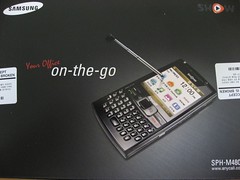
We went to see 'Alice in Wonderland' on Saturday evening, and after escaping from the hole we'd fallen into, my wife turned her five-month old Windows Mobile phone back on and it didn't work properly. I have the same model and we hardly ever turn them off - this is Korea, it's practically a social crime. Not answering within two rings annoys people, so mid-way through a sentence you can often find yourself talking to someone holding a suddenly produced phone to their ear; phone conversations have priority over face-to-face meetings. On a busy day, it's occurred to me that the best way to guarantee an uninterrupted talk with someone I'm with is actually to phone them up and stand next to them holding my phone to my ear.

Imagine the trauma then of a broken phone on Saturday evening, when the next day is a one-in-three week 'off Sunday' where the local wage-slaves are briefly released from their corporate chains and the local Samsung Service Centre is shut.

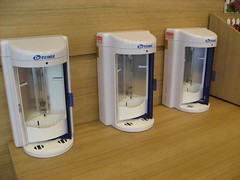
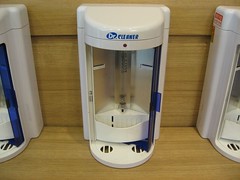
On Monday morning we travelled a mile to a large Samsung building where the elevator opened several floors up to reveal a large room buzzing with activity. One of the three young women with the kind of perma-smiles usually only seen amongst religious cults took my wife's details, assigned us a number and beckoned us to a seated waiting area, apologising that we might have to wait for fifteen minutes. Samsung had thoughtfully considered the dangers of keeping Koreans waiting in an enclosed space with no mobile phones to occupy them, and had provided a number of PCs with Internet access. And I found something new next to the PCs - phone sanitisers. Everyone knows, of course, that the original settlers on Earth - our ancestors - came from a planet that was suddenly wiped out by a virulent disease contracted from a dirty telephone, so it's good to see that Samsung are doing their bit to ensure this tragedy isn't repeated.


Apparently, you put your phone in, close the door, and five minutes later, it's completely germ free. Well, until you put your hands on it anyway.

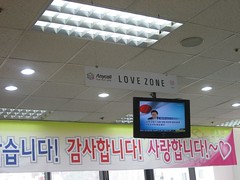
A few minutes later - not the fifteen advertised - we were called to the "Love Zone" - sadly not what you think - where beneath a large sign which read "감사합니다! 사랑함니다!" - "Thank you! We love you!", engineers sat implausibly behind their desks. The problem with my wife's Samsung SPH-4800's was that while it would boot up, all her data was missing and it couldn't even make or receive calls. We'd already tried everything we knew to fix the issue from fiddling around with the configuration, resetting, and anti-Microsoft incantations, so it was no surprise when our Love Zone liaison told us that it's love for her was dead and he would have to completely reinstall the software in a factory reset. He suggested it might have been caused by a virus, but the reset would cure it in a lucky escape for Earth. Her data and settings were lost, but it wasn't a complete disaster - she regularly synchronises it to her PC.

A mere five minutes later we were finished and I had to be impressed with that. When I once had a problem with a phone under warranty in the UK I had to send it to a repair company through the post, and it was two weeks before I got it back. In Korea, it was an hour's work. Perhaps Samsung really do love their customers.

Wednesday, December 02, 2009

The Shipping News

Before I left the UK, I decided to ship some items to Korea on the basis that if I wanted my life in Korea to eventually feel more like home, I should save at least a few of the possessions of my former life before the rest hit the bins and the charity bags. A few items had sentimental value, some of it was purely practical, but many were simply things which would be hard to replace in Korea, such as books and DVDs. For example, I had a backlog of twenty-three books I hadn't read, and if I didn't have them sent to Korea I had the feeling I would just end up repurchasing them from Amazon.com, with all the extra expense and inconvenience that importing from the US potentially entailed. The downside of living in a country where hardly anyone speaks English is that it can be quite hard to shop for products in your own language.

None of this is to say that one can just liberally transport one's life from one place to another internationally. My house in England had a basement and an attic, and while I never knew the square footage of the property I would estimate that it had at least three times the amount of space that my Korean Mother's four-bedroom apartment has. That's very much a comment on the compactness of what is typically considered to be a larger property in Korea, rather than the largess of my home back in the UK, which was a averagely-sized house. Even if we had been initially moving back to our own apartment in Korea, there would have been very definite limits to what we could have shipped over given the lack of living space, but given that we were initially moving in with Korean Mother, plus of course the costs - around £20 ($33/38,000 won) per box - and practical size limitations in sending items anyway, choices were very limited. It wasn't long before everything I owned in the world - aside from the contents of my suitcase and hand luggage - was contained in five 51x41x31cm boxes which alongside four boxes of other things would later earn the pithy official description 'used personal effects' on the bill of lading.

Women's Clothes and Other Rules

It wasn't quite as straightforward as packing the boxes, however. We had to ensure we complied with the company's rules and more importantly, Korean Customs Laws, which are unsurprisingly numerous and esoteric. For example, one rule stated that while women could import men's clothes under their name, men could not import women's clothes in a personal capacity. The conclusion is that this is not the right country for male cross-dressers to ship their wardrobes to. The practical problem for us was potentially my importing two boxes of my wife's clothes under my name. You can assume that in the end at a Korean Customs warehouse, common sense would prevail, but overestimating the common sense of Government officials has cost me a lot in the recent past. As it happens anyway, the more we got into the rules the quicker it became apparent that everything should be done under a Korean national's name if possible. Even that didn't promise to be easy at the Korean side, but it looked very much simpler than doing it as a foreigner.

In Korea

The company I used to ship the boxes operated a door-to-door service in many countries, but Korea wasn't one of them. Instead it was only door-to-port, though since the port in question was Busan, it didn't seem too big a problem, especially since we had a friend with a van.

It wasn't going to be quite that easy. We had no firm arrival date beyond 'several weeks', and when the ship carrying our 'used personal effects' arrived it was four days before our friend with the van got married, which meant he was going to be on his honeymoon by the time our boxes had gone through Customs and were ready to collect. At least, that was the theory - in practice our role in the matter became increasingly uncertain - were we merely picking up, or would we become actively involved in the inspection process? Phone calls were made, and nobody could give my wife a consistent answer as to what the procedure was, where our boxes were, or even which company in Korea was now responsible for them, given that by this time our original shipping company had subcontracted the job at the Korean end to a company that may have subcontracted it again. We finally found someone at an entirely separate company who was kind enough to check the Port database system to find out which warehouse our boxes were in and possibly therefore, which company was responsible for them.

So when we arrived early one very cold morning at the offices of the appropriate shipping company near Busan's main docks, we had already exerted a great deal of effort in just reaching this point. But this was just the beginning of our day. There were forms to be signed, and then we'd have to go to the satellite Customs warehouse where our boxes were - which was around 30 minutes drive away. Not having any idea at this point where we were going, a staff member helpfully took us to a taxi outside the offices and briefed the driver, who dropped us off at the side of a rather desolate road with instructions on which car to wait for next. Eventually a car pulled up to us driven by an employee of the company which was now responsible for our boxes, and from there we went to the Customs Office nearby. For all the problems we'd had on the phone, at least now we were dealing with people in person they were quite willing to assist us

Customs

By this time we'd been given the impression that the boxes had cleared Customs, which was a big relief; the last thing we wanted to be doing was emptying out our carefully packed possessions, potentially for individual and exhaustive scrutiny. It didn't even occur to me until later that I was probably over the limit for vitamins and supplements, several containers of which I'd packed. The big problem was the DVDs and other items which could conceivably be passed off as less than three months old and therefore new, which as such would then likely incur an import duty. Our shipping company back in the UK had advised us to bring receipts with us for as much as we could to verify purchases earlier than three months ago, but we probably only had proof for around half of the items.

And when we reached the Customs desk it appeared they hadn't been cleared after all, so I was beginning to feel pretty miserable as we trudged up and down between one office and another filling out forms and paying various charges. By the time we'd finished, the original cost of shipping - around £180 ($300/345,000 won) - had increased by 111,309 won (£58/$97) for the Korean shipping company, and another 50,000 (£26/$43) in Customs payments. Fortunately though, that was the end of it - the customs officers didn't want to check the boxes after all so we were cleared to go.

We'd managed to come to an arrangement with the local shipping company we were now dealing with, to have someone with a van who they used themselves to take us back to our apartment for a fee of 50,000 won (£26/$43), so we were soon standing in a sparsely filled Customs warehouse besides a pallet with our boxes on it and a small Bongo truck. The few other isolated pallets hinted that there were a least a few other ex-pats who had also tried their hand at the shipping experience, but what really grabbed my attention were the new and expensive foreign cars sat at one end of the building. A couple were obviously severely damaged - one had the metal surface of a rear door rolled back as though it were tin foil, another ended at the rear windscreen. It didn't take me long to realise that they were all quite badly damaged. I know things can get fairly rough on container ships, but I think there are going to be some very disappointed people in Korea when they see what's left of their imported car dream.

With our boxes on the back of the truck, and us squeezed into the cab at the front, we began the final leg of our journey home. I wasn't particularly surprised by the very thick crack several inches long across the windscreen in front of me, nor to discover that our ageing driver travelled all over the country doing delivery and moving jobs both large and small. Korea seems full of people like this - making a modest living with less than ideal equipment, in less than ideal financial circumstances.

Plans, Farces and Results

The plan to ship items to Korea seemed like a good one at the time, but it was one I began to regret as the situation began to descend into utter confusion. There was a time in the process when I genuinely wondered if our boxes were going to have transpired to have vanished into a Korean warehousing black hole, and even though we didn't end up going through several years of shopping receipts with the customs officers, there was the worry for a time that we were going to find ourselves answering endless questions with them. When we got the boxes home and unpacked them, it seemed worth the effort - and certainly despite the expense, it has saved a lot of money in replacement costs. It would not be an experience I'd be in a hurry to repeat though.

Sunday, November 22, 2009

Off Screen

We travelled all over Busan looking for a television, but it rapidly began to feel like there were only three types of stores - the official manufacturer outlets of Samsung and LG, the second-tier electrical stores Hi-Mart and Etland, and the third tier volume discounters E-Mart and Tesco Home plus (sic). And this pretty much summed up the price differences as well, so inevitably it wasn't long before we had worked our way down the pricing scale and were honing in on buying from 'Home plus'.

Not that price was in any way a fixed concept as it turned out. It's understood where I come from that while there is some scope for negotiation in the large 'high street' electrical chains, it might be considered lucky to shave 10% from the advertised price - and negotiating in a Tesco supermarket is normally out of the question. By comparison, it didn't take long to realise that the prices on the store stickers in Korea bore no relation whatsoever to the price one might actually be expected to pay, with staff discounting the advertised prices by up to 40% without batting an eyelid. It reached a point where I started mentally discounting everything I saw by 30% as a rough guide before converting it into British Pounds - which I'm still given to do in order to consider its attractiveness, and we rapidly learnt to enter a store and immediately ask what the 'real price' of a particular model was

Presumably having sticker prices which bear no relation to the actual price is meant to encourage the notion of having found a bargain in Korea, but I just found it annoying; every now and again there would be a price that would look genuinely good, but the staff would go on to explain that as this was a special offer they could only discount a little from the sticker price. If there was consistency in advertised pricing and the discounting, it would have been much easier. I was left wondering what the point was. At least it explains why Samsung and LG TVs appeared to be more expensive in Korea than the UK - something which has always mystified me; they probably weren't - it just looked that way. Hefty discounting was rampant from the manufacturer's branded stores down to the likes of 'Home plus'.

There's another thing which they all had in common - the range of manufacturers to choose from - Samsung or LG. Yes, you might spot the occasional rather neglected-looking Sony Bravia LCD here or there desperately trying to undercut the domestic brands - but otherwise, you were choosing one or the other. Confusingly, not that Samsung and LG TVs are actually branded Samsung and LG. No, on the whole, for Samsung read PAVV, and for LG read Xcanvas. You might very well wonder why, when you've invested a considerable amount in creating brand names like Samsung and LG, you'd want to hide it from your products, and so do I, but that's the way things are here. LG is Xcanvas for TVs, and DIOS for refrigerators, whereas Samsung is PAVV for TVs, Hauzen and Zipel for refrigerators, and so on. I'm sure there's some method to it, and to be fair I can see it creates the (false) sense of living in a more diversified society with more consumer choice, rather than a two-horse town (as my American cousins would call it) or more appropriately, a duopoly. And perhaps, if you're living in a rather shoddily constructed LG apartment block (for instance), you might be less motivated to go out and buy an LG TV because there's that logo again from your ill-fitting window frame (yes, I do live in an LG-built apartment block and yes, the logo is everywhere).

If by some chance we wanted to live the LG life any more than we already did, we could buy an Xcanvas LCD with a built-in 'Time Machine' hard disk and IPTV system to deliver video on demand. In principle, this seemed like an option because we hadn't yet decided which cable TV provider to subscribe to. However, this was discouraged by one particularly knowledgeable and younger store assistant, who pointed out the redundancy of paying for video on demand when 'everything is on the Internet (in Korea) within fifteen minutes of it being broadcast'. Good point.

Everything may be on the Internet in Korea, but surprisingly, shopping for TVs online proved more complicated than in the UK, where it is a given that the likes of Amazon, Play.com and Ebuyer would offer the best prices. Yes, there are large 'online malls' such as Auction and Gmarket, but these really serve as venues for a style of peer-to-peer trading which has more in common with the eBay model. Consequently, there are real trust issues involved, and potentially scant protection from fraud in a country that - as far as I can tell - thanks to the power of the Chaebols was never big on consumer rights in the first place.

So when we chose to buy our 42" Xcanvas LCD from 'Home plus', it was in the full knowledge that the cheapest Internet price was almost 15% less. As it turned out though, it was about this time that our friends who were getting married wanted to buy a TV for their new apartment, and through a personal contact of theirs who worked at a 'Home plus' store, coupled with an additional discount for buying two TVs together, we actually ended up getting a better price than on the Internet. Buying locally also meant that we had an engineer come round from the store and set it up and test it for us, which might not sound like a big job, but did involve the annoyance of extending an existing TV socket which saved us some work. He gave us his card before he left as is the norm here.

And as it turned out, for the first time we actually came to use one of these cards for an after-sales enquiry. Our three-year old PCs don't have HDMI outputs, but I did bring a DVI-to-HDMI cable with me from the UK, which I'd been using to link to a TV there. Since DVI doesn't carry sound, this requires an additional audio cable, but I was unable to get this working with the Xcanvas. The engineer was able to suggest a solution over the phone which worked. Another win for Korea's customer service ethic. So once again we are able to watch Hulu properly...

Friday, November 13, 2009

Zoom Suit

For the first time since I was 18, following the great purge of my possessions known as emigrating, I found myself without a suit to my name. So rather than just buy some casual trousers for our friend's upcoming wedding, slumming it a bit on the day and looking like I don't fit it - again - I instead decided to go hunting for more formal attire.

My search took me to the Migliore shopping mall in Busan's commercial centre, Seomyeon, which for a Saturday afternoon was distinctly lacking in customers. The first store selling suits I entered was run by a tailor. It has its usual representation of somewhat outlandish designs which must pass for fashionable in Korea in some vaguely 1970s American-Midwest-Retro-Chic sort of way, but I opted to try on something more conservative which doesn't make me look like a used-car dealer.

I was immediately awarded a 40% discount from the 480,000 won (£250/$416) starting price. Apparently this included an additional 10% 'foreigner' discount, which as the name suggests is the notional extra discount one sometimes gets at various stores for not being Korean. By this time we'd already established that I was British, not American, though it's impossible to say which one earns the lower discount. It is of course, hardly likely that foreigners get any additional discount, but if they did, it might at least balance out the the groups distributing flyers around Seoul and posting on Naver accusing foreign teachers of 'purposely spreading AIDS, molesting children, raping Korean women and consuming large quantities of narcotics'. You have to love Korea sometimes.

The price is now 290,000 (£150/$251), but Korean Mother - who's come with us - gets it down to 240,000 (£125/$208), with one free shirt and two strange Korean ties which are like clip-ons except with a hoop on some kind of zip. I've never seen anything like it, though it works rather well.


As the owner took my measurements for alterations, he told us that business is down because of Swine Flu. Between the H1N1 virus and the allegedly depressed economic environment there's certainly no hiding the fact that a good number of the concessions within the shopping mall were empty, even if other store owners gratefully use up all the space available to them in front of apparently hastily vacated areas. I felt a bit bad about Korean Mother's haggling. The measurements were done and we were told we could pick up the suit a little later the same day, which is a rather mind-blowing concept if you're from the UK.

My wife found a suit at another store, and Korean Mother once again set to work on owner, a rather round and jolly woman who promised to give as good as she got and never lost the twinkle from her eye as she deflected every attack. Sure enough, from the noises emanating from Korean Mother's throat it was apparent that she was most displeased by the final deal - but we bought anyway. Finally a store owner chalked up a victory to the scourge of Busan's shopping districts.

We ate before returning to collect the suit. I naively had the notion that it would be unceremoniously delivered to me in a plastic store bag in the style of most British high street shops and every other suit I ever recall buying. Instead it was given to me in a proper and rather nice suit holder which easily prevented the clothes getting crumpled as I fought my way back home through the subway, which Swine 'Flu or not, appeared as busy as ever.

The suit of course, fit perfectly. You have to love Korea sometimes.

Sunday, November 08, 2009

The Second Shot

So our friend who is getting married got the photographs of their wedding shoot, and she wasn't happy. To my mind, they were the kind of typical Korean fare which I've become conditioned to expect - a little too suggestive of some period romanticism which never existed except in Western period dramas or paintings - and that brought some oddities into the equation. In one shot the groom-to-be sat on an faux-antique chest of drawers while his partner stood by its side in her long white dress. Unfortunately this created the impression that he was very small in comparison to her, and even evoked vague connotations of ventriloquists' dummies, so that set of photographs wasn't ideal. In another set, the photographer hadn't given him the wooden platform he'd stood on for most of the other shots, so he looked smaller than the bride-to-be in that set, which generally seems to be unacceptable in Korea, no matter what the realities of people's heights might be.

The third problem was that despite our lively photographer's repeated cries of "Don't worry, it's all going to be Photoshopped!", the consensus seemed to be that they just hadn't been Photoshopped! enough. A social network contact in Seoul happens to be a wedding photographer in the most prestigious area of the capital city, and he was dismissive of what he was shown, likening it to the kind of shots 'we were taking ten years ago'. Truly, there can be no greater condemnation in Korea than that of being dated. So our friends asked the Seoul photographer to re-Photoshop! them, and there was no doubt they looked a lot better afterwards...

The Wedding Planner hadn't turned up to the original shoot, even though he was supposed to, so we all went along to his office to discuss the matter before our friends had their scheduled appointment for selecting the dress and suit that would be worn on the actual day of the wedding ceremony. To his credit rather than be defensive about the work that had been produced he was instead profusely apologetic, agreeing that it was sub-par, and another shoot with a different photographer and a different studio would be arranged. Incredibly, this would mean another eight-hour session and another day of lost work for the self-employed groom-to-be, but it was arranged.

There then followed a mad chase through the streets of Seomyeon as we followed the wedding planner to the bridal dress store, where we performed our roles in giving second opinions on the various outfits that were tried. Meanwhile, our otherwise respectable suit-wearing Wedding Planner sat outside reading Manga comics, an image I couldn't quite square with his appearance, position or role on the day.

We did not attend the second wedding shoot, as it was a weekday and we had to work. When the photos came back they were a mixed bag to my mind. Unlike the first shoot one set was outside this time, and on the principle that you really can't do anything artificial or silly with trees, it was much better for it. However, another set had the prospective groom crouched like a frog wearing a shirt, waistcoat and... shorts, next to the bride standing formally in her full wedding dress. Perhaps it was meant to evoke a metaphor, otherwise the purpose was mystifying. There was no doubt the overall results had the impression of being more professional - for the most part - but there was still something terribly and terrifyingly Korean about them. But our friends were happy with the results, which is all that matters.

I think if there's a lesson in this - from our friends' experiences and that of my own two years ago - it's to not be afraid to try and reassert some control of the creative process of a wedding shoot, otherwise there's a very good chance of being dissatisfied and looking silly. Perhaps very silly. It's likely that behind the language barrier Korean photographers tend towards being self-absorbed prima donnas as photographers are everywhere else. Of course, they bring a certain amount of expertise to the table which should be respected, but it shouldn't give them carte blanche to indulge their esoteric artistic whims. It's the couple getting married who have to live with those images for the rest of their lives - not the photographer.

Monday, October 26, 2009

Sicko

Thus far, my reintroduction to Korean society has been unexpectedly bumpy at best for various reasons, but there are some aspects of life in Korea which would have to go a long way downhill before they become negative parts of the equation. One of these is the Korean health system with its immediate treatment, availability of hospitals with their second and third opinions if you want them, all at a price which show up the National Health Service back home for what it is - a self-absorbed and expensive bureaucracy which two years ago Wikipedia alarmingly cited as the fourth biggest employer in the world. By comparison, the privately-based Korean system seems much more certain to actually treat illness effectively. However, there is a catch - which is the money.

The reality is that the Korean system works very well so long as you can afford to pay for it, but you're probably out of luck if you can't. This means you really need to have health insurance - at least for the more expensive treatments. Some may argue that's inferior to the British system, and perhaps it is in certain circumstances, but when I suffered the onset of mysterious back pain earlier this year that left me unable to walk for a month - the most the NHS could offer me was a three month waiting list for an MRI which I instead paid £650 (1,260,000 won/$1,064) to have done privately within a week - which is still something a Korean hospital might have been able to do within a day at a third of the cost in my experience.

Despite the relatively low-cost of procedures in Korean hospitals - and while I hope I will always have the resources to cover any ill health I experience - last week I decided to hedge my bets and arrange for an insurance quotation for myself. This involved bringing in a personal contact of Korean Mother, who works in this area. She visited us at home and while discussing the various options, bemoaned the fact that these days, "young people" tended to forego the 'social network' approach to obtaining a policy, but would instead shop around on the Internet or ask a lot of questions about the fine detail of the policy if they did come to see her. I got the distinct impression that in the good old days, the way this worked was for the personal contact to recommend a policy, which would then pretty much be blindly signed up for in the belief that if anything happened they would somehow magically be covered because their personal contact had arranged it, and they would never do anything that would disadvantage them. I became painfully aware I was asking a lot of questions through my translator.

The first thing I had to get my head around was the notion that while there seemed to be two types of insurance - "health" and "life", these are not the same concepts I am used to. The far cheaper "Health" insurance covers small diagnostic procedures and, oddly enough, a certain amount of legal protection should I ever be sued for causing damage to other people's property, or injury to third parties. I've read recently that Korea is quite a litigious society and while I was not aware of this allegation beforehand, I can well believe it from certain anecdotal evidence I am aware of within our social network, so this seems like a theoretically useful policy to have, especially as the whole package costs around £21 (40,500 won/$34) per month.

The much more expensive "Life" insurance covers larger diagnostic procedures as well as drug and operative treatments, although I was disappointed to discover the ceiling for cancer-related payments was only 20,000,000 won (£10,000/$17,000), which seemed very small. There was a lot more included though, so in principle the proposed policy had its attractions. I was aiming for a monthly cost of around £90 (174,000 won/$147) because this was the equivalent of what I would be paying in the UK, although it's very hard to compare like-with-like considering that Korean policies are so different. So I was taken aback to be quoted an annual cost approaching £1,500 - £1,750 (3,150,000 won/$2,661) if you include the "health" insurance on top of it. Friend or no friend, I was ready to show her the door, even when it was explained that I would only pay this amount for 20 years - after which I would be still covered for life with no additional premiums. This struck me as the health insurance equivalent of a Government-sponsored national pension pyramid scheme, where people paid relatively small premiums 20-30 years ago based on the seemingly ridiculous assumption that life expectancy and health costs would not rise considerably with future technological improvements. I couldn't see the insurance company keeping their system working if average life expectancy rose to 100 in the foreseeable future, which to my mind is entirely possible. I was dubious.

But the next big shock sealed the deal. It was too expensive to my mind, but I thought I could sign up and find a better deal in the next few months when I had the time to research the market properly, so I asked about penalty clauses for withdrawing from the scheme. This caused some nervousness on the part of the insurance agent - she explained that as we were a 'personal contact' she would be paying our first month's bill (probably from her bonus I thought), so it would 'look very bad' if we pulled out after only one or two months. If this happened, it seemed she would be sent for 're-education' within the company, something which had an unpleasantly North Korean feel to it. However, the real surprise was that if I withdrew, I'd get just under 69% of my premiums back - which stopped the scheme looking so expensive after all, although in some senses while they are dangling the carrot of a fixed 20-year payment plan, on the other hand it takes on aspects of a long-term - admittedly zero-interest - savings scheme. So I signed up, utterly unconvinced as I am that it is competitive or realistic. There is a lot happening right now, of which the health and life insurance is only a minor part, so there is an element of putting something in place and moving on.

The insurance agent went away and returned later in the day with the formal papers for signing, and there was a lot to be signed - so much in fact I wondered whether I was getting health insurance or promising my eternal soul to the company. I counted nine separate signatures, and because my wife is the named payer on the principle that only she can have read the considerable number of terms and conditions and understood them, she got to sign her name around fifteen times on the same documents. Unfortunately this also points out a rather sad reality about my future in Korea - it's one thing to understand social conversations, but it's going to take a long time before my understanding of the language is anywhere near good enough to understand legal contracts and the kind of small print which appears within them. There is a very, very, long way to go.

Later, the insurance company phoned me up to ensure that I'd signed up willingly to the policy because I'm a foreigner and I couldn't have understood what I was signing. But there was a problem - they couldn't speak English on the phone - so the laughable way this ended up working is with them asking a question in Korean to my wife, who passed over the phone to me with instructions on whether to say 'yes' or 'no' in Korean to the person on the other end of the line. Then I passed the phone back and we moved on to the next question. How this proves anything is anyone's guess. Corporate Korea hasn't quite worked out how to deal with foreigners as customers of their services, but I should be grateful that they even let me be a customer - it's not always guaranteed.

Sunday, October 18, 2009

The Couch Trip

The centre of the city where I used to live had a lot of retail stores as you might expect, but beyond that lay an urban residential sprawl punctuated by pockets of small shops and the occasional supermarket. So when I reached Busan I was immediately taken aback to discover that it was not so much the residential areas which seemed endless - although apartment blocks are everywhere you look - but the commercial space, which is so ubiquitous it seems almost impossible to get away from it.

While confusing at first, it later irritated me. I'd studied Economics and it didn't make any sense; there had to be a finite amount of money flowing around the economy, so how could a society support a system where every other person seemed to be running a store? Napoleon had once famously described Britain as "a nation of shopkeepers", but that was never really true and in the modern world it seems a phrase which would much more aptly describe South Korea. But I've resigned myself to never really understanding how such a system is truly economically viable, unless it can be put down to a state of near perfect competition in which people live in some kind of state of commercial subsistence. Anecdotally it's certainly my impression that a lot of people are working very long hours in small stores for comparatively little money, and maybe that's the small entrepreneur's lot in life in this country.

So when I say there are a lot of shops selling furniture in my area of Busan, the statement needs to be put into the context of there being a lot of shops selling everything, everywhere, in a hopelessly, sometimes especially, overlapping way. Sometimes though, you can still be surprised. We're looking to buy a couch for our office at the moment, and the local shops can only take us so far because they are too small. Yes, you can pick items out of a catalogue, but then it's a leap of faith as to whether it's comfortable or not. So when Korean Mother said she'd take us to the large furniture store where she'd bought her couch, it must have lost something in the translation, because before I knew what was happening a taxi was taking us up a mountain which was while still very much within Busan, certainly off the beaten track. And what we reached was not so much a large furniture store, but what I think can only be described as "furniture mountain" (otherwise known as '구평 가구단지'). It very much reminded me of those near single-street American gold-rush towns - except here we had two or three streets laid out like a town, but with every store selling furniture - I estimated there to be between 30-40 outlets. It was rather disconcerting.


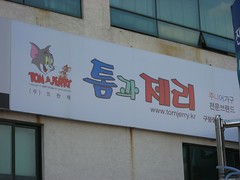
Our quest began at the Tom & Jerry furniture store, where the interior layout provided the next revelation - after seeing countless small cluttered and hopelessly jammed furniture shops in our local district, here was the first time I'd seen a place that looked like the spacious furniture superstores we had back home. The floors were flat and not dangerous in any way, there was no loose wiring trailing across it or hanging from the ceiling - for that matter the ceilings were even and there was nothing else to suggest a structural collapse as an imminent or eventual possibility.

Unfortunately this is what invariable happens in these types of stores. You go in, and pass by the two or three salespeople loitering by the entrance. The moment they are behind you, they tail you as though you were in some kind of 1960s spy movie, except their preferred following distance is about 1 foot - close enough to smell the Kimchi. This makes it somewhat difficult to take photos, which is a shame because today I saw two or three utterly hideous beds which one can only assume are being sold exclusively to love hotels or the seriously deranged, and a green couch that can only be explained as a remnant of a failed alien invasion.

I think the best advice in these situations is to buy one of the first three couches you sit on that you find acceptable, because while there might be 39 other stores to choose from, it turns out that everyone is selling slightly derivative works on the same designs. In fact, many of the couches were just the same design no matter what store we went into and it began to become a blur. You'd think that with so many rivals, competition on price would be fierce, but we were none too impressed with the prices we were quoted having shopped around on the Internet beforehand.

The other flaw in Korean Mother's plan was that it may have been easy enough getting up furniture mountain by taxi, but try getting a taxi back down late in the afternoon when people were shutting up. So we set off walking on a descent which looked set to occupy our next half-hour. But it wasn't long before a horn beeped behind us and a woman shouted a respectful "Mother!" to Korean Mother - it was one of the salespeople or owners from the third store we had visited. She kindly offered us a lift down thus ensuring that if we return, it will most likely be to do business at her establishment. However, having been overloaded with broadly similar options, and having found no options which seemed to meet our precise requirements or tastes, we had given up for the day and decided to return home to consider our next move.

Saturday, June 07, 2008

The Flipside of Dominick Hide

We left our apartment in Busan for the final time on the morning of 14th May at 11am, and began our long journey back to England which, while relatively cheap, included a 17-hour wait between flights in Japan.

Scanned and Disintegrated

The journey began badly at Gimhae Airport where I lost a USB memory stick with all my passwords on it. I had to put it through the scanner in a tray, and then pull my laptop out of a bag to go through afterwards. When I got to the other side there was, mysteriously, no memory stick. Oddly, at first the security worker said he'd put it in my bag, but when I made more of a fuss and started emptying the contents of the bag to search for it, he changed his story to say that he'd never seen it at all. How does something disappear going through an airport scanner in a tray when there doesn't seem to be anyone else around? My files were encrypted but it still meant that on principle my first job once back home was to change all my passwords. Not a good start to the journey, and a lesson learned.

Memo: Narita Airport Completely Shuts At Night

While Typhoon Rammasun had missed a direct hit on the Japanese mainland, its effects were nevertheless felt as we endured a rather turbulent descent to Tokyo Narita. I was unsure if I could leave the airport with my soon-to-expire passport, so we hadn't booked a hotel in advance, but fortunately my attempt to enter the country passed off without a hitch, and for the first time in seventeen months, I found myself primarily responsible for communicating with the outside world, on the questionable basis that my Japanese language ability was better than my wife's.

A ten-minute bus-ride through busy urban roads in the heavy rain took us to a nearby hotel which despite our detour through real-Japan ironically transpired to be near the end of one of the airport's runways. We got a room, and armed only with a Visa card and no Yen, we ventured back to the airport later in the evening to scavenge for food. Now I make no attempt at passing myself of as some urbane and seasoned traveller, and therefore feel little guilt in admitting that in all my years of Japanese experiences I had missed out on one very important aspect of travelling within the country - Tokyo Narita Airport, the country's main point of entry and exit, shuts at night. In fact, while the last flights were still scheduled to make their way in and out at around eleven, I challenge you to find anywhere to eat at 10pm - everything was already closed.

You Know It's Bad When People Start Gasping

As we slowly climbed out of Narita the next day while the lingering periphery of the typhoon continued to dump a large amount of rain on anyone foolish enough to be outside below it, the British Airways staff bravely attempted to serve food what might best be described as a variable-gravity environment.

We landed at London Heathrow Wednesday afternoon British time, and for the first time since I left I suddenly and depressingly understood all the conversations going on around me. Sometimes it doesn't take you long to remember why living in a place where you don't can be a good thing.

Chest X-Rays

Another one to file away under Beautiful Korea, Wonderful Immigration - my wife was briefly diverted by the authorities who needed to take a chest X-ray of her before allowing her into the country. Except that we'd arrived amidst the ongoing Terminal 5 fiasco, so the X-ray machines weren't working and they had to take our details down for later harassment with a pen and paper, because neither were the computers.

Yes, just because we had to fight our way back into the country, doesn't mean to say that my wife isn't going to be treated with suspicion and hostility by the establishment. Welcome to the United Kingdom. The Health Service caught up with my wife two weeks later, made a great fuss about setting up an appointment for an X-ray, and once there - after over an hour of travelling and waiting - they asked her two inconsequential questions and told her that the actual X-ray would be done somewhere else, on another day. And it's for this staggering inefficiency we pay billions in taxes every year. Welcome back to the NHS.

One flight later we reached Manchester and the final leg of our journey began - down motorways where drivers didn't change lane every five seconds and through a strangely flattened landscape devoid of the mountains which have been our constant companions during our time in Korea.

Civilisation Is An Internet Connection

I don't intend to write in this blog about my experiences in England, but I do wish to illustrate some of the realities of the reverse culture shock which is re-assimilating back into your own society.

My Internet experiences in Korea have not been trouble free, but despite the problems one constant has been the level of customer service which has backed it up, even if they couldn't always resolve our issues. British Telecom wanted to charge us £155 to fit an extra telephone socket in our attic for our ADSL connection - which is basically almost as much as an entire year of 100 megabit Internet cost in Korea - where Korea Telecom would, of course, fit extra sockets free of charge if required. We eventually got it done at half the price by an electrician, but it was still a shock, and since they didn't seem to want it British Telecom didn't get our custom.

So now I'm on an approximately 5 megabit connection and missing my 100 Korean megabits very much. To be fair, a 20 megabit service is available to some people in the UK via cable company Virgin Media, but since they think that net neutrality is 'a load of b****cks', and analysing customer browsing habits to insert adverts and bandwidth-throttling are acceptable practices it's not an option. At least we're aware of them though. I don't know whether this kind of behaviour would provoke riots in Korea or whether the people there are generally so naive about Internet security that they wouldn't realise.

Civilisation is an Internet connection, and one that is capable of the speed advertised and that doesn't involve profiling me for commercial or other reasons at the same time.

That Didn't Take Long

So we broke our computers out of storage and needed to buy some more technical equipment, including a couple of new USB memory sticks. When the box arrived with one stick missing this led to a little unpleasantness from the UK online retailer Ebuyer, which I've used for years, who sent a message which seemed to imply some dishonesty, perhaps on my part. Worse, it was obviously a standard email, so by design this is how they talk to their customers. Would Hacker.co.kr have been so rude if this had happened in Korea? I can't see it happening personally.

It must be said though, we have more consumer rights in the UK and that is a comfort in the face of the state of war which usually exists between most British companies and the people who reluctantly have to buy things from them. I've resolved to video record all future parcel openings as I have better things to do with my time than debate package contents with companies.

But after seventeen months of speaking very little, bad online retail experiences notwithstanding, I found myself eagerly bantering with shop staff, which I'm sure I never used to do. Perhaps I'm like an almost drowned man breaking the surface and gasping for air, glad to speak to anyone. Well, apart from Ebuyer, British Telecom and Virgin Media anyway.

Food, Birds and Fish

It's good to be back in England and to see friends and family again. The food I've been pining for didn't taste as good as I'd imagined it would, but even the Tesco-bought frozen pizza surpassed almost all the Korean pizzas I tried.

I can actually hear birds singing in the garden outside, the air is wonderfully fresh especially after it rains, and I can enter the kitchen and look into the sink without fear of seeing several dozen tiny dead fish staring back at me from the plug-hole, which believe me, is a huge relief.

The Flipside of Dominick Hide

While it's only been three weeks, Korea is already a rapidly fading memory with my English life proving to be a hectic one so far, a fact not helped by the power unit on my computer blowing up and a succession of IT problems that I'm only just starting to get on top of. I have seventeen months of mail to sort through, a house to probably sell and a whole range of other tasks which are going to take some time and effort to complete - welcome home. I've decided that I will try and write up my backlogged blog entries and upload my remaining photos though - while it might seem so distant now it's almost like all these things happened to someone else - maybe I need to maintain some connection to it while I get my bearings in my new, old country. Meanwhile I'm getting back to studying Korean every day, because I know it's important to try and keep up to my language skills, but it certainly will be harder now I'm not exposed to the environment. Perhaps when I return to Korea I will have some kind of fluency in the language - one must have goals.
Wednesday, April 23, 2008

Network

We never did get around to having our two 100 megabit connections installed in our new apartment, because the requirement to lose our standard landline in favour of an Internet phone proved too problematic. In any case, our work is winding down now as we prepare to leave Korea next month, so our requirement to have a backup connection diminished.

But the preparations for leaving threw up an unexpected Internet-related problem. During my time here I've taken around five gigabytes worth of photographs and sixteen gigabytes worth of videos, which amongst other things I'd much rather back-up somewhere safe on the Internet as opposed to trusting to carrying with me on numerous DVD-ROMs or an external USB hard drive. I'm also not happy that border officials in various countries now seem to have the right not only to search through one's baggage for dangerous items, but also to search through one's electronic devices for dangerous ideas.

Encryption, of course, is no barrier to search since there are precedents for passwords being demanded. Personally I object to governments rummaging through my private life on paranoia-fuelled fishing expeditions, so on principle I'm committed to keeping as much of the detail of my dull and largely uncontroversial life out of their hands as possible if only to avoid being held up by immigration officials. Perhaps that makes me the paranoid one, but having spent over six months embroiled in a legal battle with the British Government, my relationship with my government is not exactly a happy one these days.

After some fairly exhaustive testing of various online backup solutions, I came to the conclusion that none of them actually seemed to work very well. Yes, various services were ruled out because they lacked features or added annoyances, but fundamentally they all had one thing in common - they were very slow, some incredibly so. The fastest option I found was via improvised 'Google Drives', either via 'shell extensions' or Firefox addons, but there are bandwidth limitations, and such techniques are beyond GMail's terms and conditions so continue to exist at Google's whim. My preferred commercial option, Amazon S3 in conjunction with Jungle Disk, could apparently only transfer files at 32kbps per second, which meant the 36Gb's-worth of files I wanted to back up would take 128 days of continuous operation to complete.

I never suspected a problem with my ISP, because the 'GMail Drive' transfer was quick enough, as were my uploads of large amounts of files to YouTube and Flickr. But eventually I was directed to try Speedtest.net to do some testing. The results were consistently poor - LG Powercom might have decent download speeds, but uploading outside of Korea seemed to be a real problem. I could only surmise that my fast speeds uploading to the likes of Flickr and Google might be due to the variability of various servers or the possibility that unlike my backup servers, Flickr and Google were benefiting from directing me to more local servers behind the scenes. I'm not a network engineer so I don't know, but either way, what it certainly did mean was that I couldn't realistically use Amazon S3 or any other backup service I'd tried.

So I took a chance on dumping LG Powercom in favour of Korea Telecom's (KT) MegaPass service, which I hoped might have better international connectivity by virtue of being owned by the national telecomms company. My wife phoned LG, and the operator told her that KT wouldn't be any better when the reason for leaving was given. When that tactic didn't work, we were offered a permanent 15% discount.

We had to take the chance though, and fortunately KT didn't disappoint. While it doesn't consistently beat LG Powercom in every area, there's no doubt that upload speeds are vastly in excess of anything LG could provide. The results below are inevitably snapshots of the two Internet service providers (ISPs), but I tested both more than once at different times, and I'd say these offer a consistent picture of the differences.


The above results notwithstanding, it's hard to say whether this really matters to a foreigner choosing an ISP in Korea. I used LG Powercom for a long time ignorant of its poor international upload speeds, and while there's little doubt in my mind that KT's Megapass is faster both technically and noticeably in actual use, the reality is that the download speeds they provide are so fast it's questionable whether it really makes a great deal of difference. Upload is another matter, and while I only took to undertaking formal speed tests fairly late in the day, I'm satisfied that the problems I experienced with various services for two months before the realisation, suggest that LG has been poor in this area for weeks if not months. In other words, it is not just a recent technical problem which is causing the slowness, but rather a more permanent infrastructural issue. I'm also mindful of the fact that when we experienced some routing issues with LG last year, that it transpired that the connection from Busan was quite likely inferior to the one from Seoul, so the LG Powercom upload problem may not manifest itself to the same extent in the capital.

As for Amazon S3, I'm now uploading twenty times faster at around 640kbps, which maybe still isn't that great relative to what the above tests suggest could be possible, but at least it reduces my backup's total upload time from 128 days to 6.4. Meanwhile, LG have lost a customer and I'm afraid on this experience I'm not likely to be back even if I return to Korea at some point in future.

Saturday, December 29, 2007

Bad Hair Day

So Christmas Day found us in the Nampodong district again, and we went to a pasta restaurant, but I can't say which one because as I understand it the law in Korea is very much tilted towards businesses rather than individuals, especially where foreigners are concerned, which means that if I mentioned their name in the context of relating what happened next, I might find myself getting sued... ironically.

The ambience inside Unnamed Pasta Restaurant was nice and even if the dishes were a little expensive the meal promised to be a pleasant one and a perfect end to Christmas Day. It was busy, but we didn't have to wait long for a table. My wife ordered pasta but I opted for pizza as most of the pasta dishes seemed to be very hot and I wasn't in the mood to test my stomach's levels of tolerance. Her dish arrived but there seemed little hope for mine after we overheard a waiter telling another customer offering excuses to another customer nearby who was complaining. Predictably then, my wife had finished her meal by the time mine arrived, and while she registered her unhappiness about the situation with the waiter, the best he could offer in his employer's defence was that it was Christmas and it was busy. As this was now the second complaint which had emerged from our corner of the restaurant, an us-versus-them spirit of camaraderie was showing its first dangerous signs of emerging - a voice drifted up from the next table as he left, 'What does Christmas have to do with not cooking the pizzas quickly enough?' But he was already well into beating a hasty retreat in the direction of the kitchen.

The pasta was hot and a little too overcooked, the garlic cheese pizza (with zero sauce) was better but they evidently couldn't help but bake chillies into it so it was also quite hot. But that wasn't the only surprise ingredient. Waiter, there's a hair in my pizza. And obviously it's not mine, because it's silky black, which my hair isn't, and in any case it appears to be baked into the pizza between the cheese and the base in the area that would normally be occupied by the sauce, if this weren't Korea.

We attracted the attention of a passing waitress but she didn't know what to make of it, and shortly afterwards our waiter arrived. He didn't look too sure either, but by now my wife was asking what they were going to do about it. We didn't want the pizza replaced - I'd eaten most of it and it wasn't really that nice even without the hair, and so what followed was one of those unfortunate three-way conversations that my wife has to put up with in Korea. Her negotiating with the waiter, and me telling her what the protocol would be back home for dealing with this situation - which I thought in this case largely involved refusing to pay for the pizza, paying the rest of the bill and walking out immediately - and that's only if the restaurant didn't do the right thing by offering to do the same first or more. Now I didn't know what Korean protocol was for such situations, but given all my experiences here, I rather thought it might sometimes involve the restaurant descending into something akin to a scene from a Jackie Chan movie.

The manager came over and in a voice so hushed and mumbled it resembled a Dick Cheney apology, he offered us free wine or a free pizza to go. My wife chose the latter - if I'd have spoken Korean I wouldn't have accepted anything more from them - I just wanted out. But in retrospect, I can't have been completely angry because even though I'd quickly worked out the Korean for "there's a black hair in my pizza and obviously it isn't mine" to share with our neighbours, I'd elected not to share our experience with them, even though they were clearly curious. So there was a another more audible apology from the manager as we paid, presumably because it was out of the earshot of the comrades we were leaving behind, and an assurance that this really never happens but that, you know 'it is Christmas'. Ah, perhaps it was meant as a gift then.

There's a second part to this Christmas story. The one where my wife, consumed with guilt over the question of whether she'd gone too far or not far enough, polled her mother and friends to gauge what the proper reaction should have been. And the result surprised me, because the answer demonstrated some sympathy with the restaurant. 'Well, these things happen' was a common response. In fact, our friend who's antagonism towards the retail industry have sunk to such lows that she's attempted to stage re-enactments of the Cold War in Paris Baguette, told us that it often happens in really cheap places and because this restaurant wasn't cheap at least the hair was probably clean... In other words, the conclusion was that we got a good result with our free pizza. Personally, I think I'm going to be a little wary of eating out for a while.

We did eventually eat our free sweetcorn pizza. A combination of a lack of food, an unwillingness to go out, and hunger got the better of any fears I had that the cook might have spat on it out of spite. I'm told that's almost unthinkable here, unlike where I come from. But it wasn't nice - once again there was absolutely no sauce at all and not even a hint that the thin dough and cheese had ever even seen anything resembling a tomato, so really, it's just slightly elaborate cheese-on-toast as far as I'm concerned.

Korean tags: 식사, 레스토랑, 피자, 머리, 성탄절