Showing posts with label safety. Show all posts

Wednesday, July 20, 2011

Busan e-FM Week 34: Brands, Counterfeiting and Piracy

The english waves come inAbout 'Open Mike in Busan'

Background

A week earlier while I was waiting to go on air at the station, a situation was posed which led me to say “But that would be unethical”. I needed to repeat that last word a number of times. We quickly established that the English word ‘ethical’ may sound hilarious to Koreans. I wasn’t entirely convinced that this was merely a phonetic issue, which resolved me to pick a topic related to ethics for this week’s show.

Whatever I talk about on the radio, above all else I’ve been told that it has to be entertaining, so it’s fair to say I peppered the segment with the word ‘ethical’ on the principle that if it makes people laugh, instant comedy. I’ve also experimented with the word ‘morally’, but I don’t think the audience is quite ready for it yet, although I’m told ‘contract’ is quite an amusing idea here too.

I wish I was able to communicate with the engineer, because perhaps then we could have set up some canned laughter for every time the word ‘ethical’ was used. That would have been great. Anyway, we decided that ‘ethical’ was the ‘word of the day’.

Introduction

Korea seems to be a country which is particularly obsessed by brands, whether they are real or fake. I’ve always thought it must be something in the Korean psyche – there’s a need to belong to the clan.

The Korean Bag Market

I read in a newspaper that “For Koreans, a designer bag can earn prestige and maybe even a profit.” What that referred to was the fact that in some cases, second-hand prices for these bags are rising above the original purchase price because the price of new bags is rising so quickly.

As a financial trader it reminds me of the stock market – and it does seem that some people in Korea are buying these bags as investments and agonising about waiting to buy them while watching the price move away from them. I think nine times out of ten, when you find yourself in that position, it’s best to let it go. But why do prices keep rising? It seems that from the price differences between Korea and other countries, the brand companies are just raising prices here because they know the market will bear it. They are ripping people off in other words, turning Korea into a bubble-market. [This was especially noticeable when the recent Korea-EU Free Trade Agreement came into effect, and the removal of tariffs were actually accompanied by European designer brand price rises, instead of price cuts]. So Koreans are going overseas to buy these bags instead. [Yes, it’s international designer bag arbitrage!]

The 397 Generation

It’s not as if we don’t have brands in England or the West in general, but there seems to be more trust for them here. I think this is bad economically, because it makes it difficult for new brands to break into the market, and you end up with the chaebol system leading to a lack of choice. Two reasons why this is bad have been in the news recently – large chaebol-built apartment buildings have been accused of poor safety, and then there’s the beer issue. When I got here I kept seeing the same two brands of beer – which largely turns out to be because there are only two major domestic breweries [plus once again, tariffs help]. Korea isn’t a very diverse society but if nothing else you should really have diversity with beer.

Apparently a lot of the brand-worship these days is being blamed on the ‘397 Generation’, who are in their 30s, went to college in the 90s, and were born in the 70s. But from what I see, it seems more like it should be blamed on what I would call the ‘295 Generation’ - 20-somethings with IQs around the 95 mark [logically meaning in England we should probably have a ‘285 Generation’]. Anyway, it certainly isn’t limited to young people, because older people in Korea appear to have an obsession with German cars [specifically, Audis – which mainly men buy – and BMWs, which mainly women buy].

But does this make people happy? In a recent OECD Happiness Survey South Korea ranked 26th out of 34 in the Index, with 36% of South Koreans saying they were satisfied with their life [I don’t know who these people are either because it’s nobody I know here, leading me to wonder how honest the respondents were considering the potential loss-of-face involved in telling the truth]. A lot of it is linked to stress, and a fixation with money [and probably brands by implication]. But I thought a Gallup poll around the same time offered a fascinating insight into Korean life: Koreans aspire to be richer and happier, but apparently they hate rich people.

Faking it

So people harbour a lot of brand aspirations here, and animosity towards those that achieve what they don’t. Perhaps it’s this which leads to the view that if you can’t have it for real, you have to fake it. Making counterfeit items big business in South Korea.

I was surprised when I came here and saw all the counterfeit goods. It’s not as if we don’t have this problem in England as well, but here in Busan they are just out on the street in plain view in districts such as Nampodong. And then up in Seoul you have areas such as Itaewon and Myeong-dong where it’s said that 1-in-10 street vendors are selling counterfeits (and I can’t help thinking that number is probably only that low because a lot of the other vendors are selling food).

But there doesn’t seem to be a great deal of incentive to crack down because it’s good for tourism, with evidence that Japanese and Chinese tourists particularly come to Korea because the quality of fakes here is known to be ‘very high’. And this is the tip of the iceberg, because many more counterfeit items are being sold online.

Does it matter?

Personally I don’t care about bags, and I don’t get paying $1,000 for one. But morally, the business of counterfeiting is unethical [stare into control room]. But then more visible danger is counterfeit drugs; counterfeit goods are a kind of cheat, but counterfeit drugs can kill.

Doing business is an issue – if I were visiting Korea to sign a deal with a company, and saw all the counterfeiting activity going on and that it appeared to be so publicly acceptable, I might think this makes the country and people I’m dealing with in it seem less ethical, like with honouring contracts for example. So I’d wonder, is Korea an ethical or unethical country?

Software Piracy

It also extends to the media industry of course. At PIFF [The ‘Pusan’ International Film Festival], when a message came up saying “No Piracy in Korea”, people laughed. And when I first came to Busan I noticed that while there were shops everywhere, there appeared to be a distinct lack of music, DVD and software stores. Every shop seemed to be running Windows XP Professional though – which is a premium priced version of the Microsoft operating system – and you have to think that the reason is because they’re probably not genuine copies.

I used to be a software developer and I like the ‘open source’ concept but it doesn’t pay the bills. The incentive to build software that would help people in this country isn’t as prevalent as it should be, because there’s no reward if people pirate their software rather than buy. In fact it’s said that piracy in Korea may cost this country around 20,000 IT jobs. [I’ve never been totally convinced by these arguments – it may well cost 20,000 IT sector jobs, but I think the money saved just results in jobs getting shifted elsewhere – admittedly into the service sector which is a dead-end for economic development which Korea shouldn’t want].

The excuse people who pirate always use is that they weren’t going to buy the product anyway, which is undoubtedly true in some cases and undoubtedly false in others. People in Korea don’t seem to care though. I went into a computer store once to ask for a quote on a computer, and was told “we can supply whatever you want – any software... no extra cost.” I actually wanted to buy a genuine copy of Windows – and after overcoming the proprietor’s incredulity he finally laughed and said sheepishly “we don’t have any”.

I think this isn’t isolated because there was a case recently of a large supermarket chain being caught selling pirated software on netbooks, and according to official figures software piracy has reached a five-year high.

You know what really got me about my trip to a computer store? That the proprietor admitted that the one downside of the pirated copies of ‘Windows Vista’ these days is that you can’t update them, which means no security updates and all that implies. But people “don’t really care”. So there’s an ethical issue here but the bigger issue to my mind is security.

Korea’s Digital Pearl Habor

People are taking reckless chances with their online security by running pirated software, because even if you don’t get caught by some downloaded virus, your pirated version of Windows itself may include programs that spy on you, and steal your passwords and bank account details. It’s obviously occurring too because once I was called in to look at a friend’s computer that was ‘running slowly’, and it transpired to be because of the large number of spyware programs infecting the machine.

That’s a practical outcome of these security weaknesses – that to access your bank you have to go through a lot of quite complicated procedures involving digital signatures, and that sounds like it has its advantages on the principle that more security is always good, but it isn’t, because the upshot of the technical environment here is that everyone has to use inherently flawed ActiveX technology and because most people are running pirated versions of Windows which often can’t be updated, everyone designs their websites and security for Internet Explorer 6, which is very insecure.

But where this problem might really manifest itself, is in the field of cyber-warfare, which is already with us, as the attack on Nonghyup Bank earlier this year – which was blamed on North Korea – demonstrates. People often think that if war with the North happens, it’s going to start with thousands of North Korean soldiers rushing over the border, but I think it’s more likely war will begin with a massive cyber attack which, will cripple South Korea. I can see this country very quickly losing its mobile phone networks, Internet, TV, financial, GPS, power and traffic infrastructure. And even if nuclear power plants aren’t connected to the Internet as the authorities in this country claim, the same was true of Iran but foreign intelligence agencies still managed to introduce a devastating virus into that closed system.

North Korea allegedly has 30,000 ‘electronic warfare agents’ or hackers as it is, so it seems optimistic to think they aren’t going to used as part of the initial strike against this country.

So the way I see it, I feat it will be chaos before the first shot is even fired. And that’s the problem. Never mind stealing your bank details, how do you know your pirated copy of Windows doesn’t have a foreign program on it waiting to trigger as part of a cyber attack? You don’t, whether it’s ethical or not, using pirated software might turn out to be a danger to South Korea’s security, whether through war directly or just industrial espionage. Fake bags are not going to bring down society, but the thinking that accepts it, just might.

Links
Busan e-FM
Inside Out Busan

Air date: 2011-06-15 @ ~19:30
Saturday, July 02, 2011

The Honey Pot

In my mind the angry husband eventually accused his wife of caring more about her plants than she did about him, and this is the reason he chose to start dropping them, one by one, out of the window into the car park ten floors below.

As heavy ceramic pots of the sort favoured for Korean balconies, complete with large exotic plants, surreally dropped down the side of our apartment building, the ageing building janitor was called in to negotiate for the safety of the remaining foliage, even if the marriage at this point was beyond saving.

It’s not always a given that people are going to listen to their elders in this country any more, but thirty minutes later, the man was sheepishly picking up shattered ceramic fragments and traumatised plants amongst the thin layer of earth that now covered part of our apartment block's car park.

Stress is a huge problem in Korea.

Tuesday, April 12, 2011

Busan e-FM Week 12: The Safety Experience

About 'Open Mike in Busan'

Introduction

This week’s subject is safety. Perhaps when people think about this country and its culture, they think about the places, the festivals, the food and things like that, and not necessarily the issue of safety, but safety was one of the first things I thought about in Korea.

Some of it is politics

On my third day in Korea I was walking to... well, I didn’t know where we were going actually – that’s what life is like sometimes as a foreigner living with a Korean family here – and the civil defence sirens went off.

Nobody had warned me about this, so it came as a complete surprise. I grew up about a mile away from the centre of the city I lived in, which would have been a Soviet nuclear target. It was still the Cold War and sometimes the sirens went off accidentally – so hearing them again brought back some bad memories and nervous feelings.

It doesn’t really bother me any more – the threat of war. I grew up with it I suppose, so I’ve lived with it before and now I’m living with it again. Maybe I’d feel differently if I lived in Seoul. You know, I think there’s a lot less crime here than where I’m from, so Korea has its advantages, but the political situation isn’t really one of them, and it’s not the only unsafe thing here.

Taxis and zero gravity

Another early experience that felt unsafe was the taxi ride from the station on my first day. In fact, all the other taxi rides I’ve taken felt unsafe as well.

It’s partly the speed, but it’s also the general chaos. When I learned to drive in England I was taught the importance of staying in your lane, not swerving around the road, giving other drivers space – you know, all the things that don’t seem to happen on the streets of Busan. I’ve driven a lot in my life, but so often here drivers seem to go through the narrowest of gaps at quite fast speeds, and I just find it amazing. I think Koreans must make great fighter pilots. Actually, I’ve felt like some of the taxi drivers I’ve ridden with must have been ex-fighter pilots. And certainly I’ve experienced zero gravity in the back of their cars. Despite that, I must have got used to it because I stopped wearing seatbelts.

Normally I wear seatbelts in British taxis. Partly because the taxi drivers where I’m from aren’t that great either, although it’s nothing compared to Busan, but partly because it’s actually the law in England – you have to wear seatbelts, even in he back of the car. But when I first came to Busan, of course I’d look for the seatbelt and the taxi drivers used to laugh at me. Usually I couldn’t find them either because they were hidden under the seat or they didn’t work. So I gave up, and I don’t think about putting a seatbelt on any more.

Two-speed buses

Sometimes I still wish they had seatbelts in buses though. Taxis speed up and slow down, but buses only seem to have two speeds – fast and stop – with nothing in-between. Why is it that buses have to accelerate towards a bus stop and then apply full brakes when they reach it? Honestly – I’m not joking when I say this – there have been morning I’ve woken up after a bus ride the day before, when my arm muscles have ached from gripping one of those hanging handles to try and stay on my feet.

I haven’t been injured yet, but last time I came back from Incheon Airport the bus driver braked so suddenly, that I fell over and my notebook computer casing broke as we both hit the floor. Welcome back to Korea. Seriously, I don’t think it creates a good image with tourists.

Getting run over on the pavement

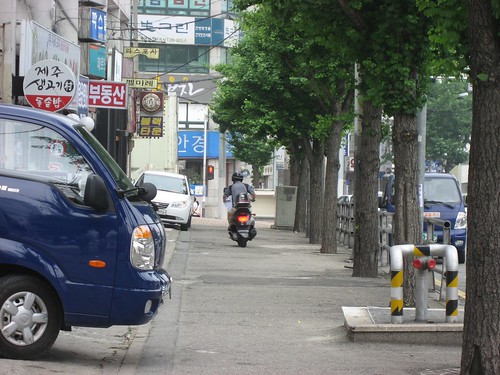
In England, people aren’t allowed to ride motorbikes on the pavements – the sidewalks – so that was a real shock when I came to Korea. Actually, sometimes it makes me really angry – when my wife was heavily pregnant suddenly she was roughly pushed out of the way on the pavement and when I looked it was someone on a bike trying to get past her. I think riding motorbikes on sidewalks is the kind of behaviour you expect in a third-world country. I know it probably gets me my pizza faster, but I’d accept slower deliveries if I felt safer as a pedestrian. I think it would be better for the delivery riders as well, because I read that a lot of them have accidents.

I’ve seen the accident statistics for bike riders in Korea and they are frightening. But I’ve seen some people doing stupid things on bikes. Bikers use the road outside my apartment as a racetrack. Seeing three people on a small moped isn’t unusual, but twice I’ve seen four. One of those times it was a man weaving around the road with three small children on the bike with him – one clinging to his back, one clinging to his front, and one crouching down hear his feet. I’d been in Korea almost three years by then, so less and less shocks me – but that still did.

Walking

So walking isn’t always safe, and sometimes cars drive straight through crossings – I always wait for other people to start to cross first. And a couple of times a new building was being constructed on the street, and I looked up and saw men passing steel bars and other construction materials to each other. If they had dropped, it could have been straight onto someone’s head.

And speaking of unsafe buildings

We used to go to DVD bangs but then there was that fire a couple of years ago in Busan at the shooting club [several Japanese tourists died], and I started looking more carefully at some of the DVD bangs and there were bars across the windows. People probably smoke in them as well, so there’s no way out if something happens. I think a lot of places are like that.

I’m not sure apartments are always a lot better. For example, when we first moved into our one-room apartment I was surprised at the gas pipe hanging down from the ceiling very close to the gas hobs. Then one time our Internet failed and we went to the roof to see if there were any obvious problems with the wires. It turned out the roof was covered in all kinds of wiring – some in bad condition. A few days earlier, we were walking down the street nearby and there was a huge flash of light – the pole with all the wires next to our building had blown up – I mean that literally – there were steaming lumps of wreckage on the ground when we got there.

Flying into the Busan e-FM control room

I’m not sure that Korea is becoming a more safety conscious country either as each year passes. For example, Busan e-FM has just moved into newly-built studios, and the door to the control room has this four centimetre frame around it, including at the bottom, so it’s really easy to trip over if you forget it’s there. I’m waiting for the day I finally forget and enter the room head-first as I fall towards the floor.

Actually, when I first came to Korea my wife said to me that there used to be a kind of attitude here, that if something happens to you it’s probably your fault for not being more careful. So perhaps it’s just a cultural difference I have to get used to.

Links
Busan e-FM
Inside Out Busan

Air date: 2011-01-12 @ ~19:30

Tuesday, March 29, 2011

Abandon Ship

The first thing you think about when the screech of the alarm first reaches you, is that 9.30pm on a Sunday evening is not a likely time to be running a drill. The automated spoken warning that it drowned out may have been meaningless to a non-Korean speaker, but there are times when no translation is necessary to understand the words "Fire. Evacuate. Fire. Evacuate."

There is only one way out of the apartment. And there is only one way out of the building. As you throw on your shoes, grabbing your baby and your dog as you do so, suddenly that one way out – down fifteen flights of stairs passing floors that may be alight – seems like a long and uncertain journey spurred on by the urgency of the alarms. On your journey, you might consider how quickly the blaze in the Haeundae 'Golden Suites' apartment block spread last year, and how as crime-ridden as living in a British house can be, at least you can always jump out of a window in an emergency and survive the fall.

Perhaps this is what comes of growing up in a country that, essentially, has never had a great belief in building upwards. But despite my lack of experience with tall buildings, I still believe I made the right choice in choosing the stairs for our escape, even if – on the evidence I saw – in a fire most Koreans will choose to wait for the elevator. So while a few people joined us on the stairs, it is the frantic movements of the elevator that forms one of my strongest lasting memories from that dark descent.

Korean Mother said she thought she could smell smoke, but I haven't learned to differentiate between that and the smell of Korean cooking. Come to think of it, it's remarkable that the thick haze that often accompanies her frying of large dead fish doesn't set off the smoke alarm in our apartment block.

Outside, a quick visual check of the apartment complex suggested nothing untoward, and we made our way to the janitor's office which had already become an impromptu refugee camp, and as it turned out, a pretty angry one at that.

You see, the reality of apartment block life in Korea seems to be this. There is a janitor's office, and a man sits in it who might be a janitor but he wears a uniform bearing a patch which reads "Security", and given the invariably high age of the wearer, one suspects this is actually short for "Social Security" to indicate their status as retirees. Our Sunday evening janitor didn’t look a day below the age of 70, and with thirty people in various states of agitation facing him, he certainly was aging fast, which he could ill-afford to do.

The problem was this. An alarm had triggered in an apartment that evidently was empty. Normally there is a building maintenance person to hand but tonight there wasn't, and there wouldn’t be until tomorrow morning. The janitor said everything was fine, though lacking any evidence for this it was clearly based on wishful thinking, and people should return to their homes, which they were unsurprisingly reluctant to do. They demanded he checked the apartment. He said he would do it the next morning when a maintenance person came. In Korea's Confucian society the stereotype of people having respect for their elders may be well-founded, but people were beginning to shout, and as it turned out one of the loudest was Korean Mother, which in its way was also unsurprising. In another time and a less patriarchal society, she would have been a fearsome tribal leader. Instead, she is merely fearsome.

The sound of a large diesel engine drew me outside and around a corner, to where a fire engine, lights flashing, had stopped. Firemen, wearing so little in the way of special clothing they had initially blended into the ranks of the evacuees outside, made their way into the janitor's office and then presumably to check the offending apartment. With competent professionals finally on hand, the incident rapidly faded into a non-event and fire or not, we drifted back to our apartment building.

An hour later, an announcement came over our apartment's speaker that the alarm had been caused by a non-fire related problem and the janitor/security guard, who was apparently a stand-in, hadn't known to just turn it off. He would be trained properly. Somehow, this explanation failed to inspire any confidence, because it seemed to beg more questions than it answered.

Many years ago I couldn't get an answer to a mathematics textbook problem unless I slightly altered the question, which I did on the assumption it was a misprint. My teacher wrote in bold angry red letters "Don't change the question to fit your answer!" Recently, in the early days of the Fukushima nuclear disaster, faced with rising levels of radioactivity they simply raised the level of radiation considered as 'safe'. I think if there’s something for the world to learn from Fukushima and the apparent history of cover-ups that preceded it, it is that for all the economic heights it has reached, Japan is often a country that likes to change its questions to fit its answers. And as my time here lengthens, I'm beginning to get a nasty feeling that Korea is exactly the same. So when one of the building's smoke alarm sensors are triggered, the official response is not to investigate the cause, but rather to know how to turn it off. How often is this happening while we sleep unaware in our homes?

The sense of a system that doesn't quite work was only heightened by a woman who said that she'd only heard about the evacuation when a friend outside the building phoned her to ask her why she wasn't outside. It was because the alarms didn’t go off at all on the 20th floor. It hadn't previously occurred to me that the alarms themselves might not work, even though, now I come to think of it, I believe that was one of the many complaints about the apartment building which burned in Haeundae. A sobering thought.

At 2.45am the alarms went off again, but this time they were so quiet I slept through it. In growing evidence of the supposition that people here like to change the question to fit their answers, apparently they'd turned the volume down on the alarms just in case they went off again. Who even knew they could do that? But this is the wrong way to solve the problem. My wife phoned the janitor's office where an evidently confused individual seemed to be struggling to know how to react. The quiet alarm finally ended and ten minutes later my wife phoned again to be told that everything 'seemed' OK. When you have only one way out of your apartment, and one way out of your building, it would be more comforting to think that the people who sat and watched over it could deal in greater certainty with greater competence.

The evening's events had raised another odd observation as well, which is why, of all the people that were outside having hastily evacuated the large apartment complex, was I the only person with a dog?

Thursday, November 04, 2010

The Hornet's Nest

Apparently Namhae has killer bees. Or something like that.

Korean Father was out very early in the morning on top of an isolated mountain mowing the grass around his mother's grave, during the last days of the summer's heat. It has to be done otherwise it would become unkempt and that would be disrespectful, and since graveyards in Korea are generally small and don't employ anyone to maintain them, it's a family responsibility. The graves of those with no nearby or surviving relatives can often easily be spotted as isolated patches of chaos in an otherwise ordered scene.

This particular morning Korean Father was stung three times by large hornets. It seems that this is OK as long as they don't get you in the head. Then you die. Really. In fact I understand that earlier this year a forty-two year old farmer died in Namhae after this happened to him, and there have been other deaths and incidents. The fourth sting caught Korean Father right between the eyes. His right eye began to lose focus, his lips numbed, he started to lose movement in his jaw, and his arms and legs weakened. He called a friend who's the head of a health clinic, and he phoned for an ambulance, which had to negotiate its way to the top of the mountain Korean Father had walked up. Fortunately there is a road, of sorts, although it's one of those Korean ones you really don't want to look down over the side of.

Fortunately with rapid treatment Korean Father quickly recovered, unlike some other unfortunate victims, although his face was still swollen days later.

Before city dwellers lull themselves into a false sense of security, according to the JoongAng Daily the Busan Fire Department had to administer first aid to 145 people this year, so clearly it's not an issue just confined to the countryside. And while we have a lot of bees and wasps (hornets) where I'm from, they pale in comparison to the Asian Giant Hornet, which grows up to two inches (50mm) in length, and injects a venom so strong it can dissolve human tissue.

So it seems like this is an important safety tip, beware of Korea's killer hornets...

Sunday, October 24, 2010

When the Smoke Clears

I really don't like mosquitoes, the dreaded Korean 'mogi'. Recently I related some of my mogi-chasing stories to someone here and she seemed to think it was more amusing than I did. When I got home, I asked my wife, "what's so funny about that?" She told me that Korean people don't usually bother enough about mosquitoes to spend an hour out of bed in the middle of the night chasing one with a newspaper. OK, that's fair enough, I may be a little crazy. But look at it this way - I'm a completer-finisher*. (*I wish - I'm actually a dangerously high scoring 'shaper').

But am I crazy enough to want to run trucks around crowded streets spraying insecticide at everyone? No - so who are the crazy ones now?

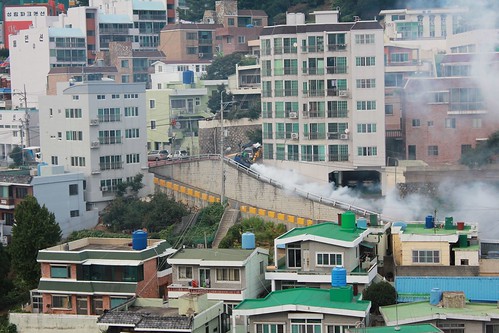
I didn't see this the first time I was here, but this summer one day I noticed a cloud of smoke in the distance. My first thought - that some old Hyundai Accent had finally reached its expiry point - proved incorrect.


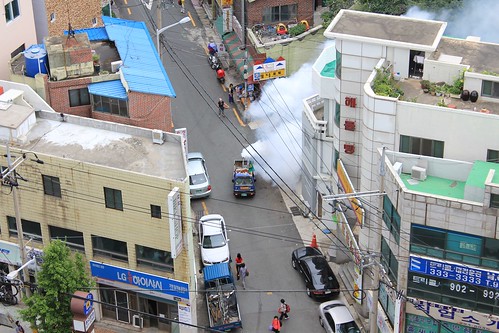
It was, I was told, mosquito spraying. I'd heard about this, but thought it was a practice largely consigned to the past. Apparently not, it seemed, as the scene was repeated every couple of weeks thereafter.


It didn't look very healthy either, as the truck in our area dashed around the narrow streets spewing a chemical cloud behind it leaving people nowhere to hide.


Obviously, the insecticide is designed to kill mosquitoes rather than people, but I can't help thinking that it can't be particularly healthy, even if it won't kill you. And will this chemical concoction still be seen as safe in future? There was a time when people thought DDT was fine too.

But what I didn't expect, was to see one of these chemical spraying trucks do a circuit of the local school ground every two weeks, enveloping the children practising football in thick clouds of insecticide.


But perhaps this means if the Korean national team ever have to play a game in fog, they're bound to win.

Maybe it doesn't cause any lasting damage though. My wife used to run through the smoke chasing the trucks down the street because she said it was fun. That was when she was a child by the way, not recently - which would be more disturbing.

Now I'm a parent though, I watch that mosquito truck making its regular rounds of the local school, and think one day that could be my child enveloped in a chemical soup. I'm not really thrilled at the idea.

But does it work? Well, this summer was amazing for three months - I didn't see a single mosquito. But just as I was contemplating the notion that actually, it really does work, I read that the unusual weather this year meant that mosquito numbers were down significantly. However, as the autumn arrived they emerged with a vengeance. The mogi-trucks are still doing their rounds, I suppose they would argue that it would be worse if they didn't. But how can we know?

Monday, July 05, 2010

Biker Boyz


Anyone who's lived here for more than a couple of weeks will probably have become used to the blatant use of pedestrian areas such as sidewalks/pavements as a more convenient off-road route. That is, as far as it's possible to learn to live with suddenly finding a large and sometimes previously unheard machine whizzing by your arm at 20mph. But lately, I've noticed that the major road outside our apartment seemed to be doubling up as a racetrack for bikers after midnight. At least, that was my theory - the enormous apparent speeds involved prevented me from getting up from my chair and reaching the window in time to actually see the physical evidence for this, even if the noise from engines and customised horns told its own story. They've also woken me up just after dawn, apparently doing racing laps of the local district, judging from the fading and crescendoing engine sounds echoing around the valley we live in.

Curious, I stopped to watch a group who I noticed were pulled into a petrol station nearby recently. It was impossible to see what kind of people they were (very young, I suspect) or what kind of bikes they had because it was too far away and too dark, but the numerous coloured LED lights on the back of their machines were unmistakable. I came back to the window a couple of minutes later as they headed off down the road with engines roaring. That's when I saw one of the rear lights wave around wildly and unmistakably crash to the floor. There was now a bike sliding along the road in a small shower of sparks, while nearby the dark shape of its former rider tumbled along next to it. I lost track of him in the darkness, but saw him again when he hit the back of a stationary car in a small cloud of smoke. I don't know what speed he was doing when he came off, but rider and machine had perhaps slid around 40 feet by the time it ended.


The ambulance came about three minutes later, and not long after that, the police arrived. I expect I'll never find out whether the rider was seriously injured. Back in England, I had a biker friend who once told me in excruciating detail of the perils of not wearing protective leathers in a similar type of accident, but here in Korea, with the temperature outside at midnight 21 degrees Celsius, what kind of clothes do these biker youths wear? Probably not the the proper gear, I expect. Laceration injuries may not be the rider's biggest problem though, given what I've since seen of other late night bikers, it's very unlikely he was wearing a helmet.


It's getting bad during the daytime as well, in a way I never really remember occurring before. It was always the case that the sensible pedestrian lets a couple of people venture out onto a crossing when the lights change to provide a target for the drivers who regularly race the lights or simply don't notice them change. But recently a couple of motorcyclists have blasted through crossings I've been at long after lights have changed and people have been mid-way across the road. A couple of days ago, I realised how deliberate this was when one rider revved his bike and speeded up as he shot through a gap in a group of rather surprised people at about 50mph. It was close enough that I could feel the rush of wind as he disappeared up the road at great pace. Sooner or later someone will, of course, get killed and then there will be some blood money to pay and maybe a bit of prison time if they're unlucky.

What seems really intended to stick two fingers up at 'the man' is ignoring the civil defence drill. I often watch these unfold below me - there's something slightly comedic about the idea that during a real attack elderly women will take to the streets and blow their whistles at both vehicles and pedestrians which don't come to a halt. Usually I see drivers try to reach the safety of side streets where they can continue their journey, or at least position themselves a few more feet down the street to cut their post-alert journey just that little bit shorter. Pedestrians meanwhile, are sometimes harangued, apparently depending on the mood of the official.

So during the last drill, for the first time, I saw someone who'd openly decided to flout it. It was, of course, a biker, who put in the following performance - if you listen carefully at the end, you can hear the whistles being blown pointlessly as he disappears into the distance:


Friday, July 02, 2010

Pong

Normally, I don't really sweat that much, and this may have been the reason why before this summer I've only had around five mosquito bites in Korea. In the last two days, I've been bitten seven times in our apartment, and I have the itchy red spots to prove it.

Having a large apartment can seem like a step up from the 'one-room' place we spent the first fifteen months in, but I discovered it had a downside: the air conditioning unit in the one-room could keep the air cool with only intermittent efforts, but the one in our four-bedroom apartment would need to stay on all the time to have any chance of making a significant difference to the temperature of our office on the other side of the building. The upshot of which is that I'm working in a room which hits 30 degrees and 80% humidity on the bad days, while three computers pump out warm air which has nowhere to go. It's hot, uncomfortable, and apparently it's made me more of a mosquito target.
The question of where the dreaded mosquitoes are actually coming from became a pressing one after their seven-bite feast. Our bed is protected by a large mosquito tent, so it isn't while I sleep. Logically then, it's almost certainly in the office where I've spent almost all my time this week. It wasn't long before careful examination of the large wire gauze cover which prevents insects flying through the otherwise open window (aka 'mogi jang' - 모기장 - mosquito net/bar) revealed it to have four large gaps in the frame where insects can enter the apartment as they wish. One of them is the gap beneath the window and the frame, which might be unavoidable, but the other three are a little inexplicable – they are lozenge-shaped holes which are clearly part of the design of the frame.

Since my wife became pregnant we can't liberally employ mosquito spray wherever we want to as we used to, and truth be told I was never convinced of its efficacy – only a direct hit at close quarters ever seemed to kill, so Korean Mother's strategy of spraying a room heavily and then closing the door for ten minutes before going to bed never seemed like it was going to harm anything apart from the person sleeping inside. I can't spray my office even if my wife isn't in the room now either, since we acquired an aquarium. So I've had to resort to using an insect swatter, which often involves cleaning up blood-splattered walls afterwards.

I hoped technology might come to the rescue, but was disappointed to find that most people on the Korean Internet felt that the kind of electrified lights which I often see in fast-food places back in the UK, but not so much in Korea, don't actually work very well. So we ended up buying an electrified mosquito swatter.


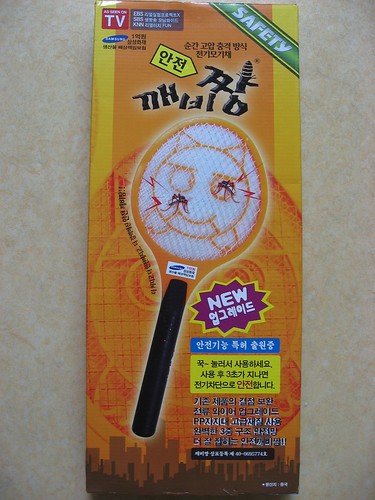
The electrified mosquito swatter seems typical of so much that is sold in Korea. It's made in China, and it's so dangerous that almost two-hundred people were injured by it last year. Shopping forums are full of cautionary tales of the huge sparks which are created and the dangers of it touching yourself or any close family members you'd like to keep. Despite this, the solution is not to ban the product, but rather to offer 100,000,000 won (£53,600/$81,500) of product liability insurance. A Samsung Insurance sticker is therefore attached above the handle for your peace of mind. If that isn't enough, the box has the word 'Safety' written in large letters in the corner, and 'As Seen on TV', though it isn't clear to me whether this was in an advert or a news report.
What kind of design aesthetic should such an apparently dangerous device have? Something that doesn't look attractive to children? No, worryingly it looks like a toy with a tennis racquet shape, a bright orange frame, and a friendly-looking cat face in the middle of the metal strings, inviting you in for a closer look.


The initial test came the day the package arrived. The device is activated with a button which must be held in while hitting the offending mosquito, although apparently it can retain a charge even after it's released. I quickly put the batteries in and pressed it – a loud crack accompanied by large retina-blurring spark immediately jumped off the metal wiring. There was no doubt this was going to be satisfyingly deadly, the only question remained as to who the victim would be. The second loud crack came as I moved the now electrified racquet gently towards the flying insect, which was left motionless in the wiring.

It's easy to be frightened by the rather cavalier attitude to public safety that exists in this country – but the electrified mosquito swatter stands as an example of how it can actually work for you; just because some ajumma set fire to her apartment with one, and just because a young girl put one in her mouth with predictably horrific consequences (yes, both actually happened), apparently nobody is going to stop you from buying it. Which is good if you're careful and responsible, but not so good if you might be Darwin Award material. Later, I'll let you know at a later time which group I fall into. Unless I can't.

Wednesday, June 23, 2010

Not Necessarily the News

The first time I lived in Korea I tried to learn the language and understand the culture I was faced with every day, but I didn't have the time to develop an understanding of some of the wider aspects of society that fills the newspapers every day, and I wasn't expecting to stay. I found this decision made Korea more enjoyable for me, because I didn't have to read about politicians arguing every day, the crimes and wider social problems afflicting the country, or endless celebrity gossip.

The second time I came to Korea, it was with every chance of staying here for much longer, so I knew I had to start trying to understand the country I was living in at a deeper level. I started making the effort to go through the newspapers every day. One of the suspicions about Korea that was confirmed by doing this was the precarious state of online security. My anecdotal experience suggested that most people used pirated versions of Windows, everyone used Internet Explorer (even though it was so troubled other Governments were issuing advisories to people not to use it at all), and ActiveX was the basis of all online banking. Firewalls and anti-virus software were optional, and resident protection systems almost unheard of save for odd anti-virus and anti-keylogging applications which tended to load for the duration of an online banking session. You are often out of luck functioning on the IE-centric Korean web if you choose Firefox, let alone an entirely different platform such as Linux or MacOS.

So I discovered that at least there is a growing debate about the state of online security in the media, with some blame even being attached to the security companies themselves, and the Government is making noises about making changes. It's a potentially important issue, because South Korea may be wide open to a coordinated cyber-assault - there have already been a significant number of isolated attacks, and given the nature of the tensions on the peninsula, an enemy may gain an advantage by disrupting communications in the South immediately prior to a military attack.

But despite the increasing media debate, ironically it appears that sections of the media have fallen victim themselves, by proxy if not directly. Last week Google Chrome started blocking The Korea Herald, followed by national broadcaster, KBS. Later, even Firefox - which is generally more tolerant or ill-informed of such issues, started blocking the Herald website. Since then, access has been sporadic. Could they be false positives? Well, this is what Google's diagnostic page had to say about koreaherald.com:

Of the 1875 pages that we tested on the site over the past 90 days, 81 page(s) resulted in malicious software being downloaded and installed without user consent.

Malicious software includes 99 scripting exploit(s). Successful infection resulted in an average of 4 new process(es) on the target machine.


Which sounds concerning, even if the chances of ending up with four new processes - doing who knows what - on your computer are limited to about 81 in 1875. And the main problem seems to be not the koreaherald.com itself, but code from other domains which koreaherald.com acted as an intermediary for. It may have been advertisers. None of which is any comfort if you fall victim to it, and it truly is malicious.

Monday, June 07, 2010

The Sandman

When I discovered that finance ministers and central bankers from the G-20 were meeting in Busan I felt like I wanted to go and stand outside the hotel to watch because suddenly, as a financial trader, my world was coming to me - here in the relative backwater that is Korea's second city, and I wondered if I would ever again be in the presence of so much collective inaction. But as events transpired, by the time they reached Busan, all I wanted to do was catch a glimpse of the British Chancellor of the Exchequer and shout “Stop letting President Obama kick sand in our faces, Mr. Osborne!” (a long story of Brit-bashing and appalling double standards, especially considering how Britain dealt with Piper Alpha).

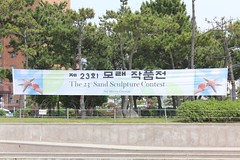
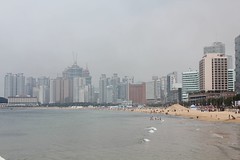
But when we reached The Westin Chosun Hotel where the G-20 meeting was being held, it was by a complete coincidence. We'd decided some time ago to attend the Haeundae 'Sand Festival' not realising its proximity to the meeting either on the calendar or geographically. Perhaps unsurprisingly, I didn't get to see my country's finance minister while walking past a stationary policeman every three meters on wooded path near the Hotel. As much as I would have loved to take a photo of the scene, that would most likely result in arrest in my country these days, and while twenty-three years after the end of military government Korea's normal policing style could best be described as 'apologetic', I wasn't going to push my luck.

My wife expressed a casual hope that the North Koreans wouldn't decide to attack Haeundae Beach while we were there. That's the thing about our northern neighbour - you have to think of the most reckless thing they could possibly do, and assume that sooner or later, they'll try it. It didn't seem quite such an absurd idea five minutes later when the sirens went off and I was treated to the sight of lots of Koreans all looking at each other in confusion. The first people I looked at were the police - who appeared completely unconcerned as usual. I suppose it must be normal. We don't get to Haeundae Beach very often - the poor part of town is too far away.


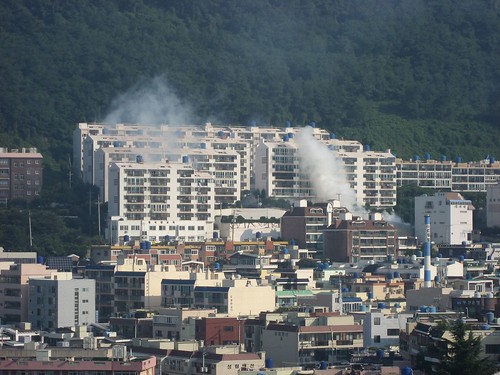
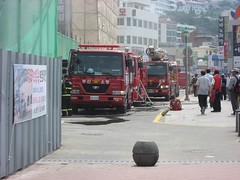
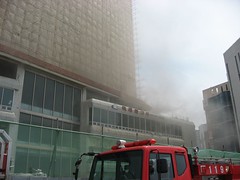
What wasn't quite as normal was the building that was evidently on fire at the far end of the beach, spewing somewhat unpleasant smoke down towards us from time to time. It probably wasn't quite the image the Korean authorities wanted to their international guests with their grandstand view in the hotel.


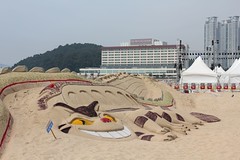
I did eventually find a smiling fat-cat, but not from The Westin Chosun - it was a sand-sculpture.


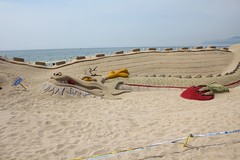
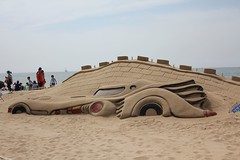
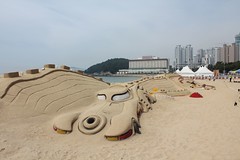
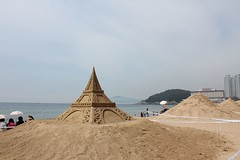
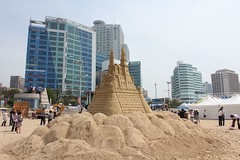
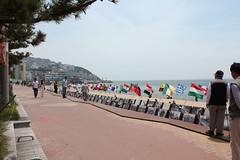
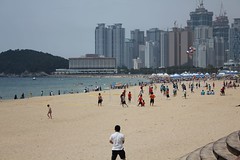
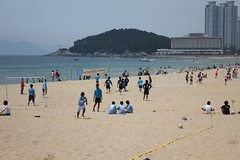
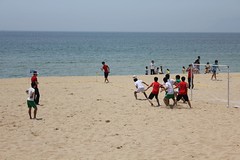
We may have arrived at the beach too early in the day. There weren't huge numbers of sculptures - a number were by the same Dutch artist, Jeroen Advocaat, and although a competition with around twenty amateur entrants seemed to be slowly getting under way it was clearly going to take some time to come to fruition. A dance contest was nowhere near beginning and further down the beach a sand-surfing ramp and football pitches were similarly lacking in activity. What I did find was a rather fascinating memorial to the Korean War - but more on this later.


I reached the end of the beach and the building which was belching smoke. It was not entirely surprising to find that it was having some construction work done - it often seems to be the way.


Unfortunately shortly after taking these shots I saw a casualty being loaded into an ambulance, escalating it from another one of those all-too-common unattended under-construction fires to something more serious.


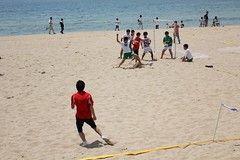
By the time I was half-way back the football had started, but that was about the only development. Much like the G-20 finance ministers over the last two years, I guess our timing was a little off.

Sunday, May 30, 2010

Sirens

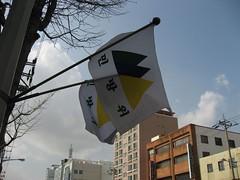
There is a civil defence drill here around the 15th of every month. The authorities put out flags a day or two beforehand to remind people. Now that the puppet regime in North Korea is threatening to attack South Korea again - in the past it has threatened to turn it into a sea of fire amongst other things, the drills take on a slightly more ominous feel.

Sometimes I don't hear the sirens - it depends where I am. If fact, it's a given that if I'm in the subway or even in a store I won't know anything about it. One person told me that she never hears it in her school where she works, and I never used to hear it in my old apartment which seemed to be positioned in a place where the warning coverage wasn't very good. One would hope that because of South Korea's love of technology, in the event of a real threat in addition to sounding the sirens the Government would have a system in place to text everyone, but I'm not sure that they do.

There is no such danger of not hearing the sirens in the apartment I live in now. And because it overlooks the main road into the centre of the city, every month I watch the entertainment unfold as the sirens sound and civil defence ajummas march into the middle of the lanes and, armed with little more than a whistle and looks that could turn flesh to stone, attempt to cajole drivers into pulling over to the side of the road. This almost always works, because they have to, but as you might expect, for some motorists the challenge is to get as far as possible before they dare not go further. I've seen cars speed past the ajummas on occasion well into the drill, soliciting the dirtiest of looks from them undiluted by my high vantage point. I'm not entirely convinced that if the sirens ever sound in anger drivers are going to be quite so well behaved and pull into the side of the road to possibly die, when their gut instinct is to get home to their families as quickly as possible.

Last month once the sirens had stopped I noticed something new. It was incredibly quiet. So quiet in fact, that I could hear birds singing. That was practically a new experience in Busan, where wildlife is largely confined to the mountains. As birdsong echoed through the valley we live in, it struck me that this must have been a beautiful place once before someone dropped a city on it.

This month there was something new again. The sirens were different. They seemed to have changed from the air-raid type sound familiar from the Second World and Cold Wars, into something more akin to a police siren, with a different pitch and a more rapid cycle. I was a little disappointed - I felt it lacked the menace of the Soviet attack warnings I grew up with, but later it transpired it was actually a natural disaster drill, and the sirens were for tsunamis and earthquakes. I'm not actually sure how you sound a siren to warn for an earthquake though – but that's what they said.


Despite its proximity to Japan, Busan is not particularly directly prone to earthquakes, which is just as well considering the dubious build quality of our apartment block. However, with climate change turning the waters off the southern coast we live on subtropical, the Korea Hydrographic and Oceanographic Administration (KHOA) are warning us of worse typhoons and tsunamis in future. Unfortunately, typhoons are a very real threat here as are tsunamis caused by major earthquakes close to Japan.

Telling the two types of sirens apart then is actually quite important, as in principle it's the difference between heading down into the civil defence shelters otherwise known as the subway system, versus heading for high ground. (In practice however it's not quite that simple anyway - the subway system might not be the best move in the event of a chemical attack where the gas is heavier than air and sinks).