Showing posts with label Internet. Show all posts

Friday, September 09, 2011

August Rush: The Web Job

Tho' much is taken, much abides; and tho'
We are not now that strength which in old days
Moved earth and heaven; that which we are, we are;
One equal temper of heroic hearts,
Made weak by time and fate, but strong in will
To strive, to seek, to find, and not to yield.

"Ulysses", Alfred Tennyson

I always liked that poem, especially those final lines. I learned something shocking during my early days in corporate life and public office. Most people are basically apathetic and most people actually don’t know what they’re doing. So the secret to success in life is generally to give a damn and know your stuff. That might sound deceptively easy, but most people are lazy, so it means that all you often need to do to pull ahead in life is to go the extra mile and put in some of those twelve-hour days I regularly work. Of course, if you want a healthier work-life balance, you’re not going to do that, and for all I know maybe you’d be right not to. In fact, I think you probably are.

As I’ve got older, the lines in that poem have increasingly summarised my life. Towards the end of my time as an elected representative serving 9,600 constituents I wondered if everything I would do professionally after it would seem like an anti-climax – it did – and before long I ended up in a job that, anti-climactic or not, paid such a lot of money really that nothing was ever likely to surpass that either, unless I progressed into upper management, a near impossibility for an IT person in the medical corporation I worked for.

So I’ve done my own thing past my peak, including working around the three years of my professional life that Meniere’s Disease wiped out, and actually I’m not sorry about much – but it has left me feeling like I’m a highly determined person blowing on the embers of past achievements. And while I know who I am and I know what I’m still capable of, my years out in the career wilderness working for myself means that I’m a riskier hire. I have to rebuild my resume. In Korea. Somehow.

It was becoming apparent that even with my TESOL qualification, getting a foot in the door of the English teaching circuit in Korea wasn’t going to be entirely easy. I was logging into Koreabridge every day and I applied for my first position, a short-term role teaching Business English, which I thought there might be a least a little chance of progressing with given that relative to some people, I have around sixteen years of business experience. Still, I wasn’t surprised when I didn’t get an interview, because I’m feeling my way in the dark here with almost no expectations. As far as teaching is concerned, I probably have to work my way up from quite a low level, and I suppose Business English jobs probably go to more experienced teachers, not experienced business people, even ones with TESOL certificates.

So the upshot of everything which has occurred recently is that I’m down on my luck, with a baby and an apartment to support, unemployed with only savings rather than income to pay the bills and career prospects that look about as attractive to me as the front of a subway train. I was desperate to find something outside teaching, but I knew it was probably impossible... until the fifth day of my Koreabridge search, when a job was advertised for a web developer with an F-class visa living in or near Haeundae, which at the time felt like a highly unlikely combination of attributes to find here in Busan amongst the relatively small expat community.

The academic institution concerned - which is reasonably well-known - didn’t seem to have much in the way of expectations either, because they offered training for any candidate who was at least IT-literate. Yet here I was, a Computer Science graduate, former software and Internet developer with years of experience, a co-founder of two serious dot-com start-up companies behind me and a couple of mildly popular British websites to my name, which were still running, and which I thought nice and publicly demonstrated my proficiency in HTML, JavaScript, MySQL and PHP along with other equally relevant technologies they ought to want. I hadn’t kept up with some of the more peripheral or specialised tools in the way I once did, but I never let my core skills lapse - aside from anything else I’ve been developing my own desktop and intranet systems over the years to support my trading. Old habits die hard.

My wife saw the job first and told me excitedly “you have to get this job”. And when I looked at the details, I replied that if I didn’t there really was no justice in world, although my answer may have used slightly stronger language. It felt like the Universe, having gone through a phase of persecuting me – things haven’t really been working out in recent months - was now offering me a break; the job was perfect for me, I believed I was perfect for it, and it came at a time in my life when I really needed it. And what was so perfect you couldn’t even make it up, was that six members of the institution’s management were British, so for once I didn’t even have to worry about the disadvantage of not being a “North American passport holder”.

I saw the job on Friday and I spent the weekend brushing up my technical skills and analysing their website, which had issues, thinking about how it could be improved and developed to meet their business goals while applying a user-centred design approach. It was good preparatory work and while I was excited and I didn’t get too carried away, because I know my days of being a well-paid software engineer are long behind me. Now I have to be grateful for finding any job in Korea I can use my skills in, which until I’m fluent in Korean and lose ten years off my age are virtually none (age discrimination is a huge problem in computing in England - where 25-34 has often been touted as an IT contractor's prime period - and I imagine Korea’s little different).

Initially I didn’t get an interview partly due to a mix-up about when I was moving to the vicinity of Haeundae, but I made an effort to persuade them to change their minds, which to their credit they did. And despite the fact that it all happened so fast that I wasn’t geared up for an interview in the way I would have been in England – I own one suit in Korea and I took notes with me in an old National Union of Students folder rather than the expensive leather-bound document wallets or attaché cases I used to have back home, I thought I gave a decent interview - not my best - but then I was also feeling really ill, and not just because I wanted the job so much - more on that later.

I suppose I’ve been around a bit in the business world. In fact, last time I sat in an interview it was when I was the one doing the recruiting and interviewing. So I knew during the interview that I hadn’t got the job. My wife had gone with me to look at the campus for future reference, and when I met up with her afterwards I told her the bad news. It was a pretty long and depressing journey home for both of us, because it looked like I’d failed in the one shot I had at reviving my technical career proper before I succumbed to the seeming inevitability of teaching English to children, and we both knew how much I’d wanted it to be different.

I’ve been told many times, particularly in the last year as my enthusiasm for working alone and 2am finishes in the financial industry has finally waned, that I should draw upon my experience and find another non-teaching job, because the perception was that being a native-English speaker with an F-2 with my background in software and Internet development gave me a fairly unique selling point in an area that admittedly looked like a narrow market niche in Busan. But I discovered that the the institution I'd applied to had been overwhelmed with apparent talent and experience, so as much as anything it was depressing to discover that I probably didn’t have any apparent unique selling points after all, at least not in the activity commonly referred to as ‘web design’, so that illusion was shattered.

I suppose for a brief moment I felt the Universe was setting me up to give me a break, but it turned out that it was just setting me up, because indeed, I didn't get the job.

It transpired I did have one unique selling point - my experience in the field of web-based databases -  So the institution suggested they might employ me to work on something else, but it didn’t sound very hopeful at the time.

When you miss out on a job in your own country, you know another will come along shortly, but given the dearth of positions in my professional field here, it felt like I'd just missed the last bus home - leaving me stuck where I am, which is probably on the verge of becoming an English teacher. And with it this country moves a step closer towards turning me into to person it wants me to be, rather than me finding my own way in life here through having a plurality of options.

John F. Kennedy once said that "True happiness is the full use of your powers along lines of excellence in a life affording scope." That's a definition - if you hold it to be true - that raises a lot of unhappy questions in Korea for an expat in my position.

Wednesday, July 20, 2011

Busan e-FM Week 34: Brands, Counterfeiting and Piracy

The english waves come inAbout 'Open Mike in Busan'

Background

A week earlier while I was waiting to go on air at the station, a situation was posed which led me to say “But that would be unethical”. I needed to repeat that last word a number of times. We quickly established that the English word ‘ethical’ may sound hilarious to Koreans. I wasn’t entirely convinced that this was merely a phonetic issue, which resolved me to pick a topic related to ethics for this week’s show.

Whatever I talk about on the radio, above all else I’ve been told that it has to be entertaining, so it’s fair to say I peppered the segment with the word ‘ethical’ on the principle that if it makes people laugh, instant comedy. I’ve also experimented with the word ‘morally’, but I don’t think the audience is quite ready for it yet, although I’m told ‘contract’ is quite an amusing idea here too.

I wish I was able to communicate with the engineer, because perhaps then we could have set up some canned laughter for every time the word ‘ethical’ was used. That would have been great. Anyway, we decided that ‘ethical’ was the ‘word of the day’.

Introduction

Korea seems to be a country which is particularly obsessed by brands, whether they are real or fake. I’ve always thought it must be something in the Korean psyche – there’s a need to belong to the clan.

The Korean Bag Market

I read in a newspaper that “For Koreans, a designer bag can earn prestige and maybe even a profit.” What that referred to was the fact that in some cases, second-hand prices for these bags are rising above the original purchase price because the price of new bags is rising so quickly.

As a financial trader it reminds me of the stock market – and it does seem that some people in Korea are buying these bags as investments and agonising about waiting to buy them while watching the price move away from them. I think nine times out of ten, when you find yourself in that position, it’s best to let it go. But why do prices keep rising? It seems that from the price differences between Korea and other countries, the brand companies are just raising prices here because they know the market will bear it. They are ripping people off in other words, turning Korea into a bubble-market. [This was especially noticeable when the recent Korea-EU Free Trade Agreement came into effect, and the removal of tariffs were actually accompanied by European designer brand price rises, instead of price cuts]. So Koreans are going overseas to buy these bags instead. [Yes, it’s international designer bag arbitrage!]

The 397 Generation

It’s not as if we don’t have brands in England or the West in general, but there seems to be more trust for them here. I think this is bad economically, because it makes it difficult for new brands to break into the market, and you end up with the chaebol system leading to a lack of choice. Two reasons why this is bad have been in the news recently – large chaebol-built apartment buildings have been accused of poor safety, and then there’s the beer issue. When I got here I kept seeing the same two brands of beer – which largely turns out to be because there are only two major domestic breweries [plus once again, tariffs help]. Korea isn’t a very diverse society but if nothing else you should really have diversity with beer.

Apparently a lot of the brand-worship these days is being blamed on the ‘397 Generation’, who are in their 30s, went to college in the 90s, and were born in the 70s. But from what I see, it seems more like it should be blamed on what I would call the ‘295 Generation’ - 20-somethings with IQs around the 95 mark [logically meaning in England we should probably have a ‘285 Generation’]. Anyway, it certainly isn’t limited to young people, because older people in Korea appear to have an obsession with German cars [specifically, Audis – which mainly men buy – and BMWs, which mainly women buy].

But does this make people happy? In a recent OECD Happiness Survey South Korea ranked 26th out of 34 in the Index, with 36% of South Koreans saying they were satisfied with their life [I don’t know who these people are either because it’s nobody I know here, leading me to wonder how honest the respondents were considering the potential loss-of-face involved in telling the truth]. A lot of it is linked to stress, and a fixation with money [and probably brands by implication]. But I thought a Gallup poll around the same time offered a fascinating insight into Korean life: Koreans aspire to be richer and happier, but apparently they hate rich people.

Faking it

So people harbour a lot of brand aspirations here, and animosity towards those that achieve what they don’t. Perhaps it’s this which leads to the view that if you can’t have it for real, you have to fake it. Making counterfeit items big business in South Korea.

I was surprised when I came here and saw all the counterfeit goods. It’s not as if we don’t have this problem in England as well, but here in Busan they are just out on the street in plain view in districts such as Nampodong. And then up in Seoul you have areas such as Itaewon and Myeong-dong where it’s said that 1-in-10 street vendors are selling counterfeits (and I can’t help thinking that number is probably only that low because a lot of the other vendors are selling food).

But there doesn’t seem to be a great deal of incentive to crack down because it’s good for tourism, with evidence that Japanese and Chinese tourists particularly come to Korea because the quality of fakes here is known to be ‘very high’. And this is the tip of the iceberg, because many more counterfeit items are being sold online.

Does it matter?

Personally I don’t care about bags, and I don’t get paying $1,000 for one. But morally, the business of counterfeiting is unethical [stare into control room]. But then more visible danger is counterfeit drugs; counterfeit goods are a kind of cheat, but counterfeit drugs can kill.

Doing business is an issue – if I were visiting Korea to sign a deal with a company, and saw all the counterfeiting activity going on and that it appeared to be so publicly acceptable, I might think this makes the country and people I’m dealing with in it seem less ethical, like with honouring contracts for example. So I’d wonder, is Korea an ethical or unethical country?

Software Piracy

It also extends to the media industry of course. At PIFF [The ‘Pusan’ International Film Festival], when a message came up saying “No Piracy in Korea”, people laughed. And when I first came to Busan I noticed that while there were shops everywhere, there appeared to be a distinct lack of music, DVD and software stores. Every shop seemed to be running Windows XP Professional though – which is a premium priced version of the Microsoft operating system – and you have to think that the reason is because they’re probably not genuine copies.

I used to be a software developer and I like the ‘open source’ concept but it doesn’t pay the bills. The incentive to build software that would help people in this country isn’t as prevalent as it should be, because there’s no reward if people pirate their software rather than buy. In fact it’s said that piracy in Korea may cost this country around 20,000 IT jobs. [I’ve never been totally convinced by these arguments – it may well cost 20,000 IT sector jobs, but I think the money saved just results in jobs getting shifted elsewhere – admittedly into the service sector which is a dead-end for economic development which Korea shouldn’t want].

The excuse people who pirate always use is that they weren’t going to buy the product anyway, which is undoubtedly true in some cases and undoubtedly false in others. People in Korea don’t seem to care though. I went into a computer store once to ask for a quote on a computer, and was told “we can supply whatever you want – any software... no extra cost.” I actually wanted to buy a genuine copy of Windows – and after overcoming the proprietor’s incredulity he finally laughed and said sheepishly “we don’t have any”.

I think this isn’t isolated because there was a case recently of a large supermarket chain being caught selling pirated software on netbooks, and according to official figures software piracy has reached a five-year high.

You know what really got me about my trip to a computer store? That the proprietor admitted that the one downside of the pirated copies of ‘Windows Vista’ these days is that you can’t update them, which means no security updates and all that implies. But people “don’t really care”. So there’s an ethical issue here but the bigger issue to my mind is security.

Korea’s Digital Pearl Habor

People are taking reckless chances with their online security by running pirated software, because even if you don’t get caught by some downloaded virus, your pirated version of Windows itself may include programs that spy on you, and steal your passwords and bank account details. It’s obviously occurring too because once I was called in to look at a friend’s computer that was ‘running slowly’, and it transpired to be because of the large number of spyware programs infecting the machine.

That’s a practical outcome of these security weaknesses – that to access your bank you have to go through a lot of quite complicated procedures involving digital signatures, and that sounds like it has its advantages on the principle that more security is always good, but it isn’t, because the upshot of the technical environment here is that everyone has to use inherently flawed ActiveX technology and because most people are running pirated versions of Windows which often can’t be updated, everyone designs their websites and security for Internet Explorer 6, which is very insecure.

But where this problem might really manifest itself, is in the field of cyber-warfare, which is already with us, as the attack on Nonghyup Bank earlier this year – which was blamed on North Korea – demonstrates. People often think that if war with the North happens, it’s going to start with thousands of North Korean soldiers rushing over the border, but I think it’s more likely war will begin with a massive cyber attack which, will cripple South Korea. I can see this country very quickly losing its mobile phone networks, Internet, TV, financial, GPS, power and traffic infrastructure. And even if nuclear power plants aren’t connected to the Internet as the authorities in this country claim, the same was true of Iran but foreign intelligence agencies still managed to introduce a devastating virus into that closed system.

North Korea allegedly has 30,000 ‘electronic warfare agents’ or hackers as it is, so it seems optimistic to think they aren’t going to used as part of the initial strike against this country.

So the way I see it, I feat it will be chaos before the first shot is even fired. And that’s the problem. Never mind stealing your bank details, how do you know your pirated copy of Windows doesn’t have a foreign program on it waiting to trigger as part of a cyber attack? You don’t, whether it’s ethical or not, using pirated software might turn out to be a danger to South Korea’s security, whether through war directly or just industrial espionage. Fake bags are not going to bring down society, but the thinking that accepts it, just might.

Links
Busan e-FM
Inside Out Busan

Air date: 2011-06-15 @ ~19:30

Sunday, February 06, 2011

The Trojan Horse

So then the engineer said you can't turn off the wireless connection. But it's protected by a password. It's basically four characters long and can't be changed. What? Let's jump back.

I was still in bed at 09:50 Saturday morning with my wife rushed in to put on some better clothes. Was she going out? No, a KT engineer was coming to our apartment to install an Internet phone.

You know how these days it's quite popular in scripted television to dispense with a linear narrative and instead join a story half way through, and then jump around in time to fill in the back-story? That's what my entire life is like in Korea behind the language barrier.

So what's the Internet phone back-story? Apparently between our Internet connection and TV package we spend a lot of money, so we were offered one for free. Well, I say 'we', but only in the most general sense, because no-one offered me anything. You know how people sometimes say they didn't get the memo? Sometimes I think I might not even be on the payroll.

But OK though – it ticks all the boxes, because the deal contains two of the three most important words in the English language – 'free' and 'Internet'.

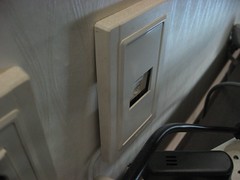
The engineer arrives and hacks away at one of the wall sockets behind the TV in the lounge. By the time he's finished a wire will run out from under the plastic housing which from experience I increasingly believe must be the method taught in Korean schools and universities. Later, the plastic cable shielding is dispensed with entirely in order to split the underlying wires off in different directions.


And then our phone comes out of the box, along with a large block of moulded plastic which I quickly surmise from the holes in the back is a four-port router. Interesting, I think to myself – because our current 'Anygate' router is in our office and it seems to have a wireless reach of about 15 feet in our apartment, although it really needs a clear line of sight to work well, despite its six inch antenna. By coincidence, six inches is about the distance my Samsung NC10 likes to be away from the router to get a good connection. Perhaps our apartment has thick walls, bad atmospherics and radio spectrum interference.

The new router transpires to be wireless, for the phone – prompting my first question – how can we turn it off? You can't. I suppose that follows – because it's needed for the phone, and I guess you'd expect to have that on all the time. But now this isn't looking like such a good plan. My computers run a mix of Ubuntu Linux and Windows, the latter being a reluctant necessity for some of my trading systems and Korean Internet banking. I try to aggressively protect our IT infrastructure because computer problems cost money in my line of work, and our office router has the longest possible encryption key and its wireless networking switched off when not in use. Then along comes our new Internet phone and suddenly we're broadcasting to all and sundry.

My next question, translated into Korean, is 'will this frak around with our office network?' So the engineer suddenly enters our office and walks up to my computer before I realise what he's doing. He predictably fails to recognise that I already have a browser window open on my Windows machine because it's sitting inside a VMware window running Ubuntu, but he does win points for recognising the Firefox icon and immediately starting it up. “This country is changing”, I thought – back in 2007 when I presented an earlier KT Internet engineer with a Firefox window so he could check something he practically panicked. In fact, I'm not sure he understood that you don't need Internet Explorer to access the Web.

Personally, I might have turned off the phone at night, because apparently we're keeping the old landline phone, and we all have our mobiles turned on 24 hours a day anyway since this is how we communicate with each other in the apartment. Yes, we're just another Korean cellphone family.

So the router has a password written on the back. It can't be changed. It's four characters long. Four. But hey, I write sarcastically, at least it's a mix of letters and numbers. As a British computer science graduate, I often wonder what they teach computer science undergraduates in Korean universities, because it certainly doesn't seem to be computer science and it certainly isn't common sense either. This Windows-ActiveX obsessed country frets about the risks of cyberwarfare from North Korea and, realising that hardware is becoming increasingly commoditised and made in China, it wants to become a 'global software hub', even though it's kind of hard to base your economy on intellectual property when your citizens think that software piracy is practically a human right. There are a lots of things I like about Korea, but with my background, software and IT security aren't among them.

Every week I go to Busan e-FM and recently they've moved to a new location. They are now housed in a building belonging to the Busan IT Promotion Agency. I wish them luck.
Apparently, our new KT Internet phone can call other KT Internet phones for free. But not SK or LG phones. So if we say it's VoIP, it's a very broad definition of the term because it's only really useful in the walled-garden of our provider; as I understand it otherwise the charges are comparable to normal. But, allegedly, you can buy another KT Internet phone for 30,000 won, take it or send it overseas and plug it into an obviously non-KT connection, and still phone other KT Internet phones in Korea for free, which is quite handy if true. Whether it's really worth potentially compromising your network security over however, is a question only you can answer.

Wednesday, June 23, 2010

Not Necessarily the News

The first time I lived in Korea I tried to learn the language and understand the culture I was faced with every day, but I didn't have the time to develop an understanding of some of the wider aspects of society that fills the newspapers every day, and I wasn't expecting to stay. I found this decision made Korea more enjoyable for me, because I didn't have to read about politicians arguing every day, the crimes and wider social problems afflicting the country, or endless celebrity gossip.

The second time I came to Korea, it was with every chance of staying here for much longer, so I knew I had to start trying to understand the country I was living in at a deeper level. I started making the effort to go through the newspapers every day. One of the suspicions about Korea that was confirmed by doing this was the precarious state of online security. My anecdotal experience suggested that most people used pirated versions of Windows, everyone used Internet Explorer (even though it was so troubled other Governments were issuing advisories to people not to use it at all), and ActiveX was the basis of all online banking. Firewalls and anti-virus software were optional, and resident protection systems almost unheard of save for odd anti-virus and anti-keylogging applications which tended to load for the duration of an online banking session. You are often out of luck functioning on the IE-centric Korean web if you choose Firefox, let alone an entirely different platform such as Linux or MacOS.

So I discovered that at least there is a growing debate about the state of online security in the media, with some blame even being attached to the security companies themselves, and the Government is making noises about making changes. It's a potentially important issue, because South Korea may be wide open to a coordinated cyber-assault - there have already been a significant number of isolated attacks, and given the nature of the tensions on the peninsula, an enemy may gain an advantage by disrupting communications in the South immediately prior to a military attack.

But despite the increasing media debate, ironically it appears that sections of the media have fallen victim themselves, by proxy if not directly. Last week Google Chrome started blocking The Korea Herald, followed by national broadcaster, KBS. Later, even Firefox - which is generally more tolerant or ill-informed of such issues, started blocking the Herald website. Since then, access has been sporadic. Could they be false positives? Well, this is what Google's diagnostic page had to say about koreaherald.com:

Of the 1875 pages that we tested on the site over the past 90 days, 81 page(s) resulted in malicious software being downloaded and installed without user consent.

Malicious software includes 99 scripting exploit(s). Successful infection resulted in an average of 4 new process(es) on the target machine.


Which sounds concerning, even if the chances of ending up with four new processes - doing who knows what - on your computer are limited to about 81 in 1875. And the main problem seems to be not the koreaherald.com itself, but code from other domains which koreaherald.com acted as an intermediary for. It may have been advertisers. None of which is any comfort if you fall victim to it, and it truly is malicious.

Tuesday, April 06, 2010

The Republic

Quis custodiet ipsos custodes?

My wife and I are members of a newly formed social group in Busan. There are a lot of groups like this in Korea variously meeting up for cultural activities, going out and engaging in charitable activities. The new group plans to do all three.

In a culture where there are reckoned to be two million Internet addicts, inevitably there is an online forum for members, and I felt obliged to participate. Because the forum is run by Daum, one of the Korean Internet oligopolists, it isn't possible to just register by creating a user name and password as you might expect to with an equivalent Western web site. Instead, it's necessary to submit a full national ID number, or in the case of foreigners, the ID number from their 'Alien Registration Card', along with a full official name as per one's identity documents.

In other words if I'm to fully participate in Korean society, which these days is in no small part conducted online, I must forego my anonymity and potentially associate my name with every aspect of that life, with all the loss of privacy and potential for governmental profiling that this entails. Is the Korean Government spying on its citizens, and casting a worryingly wide net in doing so? Quite possibly.

After I entered my identity number and full name, I then needed to authenticate my online identity with the Government's 'identity bureau', either by mobile phone, by verified banking digital signature, or by entering my credit card details. My mobile phone is in my wife's name for simplicity, ruling out that option, my banking key turned out not to work with the Government's badly designed software even though it works with my bank, and I wasn't thrilled about handing my credit card details over because I don't really trust them with it. But, I had to go with the latter option. It really didn't seem worth it but I took the view that sooner or later I was going to have to let the Government's computers open a file on me so that the software can, in principle, start building up the evidence that I'm anything they later accuse me of.

The other problem with joining is that now I feel obliged to participate in online conversations - but even though the main method of communication tends towards Twitter-like brevity, even then trying to construct the Korean takes me a long time. Still, it all helps with the language study, and in the end it's probably an inevitable part of the process of integrating further into Korean society.

Sunday, November 22, 2009

Off Screen

We travelled all over Busan looking for a television, but it rapidly began to feel like there were only three types of stores - the official manufacturer outlets of Samsung and LG, the second-tier electrical stores Hi-Mart and Etland, and the third tier volume discounters E-Mart and Tesco Home plus (sic). And this pretty much summed up the price differences as well, so inevitably it wasn't long before we had worked our way down the pricing scale and were honing in on buying from 'Home plus'.

Not that price was in any way a fixed concept as it turned out. It's understood where I come from that while there is some scope for negotiation in the large 'high street' electrical chains, it might be considered lucky to shave 10% from the advertised price - and negotiating in a Tesco supermarket is normally out of the question. By comparison, it didn't take long to realise that the prices on the store stickers in Korea bore no relation whatsoever to the price one might actually be expected to pay, with staff discounting the advertised prices by up to 40% without batting an eyelid. It reached a point where I started mentally discounting everything I saw by 30% as a rough guide before converting it into British Pounds - which I'm still given to do in order to consider its attractiveness, and we rapidly learnt to enter a store and immediately ask what the 'real price' of a particular model was

Presumably having sticker prices which bear no relation to the actual price is meant to encourage the notion of having found a bargain in Korea, but I just found it annoying; every now and again there would be a price that would look genuinely good, but the staff would go on to explain that as this was a special offer they could only discount a little from the sticker price. If there was consistency in advertised pricing and the discounting, it would have been much easier. I was left wondering what the point was. At least it explains why Samsung and LG TVs appeared to be more expensive in Korea than the UK - something which has always mystified me; they probably weren't - it just looked that way. Hefty discounting was rampant from the manufacturer's branded stores down to the likes of 'Home plus'.

There's another thing which they all had in common - the range of manufacturers to choose from - Samsung or LG. Yes, you might spot the occasional rather neglected-looking Sony Bravia LCD here or there desperately trying to undercut the domestic brands - but otherwise, you were choosing one or the other. Confusingly, not that Samsung and LG TVs are actually branded Samsung and LG. No, on the whole, for Samsung read PAVV, and for LG read Xcanvas. You might very well wonder why, when you've invested a considerable amount in creating brand names like Samsung and LG, you'd want to hide it from your products, and so do I, but that's the way things are here. LG is Xcanvas for TVs, and DIOS for refrigerators, whereas Samsung is PAVV for TVs, Hauzen and Zipel for refrigerators, and so on. I'm sure there's some method to it, and to be fair I can see it creates the (false) sense of living in a more diversified society with more consumer choice, rather than a two-horse town (as my American cousins would call it) or more appropriately, a duopoly. And perhaps, if you're living in a rather shoddily constructed LG apartment block (for instance), you might be less motivated to go out and buy an LG TV because there's that logo again from your ill-fitting window frame (yes, I do live in an LG-built apartment block and yes, the logo is everywhere).

If by some chance we wanted to live the LG life any more than we already did, we could buy an Xcanvas LCD with a built-in 'Time Machine' hard disk and IPTV system to deliver video on demand. In principle, this seemed like an option because we hadn't yet decided which cable TV provider to subscribe to. However, this was discouraged by one particularly knowledgeable and younger store assistant, who pointed out the redundancy of paying for video on demand when 'everything is on the Internet (in Korea) within fifteen minutes of it being broadcast'. Good point.

Everything may be on the Internet in Korea, but surprisingly, shopping for TVs online proved more complicated than in the UK, where it is a given that the likes of Amazon, Play.com and Ebuyer would offer the best prices. Yes, there are large 'online malls' such as Auction and Gmarket, but these really serve as venues for a style of peer-to-peer trading which has more in common with the eBay model. Consequently, there are real trust issues involved, and potentially scant protection from fraud in a country that - as far as I can tell - thanks to the power of the Chaebols was never big on consumer rights in the first place.

So when we chose to buy our 42" Xcanvas LCD from 'Home plus', it was in the full knowledge that the cheapest Internet price was almost 15% less. As it turned out though, it was about this time that our friends who were getting married wanted to buy a TV for their new apartment, and through a personal contact of theirs who worked at a 'Home plus' store, coupled with an additional discount for buying two TVs together, we actually ended up getting a better price than on the Internet. Buying locally also meant that we had an engineer come round from the store and set it up and test it for us, which might not sound like a big job, but did involve the annoyance of extending an existing TV socket which saved us some work. He gave us his card before he left as is the norm here.

And as it turned out, for the first time we actually came to use one of these cards for an after-sales enquiry. Our three-year old PCs don't have HDMI outputs, but I did bring a DVI-to-HDMI cable with me from the UK, which I'd been using to link to a TV there. Since DVI doesn't carry sound, this requires an additional audio cable, but I was unable to get this working with the Xcanvas. The engineer was able to suggest a solution over the phone which worked. Another win for Korea's customer service ethic. So once again we are able to watch Hulu properly...

Saturday, July 26, 2008

Che Guevara

"Police arrested two communist activists, Kim Yong-Chan and Kim Jong Gon, on 11 July 2003 for possessing books about communism and for downloading from the Internet material including Karl Marx’s Communist Manifesto." - Reporters Without Borders

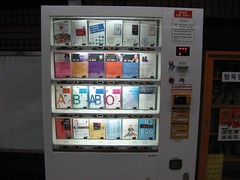
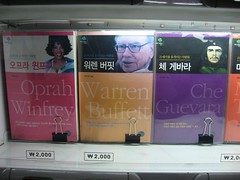
So what are the chances of finding the thoughts of Marxist revolutionary Che Guevara in a subway station book vending machine between legendary investment guru Warren Buffett and Mother Teresa? If you thought "not high" then think again:


But don't take this to mean that Glasnost has broken out in South Korea, because when I left two months ago my Internet connection was still being censored.

So how does Che end up in a South Korean subway station? Perhaps it's an oversight, or perhaps the material does not fall under the definition of 'books about communism' which need to be banned by the democratic Korean government, or perhaps they just think it's a story with a happy ending. Alternatively, it may be a manifestation of geography.

Many Westerners have been surprised to learn of the existence of the Hitler bars that once appeared in this part of the world, but Nazism happened a long way from Korea and arguably it was really someone else's problem. Recently in my own country, there was a case of an elected public figure who was wrongly alleged to have participated in a Nazi-themed orgy. Before the judgement was handed down there was considerable public revulsion and a confidence vote was held within his organisation in which, it was suggested, European members voted against him and Asian and African members voted in favour. Certainly, anecdotally I'm aware that Korean people didn't necessarily see the matter as being of any great significance. However, when I hypothetically asked how they would react if a public figure in their country was accused of dressing up as a Japanese soldier and performing acts with 'comfort women' an entirely different attitude emerged.

I should add though, that if there is a historical and geographical gulf of understanding between myself as a Westerner and Korean people, it's not simply an inevitable division along racial lines; my family was selling a piano some years ago and the elderly gentlemen who eventually bought it for their club initially phoned and opened up their conversation with the question "It's not Japanese is it?" They'd been in Singapore during the war.

Personally, while Che Guevara didn't make the wall of my student flat back at University, unlike those of quite a few of the people I knew, I'd still like to think my book-vending machine discovery is a positive sign of progress in Korea.

Wednesday, April 23, 2008

Network

We never did get around to having our two 100 megabit connections installed in our new apartment, because the requirement to lose our standard landline in favour of an Internet phone proved too problematic. In any case, our work is winding down now as we prepare to leave Korea next month, so our requirement to have a backup connection diminished.

But the preparations for leaving threw up an unexpected Internet-related problem. During my time here I've taken around five gigabytes worth of photographs and sixteen gigabytes worth of videos, which amongst other things I'd much rather back-up somewhere safe on the Internet as opposed to trusting to carrying with me on numerous DVD-ROMs or an external USB hard drive. I'm also not happy that border officials in various countries now seem to have the right not only to search through one's baggage for dangerous items, but also to search through one's electronic devices for dangerous ideas.

Encryption, of course, is no barrier to search since there are precedents for passwords being demanded. Personally I object to governments rummaging through my private life on paranoia-fuelled fishing expeditions, so on principle I'm committed to keeping as much of the detail of my dull and largely uncontroversial life out of their hands as possible if only to avoid being held up by immigration officials. Perhaps that makes me the paranoid one, but having spent over six months embroiled in a legal battle with the British Government, my relationship with my government is not exactly a happy one these days.

After some fairly exhaustive testing of various online backup solutions, I came to the conclusion that none of them actually seemed to work very well. Yes, various services were ruled out because they lacked features or added annoyances, but fundamentally they all had one thing in common - they were very slow, some incredibly so. The fastest option I found was via improvised 'Google Drives', either via 'shell extensions' or Firefox addons, but there are bandwidth limitations, and such techniques are beyond GMail's terms and conditions so continue to exist at Google's whim. My preferred commercial option, Amazon S3 in conjunction with Jungle Disk, could apparently only transfer files at 32kbps per second, which meant the 36Gb's-worth of files I wanted to back up would take 128 days of continuous operation to complete.

I never suspected a problem with my ISP, because the 'GMail Drive' transfer was quick enough, as were my uploads of large amounts of files to YouTube and Flickr. But eventually I was directed to try Speedtest.net to do some testing. The results were consistently poor - LG Powercom might have decent download speeds, but uploading outside of Korea seemed to be a real problem. I could only surmise that my fast speeds uploading to the likes of Flickr and Google might be due to the variability of various servers or the possibility that unlike my backup servers, Flickr and Google were benefiting from directing me to more local servers behind the scenes. I'm not a network engineer so I don't know, but either way, what it certainly did mean was that I couldn't realistically use Amazon S3 or any other backup service I'd tried.

So I took a chance on dumping LG Powercom in favour of Korea Telecom's (KT) MegaPass service, which I hoped might have better international connectivity by virtue of being owned by the national telecomms company. My wife phoned LG, and the operator told her that KT wouldn't be any better when the reason for leaving was given. When that tactic didn't work, we were offered a permanent 15% discount.

We had to take the chance though, and fortunately KT didn't disappoint. While it doesn't consistently beat LG Powercom in every area, there's no doubt that upload speeds are vastly in excess of anything LG could provide. The results below are inevitably snapshots of the two Internet service providers (ISPs), but I tested both more than once at different times, and I'd say these offer a consistent picture of the differences.


The above results notwithstanding, it's hard to say whether this really matters to a foreigner choosing an ISP in Korea. I used LG Powercom for a long time ignorant of its poor international upload speeds, and while there's little doubt in my mind that KT's Megapass is faster both technically and noticeably in actual use, the reality is that the download speeds they provide are so fast it's questionable whether it really makes a great deal of difference. Upload is another matter, and while I only took to undertaking formal speed tests fairly late in the day, I'm satisfied that the problems I experienced with various services for two months before the realisation, suggest that LG has been poor in this area for weeks if not months. In other words, it is not just a recent technical problem which is causing the slowness, but rather a more permanent infrastructural issue. I'm also mindful of the fact that when we experienced some routing issues with LG last year, that it transpired that the connection from Busan was quite likely inferior to the one from Seoul, so the LG Powercom upload problem may not manifest itself to the same extent in the capital.

As for Amazon S3, I'm now uploading twenty times faster at around 640kbps, which maybe still isn't that great relative to what the above tests suggest could be possible, but at least it reduces my backup's total upload time from 128 days to 6.4. Meanwhile, LG have lost a customer and I'm afraid on this experience I'm not likely to be back even if I return to Korea at some point in future.

Monday, February 04, 2008

When Eight Bells Toll

Being stock market traders, it's quite important that my wife and I have two Internet connections, so there's a backup in case of a problem with the first. In our old apartment, we'd started out with a 10 megabit cable connection from LG Powercom, but persistent problems had led to us installing 8 megabit KT MegaPass via ADSL. Later, KT offered us a great deal on their Video-on-Demand (VoD) Mega TV service, so we may have only had a one-room apartment, but in technology terms, we were living in some luxury.

There was a problem though. The ADSL modem started dropping connections regularly after Mega TV was installed. It seems the set-top box didn't have its own modem, so the wire had to be routed to it via the modem sitting on top of my computer. I don't know whether 'noise' from the VoD traffic was interfering with traffic heading for the computer, but either way, it resulted in my losing streaming connections, and while one of my trading platforms simply waited for data to resume, another, which you can tell from the interface design was probably written by a bunch stoned university drop-outs who'd never placed a trade in their life, tended to log out or crash horribly. We talked to KT and their engineers did admit they'd had other Mega TV customers with drop-out problems - but none as much as us. Then again, probably none of them are running streaming services ten hours a day to notice, although I suspect you'd soon see the problems if you were playing Kartrider. Anyway, the upshot of all this is we are a bit dubious about Mega TV now.

Because the new apartment was only built four or five years ago, LG told us we were able to upgrade to a 100 megabit connection, and in a twist of Korean Consumer Economics which would probably strike any foreigner as bizarre but now no longer quite surprises me, it would be cheaper than our 10 megabit connection. In fact, we couldn't have 10. It was 100, or nothing. KT told us the same thing, and it was cheaper with them too, so the upshot of this was by the end of the day we expected to be sitting on two 100 megabit connections. There may be things about Korea I don't like, but any country that can give me 200 megabits worth of Internet capacity for around £30 ($55/60,000 won) a month can be forgiven for so many other things.

To give a perspective on speed, a 10 megabit connection allows you to download a 5Mb (megabyte) music file such as an MP3 in about four seconds. A 100 megabit connection means the same file in 0.4 seconds with a theoretical maximum speed of 12.5Mb per second.


That said, we have a Linksys WRT54GC router, and our LG engineer told us it only seemed to be able to handle speeds up to 30 megabits. As far as I knew, it was rated up to 100 megabits, but I guess that's something to look into and figure out later. It's a shame to lose 70 megabits of capability just because of that.

And we discovered another problem. The LG Engineer told us our apartment has '8 lines' coming into it, and the 100 megabit connection uses up four of these 'lines'. But, the same would be true of KT, so while two 100 megabit connections would give us more bandwidth in our home than some small British data centres run their businesses with, we wouldn't be able to connect up a phone. So the LG engineer went ahead with his installation, and when the KT engineer turned up, she had to be told just to connect up our KT phone - we'd have to work out what to do about their Internet service, and Mega TV which relies on it, later.

But with some further investigation it transpired that we could have an Internet phone, which to all intents and purposes is like a normal phone, though it requires a special handset which presumably can talk to the network using Internet communication protocols. Initially we were told that we'd have to have a special number, but then that we could bring our old number with us after all. So, it seems our problems are solved. The Internet phone handset is going to cost us about £48, but cancelling MegaPass and Mega TV is going to cost £72 because we can't fully cancel the contract early. When we originally agreed to the two year contract - part of the Mega TV launch deal - we didn't know whether we'd be staying in Korea or not, but if we were allowed to return to the UK, we'd planned to move the service to Korean Mother's apartment. Now she's moved in with us, that cunning plan has come somewhat unstuck.

Hopefully, we'll sort out our problems with KT, get Mega TV installed again, and have a backup Internet connection for our work once more. And, as my old cable company back in the UK impresses people with its plans to upgrade its top service from 20 megabits to 50, I can return home and tell of far away lands where 100 megabit connections are... ubiquitous.

Friday, October 12, 2007

Thoughtcrimes

"Bad laws are the worst sort of tyranny." - Edmund Burke

In my unceasing attempts to extract my own surplus value, I trade stocks and occasionally invest for the longer term. Last week's unexpected détente between South Korea's President Roh Moo-Hyun and North Korea's Kim Jong-Il raised the possibility that there may in fact be peace in our time after all, which in turns means that my previously mainly dormant North Korean investment otherwise known as Aminex might wake up from its slumbers. This only seemed to be further confirmed by the announcement that oil exploration had been one of the summit discussions. And there was me thinking that these meetings mainly degenerated into arguments about who sits where and which country makes the best kimchi.

When I saw another news story stream though my Dow Jones newswire it seemed like another piece of good news - the North Korean News Agency was reporting that the US was lifting sanctions against them (there is a bit of a reality distortion field up there though). Since the 'news' was nothing more than a headline I tried to go to the Agency's website to get some more detail, and was confronted with this:


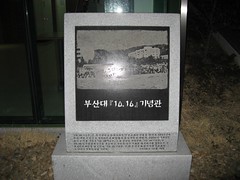
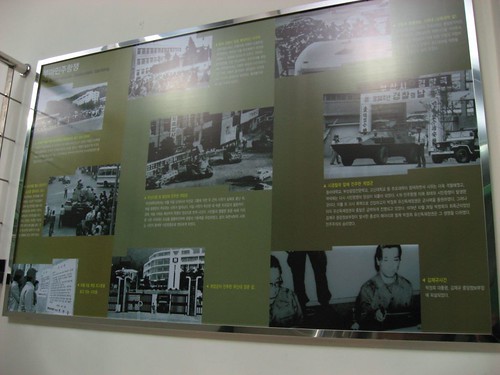
And what this basically means is that you can't access the North Korean News Agency's website because South Korea is the kind of democracy where freedom of information is controlled by the government. Although to be fair, this seems to be something of a developing trend globally in some of the world's oldest democracies which should know better. But it wasn't so long ago that I was in the '10.16' Building on the PNU Campus which commemorates a failed student uprising against the military government 28 years ago. It seems that when freedom finally arrived nine years later it came with a large dose of realpolitik built in as far as the North was concerned.


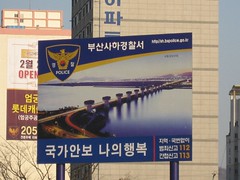
Last time I had a problem accessing this website I was using LG Powercom as my ISP and simply couldn't load the page, but I couldn't load a lot of pages, so I wasn't certain whether it was by accident or design. Later the North Korean site became available while some other sites, including that other well-known hotbed of Marxist radicalism, Barclays Stockbrokers, got blocked, so I had to switch to Korea Telecom's MegaPass service. Evidently, this is the very obvious way they deal with information the National Police Agency and Korea Internet Safety Commission don't approve of. But it begs the question why one major ISP is trying to censor the site while another wasn't (unless it was a mistake - the site is now inaccessible again via Powercom). Whatever the case, surfing around the web and suddenly being confronted with a warning messages with the National Police Agency logo on them is the kind of more associated in the popular mindset with China than South Korea.

One of the concerns over the Irish Aminex is that the day may come when the relationship between North and South will become strong enough that in a burst of national pride both governments will conspire to ensure outsiders are kept out, and that in some way the company's contract will be declared null and void, despite being made under Swiss law. I think anyone who's spent time in Korea knows what the score is as far as social and economic protectionism is concerned, so I'm under no illusions over what may eventually transpire. On the other hand, the continued blocking of what the North Korean government have to say may tell us a lot about how deep rooted the mistrust between these countries are, and it cuts both ways because by some accounts defectors from the North are so indoctrinated and traumatised by their experiences that they have huge difficulties integrating into Southern society. There may be a very long way to go before the Koreans can truly call themselves one people again, if they ever can.

Korean tags: 북한, 범죄, 자유, 정보, 경찰

Tuesday, August 14, 2007

TRON

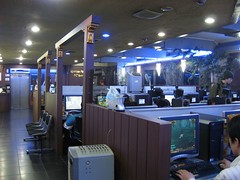
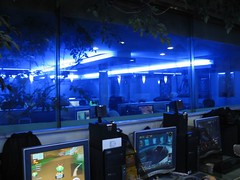
It may or may not be the case that once upon a time Korea's multitude of PC rooms, known as PC Bangs ('bang' is Korean for room), were used for surfing the Internet and doing a spot of word-processing, but if they were those days have long since gone. These days, PC Bangs are basically video game rooms. That said, you can still find some of them that are willing to do something as old-fashioned as print out a document for a price, although based on my experience these are few and far between. And even then, the one we found doesn't have copies of Microsoft Word on its computers so we are reduced to printing out using 'Word Viewer'.

Because of the work generated in preparing our appeal against the decision to prevent myself and my wife returning to the UK, we've been at the PC Bang that prints a number of times of late, and I've begun to realise that these places are full of people no matter what time or day it is, shattering my illusions that they might be quiet during weekdays, when people are supposed to have jobs to go to. That said, I gather that PC Bangs are favourite haunts of Korea's unemployed.

As we were struggling to persuade a computer to print out a document to a networked printer the other day, I couldn't help but note that the guy sat next to us was well into ajeossi territory - mid-40s would be my guess - which admittedly is not your typical demographic in a PC Bang. But what was typical was his choice of game - an online 3D game which may have been Counter-Strike or something called Special Forces which seems to be popular here - with copious amounts of weapons, violence and blood. Perhaps they help deal with the psychological trauma stemming from the National Service which Korean men have to do.

I couldn't help thinking that something about this picture didn't fit, which I suppose is my prejudice of seeing video games as predominantly an activity for young males. On the other hand, it's a distinct possibility that a good number of today's Korean PC Bang and patriot-gaming generation are going to get older and keep playing - so perhaps our 'ajeossi' neighbour was in the vanguard of a subtle Korean social revolution. If I come back here in thirty years will the PC Bangs be full of grey gamers? A possibility. It probably beats what appears to be one of the most popular activities for old people in Korea at the moment, which is hanging around in parks keeping out of the way of family members and waiting for the end. It's common in this day and age to see disaffected youth as a 'lost generation', but in high-tech Korean cities which have long-since forgotten their recent heritage, I'm not so sure it's not really the elderly.

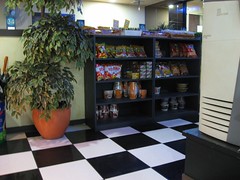
Our PC Bang of choice also features another tell-tale sign of Koreans' determination to stay here far into the future - beyond the inevitable drinks machines they sell snacks. We're not just talking chocolate bars and packets of crisps/potato chips here, because with the addition of hot water or the microwave you've got a complete noodle or rice meal in a tub. And as we regularly struggle with the mysteries of network printing a steady stream of haggard looking gamers make their way to the only female to be seen - the one behind the counter at the entrance - to buy what sustenance is necessary for another fix of murder and mayhem. I suppose it really is like being in the army. Predictably, I've never seen a gamer browse for their lunch. Leave chair, walk north to food counter and take nearest object, return to chair, play and eat. It's no wonder every so often, gamers die of exhaustion in these places.

Had Einstein been alive today, it's possible that he could have cited Korean PC Bangs as conclusive proof of the theory of relativity, because it appears that the measurement of time is not the same in a PC Bang as that which exists outside in the real world.

Korean tags: , 아저씨, 인터넷, 비디오, 게임, 음식

Saturday, July 28, 2007

Firewall

Of all my experiences in Korea, one of the more frustrating has proven to be the long-running saga of our Internet connection; despite this country projecting itself as something of a high-tech paradise the reality of life under LG Powercom has been one of routing problems and downright failures of varying durations. After our cable modem was replaced back in February, there was an improvement for a time, but lately we've been losing connectivity sporadically, and one of the websites which became permanently inaccessible was that of a stockbroker in the UK I happen to use, and that escalated it from an irritation into a major problem.

So having exhausted my own investigations into the issue, my wife phoned Korea Telecom (KT) yesterday morning to have their allegedly 8Mb MegaPass ADSL service installed. Meanwhile, LG offered to come around to troubleshoot their existing 10Mb connection. Early afternoon, both engineers phoned us to confirm the directions to our apartment and we faced up to the slightly awkward reality that they would arrive within minutes of one another. Sure enough the KT guy had barely sat down to start fiddling with our phone socket before the LG representative appeared. I think had it been in the UK the two engineers would have talked, but aside from one of them asking the other to move his computer at one point there wasn't even eye contact - maybe there was some genuine sense of rivalry under the surface.

Our KT engineer had me up and running at 6.5Mb (unsurprising as we're not sat on top of the exchange) within twenty minutes, and he was gone, a mere four hours after our order - when customer service is good in Korea it can be truly excellent - I know someone back home who's having to wait for two weeks for a large provider to come out and fit her connection, and it's not uncommon. Even better, the unfortunate clash meant that our LG engineer got to see our troublesome website loading up unhindered on his competitor's system while we enjoyed a quiet moment of triumph - though I did feel terribly sorry for him at the same time.

What was really intriguing though is this. LG Powercom's main office in Seoul told us on the phone that they could access my stockbroker's website. But when the engineer failed even with his own computer he phoned his office in Busan to be told that they couldn't either. When we'd phoned KT in the morning to place an order for their service, an knowledgeable-sounding employee told us that he suspected that LG filters sites outside Korea and sometimes innocent sites get wrongly tagged as being against the Korean rules in some way, and are then caught up in the block-list. I thought something of this nature might be the case because I could 'traceroute' through to the site in question but all attempts at direct web access (i.e. without using a proxy server) failed. The fact that the LG network operations centre in Seoul probably sits above this filter but the one in Busan doesn't fits with what happened, but Seoul denied they were operating such a list. By the time our LG engineer left though, he wasn't so sure that what they were telling him was true.

So we now have two Internet connections, even if it's something we should have done months ago, the KT engineer has the story of how they put one over on their rivals LG, and the LG engineer has a small conspiracy to unravel.

Korean keywords: 아파트, 인터넷, 엔지니어

Tuesday, February 13, 2007

Mixed Signals

About eighteen months ago I joined the South Korean government in generally investing in the North, by buying shares in a small Irish oil explorer called Aminex that had just announced the signing of a deal with the North Korean government, under Swiss law, which would open up areas of the west and east sea for prospecting. At the time, it looked as though the North was toying with the notion of going down the Chinese road of economic development and possibly even opening up accordingly. The first step was the kind of energy development the North needed, not to mention the potential for dollar earnings that might come from any significant oil discovery. The idea wasn't fanciful - the Chinese were already operating fields to the west of the peninsula which were considered to be part of the same geological structures.

Of course, as things turned out, the US started to turn the screws on the North's overseas banking operations and North Korea decided to put its energies into building bombs instead. So having bought Aminex at 9 and watched it rise to 50, I spent the next nine months watching it drop back to 18 even though during the interim we all wrote off the North Korean dream and got excited about East Africa instead. From time to time as North's government blew hot and cold we'd check the various pronouncements from the official news agency's website - trying to read between the lines to work out whether we were ever going to see any progress on that part of our investment.

When I came to South Korea I discovered after a few weeks when I came to follow a link to a story on the site, that I couldn't access it. At first I didn't know whether this was by design or accident - I've written before about the inability of my ISP, LG Powercom, to connect to several websites I frequent such as financial site Citywire and shopping site Quidco, both of which are not noted for their views on Marxist ideology. A brief search revealed that I wasn't the only one with the problem, so it seemed that the inaccessibility was not an accident.

I found a couple of Korean proxy servers to route through so that I could access the daily round-up of broker recommendations for various UK stocks on Citywire, but of course, that didn't solve the News Agency problem. Over the weekend I really wanted to know what they were saying, so I finally got around to installing Tor, Privoxy and Vidalia to discover a very matter-of-fact report on the delegation leaving for China. There was no rhetoric or vitriol - and I thought it highly significant. As a deal appeared to edge closer yesterday, I altered my position on Aminex accordingly.

There's a lot that could be said about this whole business because the implications about life here are profound but of course, I really can't. But here's a fascinating footnote to this story. The North Korean News Agency website, which was still blocked as late as Sunday is now accessible through LG Powercom with no proxy servers to route around the firewall. So maybe this deal, which honestly I thought would probably only be good for a few months before another breakdown, really is the start of something new. Maybe, at least.

Saturday, February 10, 2007

Patriot Games

We have a lot of TV channels in the UK, but I think it has to be said that after the first twenty or so, it's niche, long-tail and lowest-common denominator entertainment all the way. So I admit, an entire channel of consisting of "The World's Scariest Police Chases" seems like overkill even if it's your thing. But despite the fact that a lot of people in the UK play video games, there's no games channel and I can't even recall ever seeing a specific gaming programme beyond an old TV show called Gamesmaster which was pulled off the air in 1998.

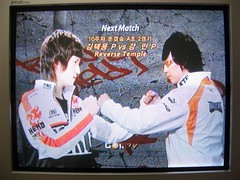
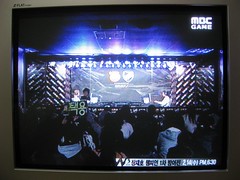
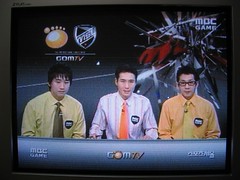
The Korean cable TV service we subscribe to for 5,000 won per month (about £2.72) in our apartment building is a fairly standard one which a lot of people have. Out of approximately 60 channels, three are video game channels, and a couple of the others feature hours of video gaming during the night. If you weren't convinced by the PC Bang experience already, this should tell you a lot about the prevalence of gaming as an activity and subculture here.

In fact though, merely labelling them as gaming channels doesn't really explain what they are. Their focus is online gaming, and the standard programme consists of tournaments between individuals and teams. Serious and haggard looking - and almost exclusively male - youths with slightly wild or vacant eyes hunch over their screens while commentators provide a running dialogue on the action. Meanwhile a crowded audience watches almost as intently. Girls scream when they show the players up close on the big screen. I never really thought of video games as a spectator sport, or gamers as high-school pin-ups, but here it is.


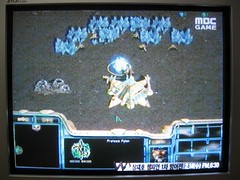
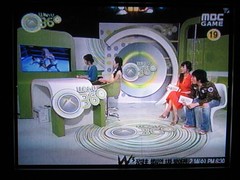
Oddly enough, three months of flicking through the various TV channels would lead you to the conclusion that there are in fact only three online games played in Korea. World of Warcraft, Starcraft and some first-person-shooter Doom-variant I've never really identified. I actually dubbed one of the channels 'World of Warcraft TV' in my mind because as far as I can tell that's all they ever show. In fact, I know from my own experience playing the hugely-popular Kartrider that there are others, but I've never seen any coverage of them. Very occasionally ordinary multiplayer games make an appearance, so I've seen coverage of a basketball game a few times and last night, bizarrely, a women's wrestling game on the MBC Game channel - with female gamers - rated 19 - adults only (note the logo in the top-right of the screen!)


I couldn't honestly say what the specific content of the Korean gaming channels is beyond coverage of the Korean World of Warcraft League and 'Star League' as I can't understand Korean, but Arirang - the English-language and ever-so-slightly foaming at the mouth Korea-to-foreigners channel (slogan - 'Korea for the World, the World for Korea'), started showing some of the tournaments late at night - especially between Korean teams and foreign ones. Having never played them, I just don't understand World of Warcraft or that genre of game, so I was no wiser despite the valiant attempts of the commentators to explain the battles as they unfolded, and it remains an unsatisfying spectator sport in my book - even in English. But the take home message from the game I watched was that the Korean team beat the Chinese team and there was much rejoicing which left me feeling slightly ill-at-ease.

I continue playing Kartrider because going round and round in circles as a cartoon-like figure is something I can relate to from my real life, and besides I only need another 1,000 points to lose my 'green-glove' status and progress on to the next colour (spot the sign of addiction here). Plus, now that I have Korean Windows I can actually talk with the other players in-between races - something I couldn't do with English Windows even though Korean input worked with normal desktop applications. Whether I will or not is another matter though, I can't type Korean fast enough and even if I could, I'm not sure how my nationality will go down, particularly when I'm winning...

Thursday, February 08, 2007

Live Wires

We had to phone LG Powercom again yesterday after losing our connection completely twice for ten minutes and then struggling with a sporadic link for the best part of an hour. Surprisingly, the call centre had an entire history of our calls, and when an engineer came out, rather than just replace the cable modem in blind hope, he spent a considerable amount of time trying to identify the cause of the problem, admittedly without success. He eventually replaced the modem anyway.

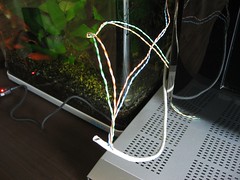
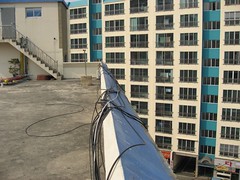
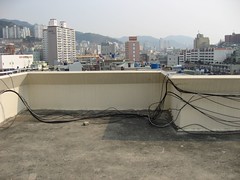
During the course of our investigations, we went to the roof in search of any potential cabling problems - and the local hub box. The cabling on the roof was a mess - the pictures here doesn't do the full horror of it justice - and it turned out that the hub was on the telegraph pole which blew up in December anyway. The question is, if it were a wiring problem, how would you tell?


I doubt it will prove to be the end of our problems, and we'll have to get a slower MegaPass connection as a backup.

Sunday, January 28, 2007

Drop Zone

While Korea might be a country that's proud of its connected society, after three months we still can't get our Internet Service Provider, LG Powercom, to provide anything more than the sorriest connection I've had the displeasure to use in years. Every now and again we phone them to ask why our connection keeps dropping, but they haven't a clue. Problems are escalated to the network team, who promise to call us back but contrary to most standards of Korean customer service never do. And when it comes to the question of why several of our favourite websites are inaccessible through their network, the only suggestion they can offer, incredibly, is that we switch to MegaPass - one of their rivals - who have no problem accessing these servers. Unfortunately though, they have us over a barrel - MegaPass can only provide us with a relatively slow ADSL connection in our building, so we're pretty much stuck with LG if we want to have a broadband connection of any kind.

In recent days connections have deteriorated further, and LG have started scheduling several hours of downtime for 'maintenance', which suggests that all is not well with them. I suppose this carries with it some hope that they'll eventually get to the bottom of their problems, but I won't hold my breath. One can only assume that LG don't do a lot of business with PC Bangs or at least have a better network backbone for them because if customers in those places had to put up with what we're experiencing I think there'd be a riot. Meanwhile, I'll have to endure the dropping connections affecting my work, while promising myself that the next apartment building we move into will be one serviced by a reliable Internet connection, provided by MegaPass, as LG recommends.

And every once in a while, there'll be yet more coverage in the UK on some amazing aspect of Korea's Internet society, and friends from back home will ask with great expectation what kind of connection I have, expecting some answer in the hundreds of megabits - but my answer is simply this - "a terrible one". Don't believe the hype.

Thursday, December 21, 2006

Korea Blog Search

Trading is winding down as Christmas approaches so with a couple of hours free I got the idea to throw this together. It's a search engine for Korean Blogs in the English language. With over 200 such blogs currently in existence there's too much to read but the search engine allows me to trawl them all for information.

Homepage link


Google Custom Search


Add to Google

Saturday, December 16, 2006

Bang the Machine

Trading has been slow for the last couple of days, so when a friend phoned to invite us out for pizza we jumped at the chance, leaving our systems to work for us while we were out. After pizza at the unlikely named Big Bowls, it was off to a PC Bang (PC room) for a few rounds of Kartrider, as you do.

I've had some brief experiences of PC Bangs while in Korea - but they've been limited so far to hanging around the entrances while my girlfriend went in looking for people. So today was my first entry into the world which so many Koreans seem to inhabit.

It wasn't quite what I expected. While the closely packed machines accompanied by the whirr of fans and the smell of CPU-heated air mixed with body odour took me back to my university days, I was surprised to find that it appeared to be little more than a glorified arcade - since almost everyone was playing a game of some kind.
Until today, I'd laboured under the illusion that people in PC Bangs were surfing the Internet, checking their email, watching videos and doing all the kind of things that people generally do aside from gaming. But it all appeared to be gaming, and in fact, to be absolutely precise, of the hundred-or-so computers, everyone was playing one of five different games as far as I could tell. Unfortunately, my knowledge of games is sufficiently limited that the only one I could readily identify was Kartrider.

When we sat down - in the smoking section to start with (there was no room in non-smoking) - a woman brought us a drink that tasted suspiciously like flat Sprite, and about as unpleasant as that sounds. There have been quite a few stories in the past couple of years of Koreans playing games in PC Bangs so long without a break for food, drink or sleep they've actually died, so perhaps this was a small concession to that. Each computer also had a very small vending machine next to it, containing nuts or chocolate for 100 won a time. It wouldn't keep you going for long though - even if you had the change.

A fascinating aspect of the place the PC Bang has in Korean culture is that by some technical means that I am not aware of, Kartrider knows that you're playing in one and whatever points you would have scored at home are doubled. Not only that, special PC Bang-only cars are available which make the game easier to play. Which all serves to put PC Bang players of the game at a distinct advantage to those who choose to play elsewhere. I understand that we paid more for playing Kartrider than had we just accessed the Internet, so I imagine there's some kickback for the company as well as the PC Bang in doing this.

The downside of playing in the PC Bang was the noise - I found it impossible to hear my own computer above the racket of all the others - and when I finally left the PC Bang, I discovered I couldn't hear properly as I'd been slightly deafened. I think if I ever specifically went there to play a game in future, I'd take some small headphones.