Showing posts with label TV. Show all posts

Friday, July 08, 2011

Busan e-FM Week 33: Humour/Humor, Satire and Ire

The english waves come inAbout 'Open Mike in Busan'

Background

In retrospect, I can’t quite believe I got to make some of these points on the radio. I love humour - I'd much rather be watching an episode of Blackadder, Community, Seinfeld, The Big Bang Theory or Better Off Ted [which inexplicably nobody watched] than Saw 6. In fact I consider my life to be one long extended joke. So I wanted to talk about the subject of humour, but I also thought it would be nice if the next generation of Koreans that largely make up the Busan eFM audience could learn to lighten up. They won't of course, life in Korea is often an extremely serious, depressing and stressful experience, and anything I say on air is a drop in the ocean - an ocean in which everyone has long since drowned. But you know what? Never give up. Never surrender.

Introduction

Last week I talked about how the Expat Internet is hell. But foreigners can be funny too, and not just in a strange way. This week I’m covering expat humour in Korea.

What's so funny anyway?

Humour is a very funny thing. What one person finds amusing, another may not. Between foreigners, there’s a difference between British and American humour for example – even the words are spelt differently. I feel that British humour is more deadpan, darker, sometimes meaner, and more surreal. I think American humour is different, but still funny.

Babopalooza in Busan

I think there’s a huge difference between Korean humour and Western humour though. My first experience of this here came in the form of an expat comedy called ‘Babopalooza’ here in Busan back in 2006. It became quite a big issue in the foreign community.

This is my understanding of it: essentially a group put on a theatre performance which made fun of life in Korea. The targets for the humour were Koreans and Western foreigners. But one of the potential dangers with cultural comedy, especially here I think, is that Koreans only see Koreans being made fun of. In fact one of the co-writers actually said the ‘babo’ in Babopalooza were the foreigners. Anyway, apparently the police or immigration officials came to watch, and allegedly the upshot of it all was that people lost their jobs and had to leave Korea, while others had problems with visa renewals. So really, it was a comedy with a sad ending.

Babopalooza happened six weeks after I came to Korea for the first time. I appreciate that public comedy performances are really tough to pull off, but the reaction to the show made me think that however nicely people were treating me, beneath the surface this country might not be a very friendly place.

I’ve seen Korean performers on TV putting on ‘black faces’ [or masks] and pretending to be black or Africans. I guess that’s – apparently – OK here [it’s not], but you can’t do that in England because it would be racist. By our standards, that’s quite nasty – not funny at all – but it’s acceptable here, whereas Babopalooza was unacceptable.

So these examples made me think that Koreans can make fun of foreigners, but foreigners making fun of Koreans is unacceptable. I’m afraid that doesn’t create a good image of Korea or Koreans [some foreigners also lean towards the view that foreigners in Korea should keep their mouths shut and just do their jobs].

Anyway, while I gather there was a lot of creative energy here in Busan before Babopalooza, after what happened – for a while – foreigners were afraid to do any public performances. Busan wants to have art and culture to create a multicultural city, but it makes me think that what they want is the Korean version of multiculturalism, where everyone thinks like a Korean. [Bazinga!]

The Line

I don’t think Babopalooza went too far, but I’m not going to pretend that other expats haven’t crossed the line. Last year a foreigner started a blog [Blackout Korea] which others perhaps contributed to as well, that consisted of pictures of drunk, unconscious Koreans. I can see how that might seem funny for a couple of moments, but beyond that I don’t find it funny – instead it’s a rather sad reflection on all the pressures in Korean society which causes this.

Some drugs (like alcohol) [Korea likes to think of itself as ‘drug-free’ but that depends on your definition] are OK in moderation, but this kind of drug abuse seems a big problem in Korea, just like it is in my country – and it’s not funny there either. But obviously some foreigners found it funny, and this shows that the problem with humour is that it can easily be one-sided and insensitive, and that ultimately it can easily slip into racism. It doesn’t have to be like that though because I think there are better and genuinely funny blogs written by foreigners in Korea.

Humorous Expat Blogs... Or What Amuses Me

I’ll tell you how I feel about expat blogs here. There are the big name bloggers which everyone reads, and they’re churning out entries for their audience, but some of the lesser known blogs here such as Expat Hell and The Supplanter feature – to my mind – excellent writing which really attracts me, and they contain a lot of self-deprecating humour. I feel I make fun of myself quite often in my blog so I suppose I appreciate that style.

But then some of the expat blogs are written explicitly not as personal experiences of life in Korea, but more for the purpose of satire, which I find especially interesting.

Satire

The satirical blogs are different to the other expat blogs, which tend to cover daily life. Wikipedia defines satire as a format in which “vices, follies, abuses and shortcomings are held up to ridicule, ideally with the intent of shaming individuals, and society itself into improvement. Although satire is usually meant to be funny, its greater purpose is often constructive social criticism, using wit as a weapon.”

So people can find satire uncomfortable, and that was the problem with Babopalooza. In fact, the Wikipedia page on satire even mentions something that happened here in Korea to the foreign journalist Michael Breen, who wrote a satirical article in The Korea Times, which resulted in him being sued for $1 million by the chaebol he satirised [Samsung]. Mike Breen said the prosecutor in his case didn’t get his satirical article, telling him “It’s not funny if it’s not true.” [comment 24].

I gathered that apparently there’s no tradition of written satire in Korea, so writing satirical material can be a dangerous activity in Korea. And yet I think it’s important in today’s world because so many people are ignorant of the news. In fact, in America surveys show that presenters such as Jon Stewart and Steven Colbert are the only way some people actually know what’s going on – even if it’s dressed up as satire.

The Yangpa, Dokdo Is Ours, and The Dokdo Times

I think the first satirical blog in Korea was The Yangpa, which presumably was inspired by the famous American satire site, The Onion. The Yangpa blog started before I came to Korea, and people talked about it back then but I must admit I rarely read it. The problem for me was highlighted by one early entry about a pop singer/actress who was guilty of plagiarism with her degree. When I first came here I didn’t understand enough about Korea to know who this was or why plagiarism was a good satirical subject, so the humour was lost on me. I think this illustrates why satire requires knowledge.

The Yangpa ended in 2008, then a site started called ‘Dokdo Is Ours’, and when the writer ended that last year, another new site started, this time called ‘The Dokdo Times’, which is essentially written in the style of a fake Korean newspaper. What I like about these sites is that they aren’t just aimed at satirising one group of people – but everyone, including foreigners. For example, the most popular ‘story’ on The Dokdo Times’ site is about a Korean woman who married a foreigner and then realised he’s actually an idiot. I think that’s something both Koreans and foreigners can relate to.

But What Do They Think?

I’m not sure what Koreans really make of this foreign humour. Despite what Mike Breen said about the prosecutor in his case, I believe from what I've read that some Koreans in Korea really find some of these satirical sites funny. [And at least one Korean comedian may be out there pushing the envelope as well]. They are a test of English as well – if you understand humour written in another language then you’ve really done well. Even when I’ve learnt Korean, I think it might still be some time before I understand Korean satire, assuming that exists.

‘Babopalooza’ was judged ‘not funny’ by the authorities, and sometimes Koreans get very angry at some foreign humour – either they don’t get it or the humour wasn’t funny in the first places and it just ended up being offensive. Comedy and satire can be very difficult things to pull off, especially in a foreign country.

Learning About Korea Through Humour

I’d say that I’m learning about Korea through humour. I read the Korean news but it’s easy to miss things or not really think about them deeply. For example, one of these recent satirical ‘news articles’ from The Dokdo Times detailed how people with three or more drunk driving convictions would be banned from working as bus and taxi drivers. It sounds like a joke but it’s actually really true, which to me is a serious issue which people should be thinking about more. Maybe if people did, the society we live in could become a better, more tolerant and less hypocritical place [or it might at least become safer].

Can Satire Change Attitudes in Korea?

I don’t know if satire can change attitudes in Korea though. Can anything change Korea? Recently I read that that Korea is the fifth ‘most socially tight’ country in the world [actually, the fifth among 33 countries surveyed, not that the Chosun Ilbo ever let a detail like that get in the way of a good headline], meaning there is a great deal of conformity here, and pressure to conform. Satire represents the opposite of conformity in many ways, because it points out the inconsistencies and hypocrisies in society. There’s nothing wrong with conforming if that’s what you want to do, but humour and satire are good ways of encouraging you to think for yourself too.

Links
Busan e-FM
Inside Out Busan

Air date: 2011-06-08 @ ~19:30
Wednesday, May 25, 2011

Busan e-FM Week 30: Family Month

The english waves come inAbout 'Open Mike in Busan'

Background

I prepare notes for my radio segment; I always felt that to be my best on the show I had to construct a narrative. Like most of the things I write, it’s more time consuming than the result appears to suggest or justify; I tend to debate each word and nuance in my head. Sometimes it turns violent. This week was a new low; the preparation time for my ten minutes on air was nine hours.

My topics are sometimes purely anecdotal experiences and while there may be deeper points to be made, the intention is primarily to entertain. But other times there are serious issues to discuss, and this seemed to be one of those times. I feel there are a lot of stereotypes of foreigners in Korea, often perpetuated by the media. One of the reasons I agreed to do a weekly slot on Busan eFM – and then sign on for a second season – was the notion that in just being out there and talking to a Korean audience – albeit one that is learning or already speaks English – it might provide more of an insight into the deeper thoughts and fears of a foreigner living here. I wanted to speak out. I think if you don’t, Korea is something which just happens to you.

But after kicking the ideas around in my mind for a long time, forming structure and writing sound-bites, I felt the result I wanted had eluded me. Writing to me feels like a game of chess, where the paragraphs are pieces and the various parts have to be carefully choreographed into a winning position. Except it’s not so much chess as blitz chess, played against the clock for suboptimal results. This week I really felt the need to win the game, but as it wore on I realised I’d forgotten how to play.

The powers that be at the station seemed to like it, but I’m not under the illusion that anyone really cares. In the end, my writing is as much about getting my own thoughts in order and understanding the confusion of contradictions that is myself, as much as it is about anything else.

Introduction

May is kind of family month in Korea, because of the close proximity of Children’s Day and Parents’ Day. So the TV channels are running lots of family-related programmes. Inevitably this includes the vaguely self-satisfied ‘foreigners integrating well into Korea’ genre of programming, and there are two main types of show – women from South-East Asian countries brought here via marriage brokers for older Korean men, and Western foreigners married to Korean women.

Reality and unreality

I find the programmes featuring the Western men fascinating. Some are obviously willing collaborators, but sometimes I feel that others have a kind of haunted look about them – the look of men who are trapped. There’s something in the body language and the tone of what they say in English. It’s a subtlety I suspect is lost on most of the Korean audience; it’s easy to focus on how well foreigner is eating kimchi or speaking Korean.

I suppose I don’t find these programmes realistic – certainly at least, they don’t match my experience. But then I’ve read a lot of foreigners talking on the Internet about their Korean lives, and these programmes don’t often seem to match their experiences either. They tend to create a positive image, but perhaps that’s not the reality. My wife actually said to me that she hopes her mother doesn’t watch too many of these shows, because they make me look bad in comparison.

Unfortunately she does watch them. In fact we were in a taxi a few ago and the female driver watched these programmes too. “Living with him must be ‘fun’” she suggested. My mother-in-law smiled, but gave no answer, which I think tells you the truth.

So I think these programmes make my life more difficult – I can’t live up to the snapshot positive image they create. I suspect that if I were on one of these programmes, even I’d look better than I am on them; I’d look integrated because I live with my mother-in-law, and now brother-in-law (again), but it’s not the reality.

It can be difficult marrying someone from another culture and living in that culture. It’s easy to feel isolated because of the cultural barriers and language barriers. There’s the pressure to integrate, to learn Korean, to conform, and it can create a lot of stress. My life’s pretty messed up really. Don’t get me wrong, I like living in Korea, but my living here is full of problems – and that’s the reality.

International Marriage Damage and Prevention

There’s been some controversy about these TV programmes in the last week, which stems from the rise of ‘anti-multicultural groups’ in Korea.

One group, the wonderfully titled International Marriage Damage & Prevention Center, plans to hold a rally outside KBS headquarters in June to urge the broadcaster to stop airing the programmes which they accuse of ‘beautifying’ multicultural families by creating ‘illusions’ about them. That’s basically the same thing I said, but the difference is that my concern is purely the portrayal on television of these relationships – I think it’s clear what these anti-multicultural groups really want is just for certain types of foreigners to be kept out of Korea.

I find it fascinating that they are mainly targeting migrant workers and imported foreign wives – not Westerners – even though we’re all part of multiculturalism here. Their argument is that migrant workers are taking away jobs from Koreans and ‘committing crimes’, and immigrant wives are coming here as part of marriage scams to ‘earn money’.

I think this ‘committing crimes’ thing is a huge clue as to where they are coming from. There’s always been a strong nationalistic streak running through Korean society, and there’s nothing wrong with being proud of your country, but there’s a narrow line between pride and hatred. The English author Samuel Johnson said that “Patriotism is the last refuge of a scoundrel”. I don’t think he meant that all patriotism was necessarily bad, but he was highlighting how common it is for people who have no intellectual argument – or no intellectual ability – to dispense with rational debate in favour of appealing to people’s fears and hatred. I think Europeans like myself are especially sensitive to this kind of behaviour because of what happened in 1930s Germany and other European countries in history. Nothing good ever comes out of trying to make an entire country irrational and angry by lying to them, and it scares me when groups start trying to manipulate people by creating fear.

All Foreigners in Korea are (Potential) Criminals*

I don’t agree with these criminal accusations. I’ve said before that National Police Agency figures show that foreigners in Korea commit fewer crimes per-person than Koreans, and it makes sense if you think about it; if you’re an economic migrant – or any kind of foreigner here – the last thing you want to do is commit a crime, get caught, thrown out of the country and lose it all. Of course, a few foreigners will commit crimes, but these groups are trying to create the fear among Koreans that all foreigners are criminals – it’s certainly the implication of the statements they are making – and that’s just simple racism.

Even though they aren’t targeting Western foreigners, we’ve had these accusations ourselves in the past of course. A few years ago the newspapers were full of suggestions that foreign English teachers were coming to Korea and spreading HIV and AIDS. This time, these hate groups are attacking ‘economic migrants’ from countries perceived to be ‘inferior’ (i.e. poorer) to Korea, which is another thing that tells you this is racially motivated.

The odd thing is if you think about it – given the poor job situation in my country and especially America, many Westerners here are really economic migrants too. It’s not uncommon to hear native-English teachers here say they can’t easily go back home because there are no jobs. But these anti-multicultural groups aren’t attacking Westerners - strangely only people from other Asian countries seem to have this stigma attached to them - although if they aren’t stopped they’ll probably come for us next.

Of course, Koreans in the U.S. have committed crimes – some very high profile like the Virginia Tech Massacre. But how would Koreans here feel if American groups started campaigning for Koreans to be kept out of the country? For that matter, people from Busan have committed crimes in Seoul – how would Busan citizens feel if groups in Seoul said people from this city shouldn’t be allowed to move to the capital because people from Busan are ‘criminals’ or only going to Seoul as part of ‘scams’. It would be ridiculous, but then why should foreigners in Korea have to be treated like this?

Fairly unbalanced

I think these TV programmes are actually part of the problem. By making multicultural families look more positive than they are they are feeding these hate groups. I don’t know if there’s a solution, but it’s clear that migrant workers have lots of problems with discrimination and working conditions, and there have been numerous cases of immigrant wives being abused and even murdered by their husbands in recent months alone. Even as a Westerner, I have problems here. Of course, these groups are probably pretending that these things don’t happen, unless they are particularly ignorant – which is always a possibility.

But perhaps if these programmes showed more of these problems then maybe – like my mother-in-law has realised, and that taxi driver hasn’t – multicultural families are not necessarily as much ‘fun’ as they are made to look on TV.

Links
Busan e-FM
Inside Out Busan

Air date: 2011-05-18 @ ~19:30
Thursday, April 21, 2011

Busan e-FM Week 21: The Korean Media

About 'Open Mike in Busan'

Introduction

Today’s topic is the media in Korea – so I’m talking about TV, radio and the newspapers.

Television

I never saw a lot of Korean TV before I came here. I’m afraid that there’s no Korean Wave in England. Of course, I’ve seen some here now. From what I’ve seen I suppose you’d say it was broadly similar to British TV, but there really seem to be three main types of Korean television programme – historical dramas, soap operas and light entertainment shows. Or maybe I have this impression because it’s what my mother-in-law always watches.

We subscribed to a big multi-channel package here, and it has a lot of American programmes. I had a service like this in England, but it’s a lot cheaper in Korea, which is just as well because really, I’m too busy to watch it. Anyway, it’s pretty difficult to work out what’s on when you have to translate the Korean schedules. In a way, the video-on-demand service seems more of a promising option, but with ours [Mega TV] the menu system is awful and the hardware is worse – it’s painfully slow, and has a badly designed remote control with poor infra-red sensitivity. Changing channels is an ordeal - you can press a number on the remote control and wait five seconds for it to it to appear on the screen, and it doesn’t always catch it so you end up on a different channel and then the whole process begins again. It can take up to a minute to change channels. You can watch a lot of programmes on TV about serial killers, but this might actually be the first TV service that can turn you into one.

When we were shopping for a new television, we also looked at TVs with a time-machine function – it’s like TiVo – essentially a system where the TV records programmes automatically. We had this in England and it was quite useful. But the staff member in the first store we went into said “Why do you need it? Just download what you want to watch from the Internet.” I appreciated his blunt assessment of the realities of watching TV in Korea, but if anything it was almost an argument for not buying a TV at all.

Television versus learning Korean

Maybe it would have been better not to buy a TV; it’s bad for learning Korean because it’s easy to end up watching American TV shows all the time. I think this is the paradox of learning Korean in today’s world. In principle, we have more technology such as computer programs, mobile applications and electronic dictionaries to assist us, but on the other hand it’s a more globalised, smaller world in which it’s much easier to stay in touch with people and the culture back home.

I imagine that twenty years ago there was a much greater sense of isolation – less television, no Internet [for the general public at least], no Facebook and no easy phone calls to friends and family back home. There weren’t the fancy toys to help in the learning process, but it was real immersion in the language and culture. Now, we can sit around in our Korean homes watching American shows and not have to learn Korean for our TV fixes.

Favourite Korean programmes

I don’t really have any favourite Korean TV programmes because my language ability isn’t good enough. But some programmes are useful, such as the game show with parents and children, guessing a word from clues. Things like that are easier to follow.

I’d heard about the e-leagues – video game leagues – here, but I’ve still been amazed to find an entire channel apparently dedicated to StarCraft. It’s even more amazing now they show StarCraft II in HD. I used to play Kartrider a lot and it was interesting to see the Kartrider competitions on TV too. We don’t have game channels in the UK.

Non-Favourite Korean programmes

What shocked me about Korean TV was the casual animal cruelty you can see. I turned on the TV once and was immediately confronted by a show showing cock-fighting – and it was an entertainment show, not some kind of documentary. In the US there are organisations such as PETA monitoring content, and you always see the disclaimer on programmes and movies ‘no animals were harmed during the making of this’. When I saw the cock-fighting I half-expected to see Borat commentating – it had that kind of atmosphere.

Then there was a show that featured fish fighting, with an excited sports-commentary style voice-over. I have to say, watching fish tearing each other apart can be pretty brutal. And on another game show contestants had to scoop as many live crabs up from one place in a bucket to deposit them in another. It was rough – legs were coming off and flying everywhere. It’s sad to see this kind of thing.

Sex and violence

Then there’s the ‘19-rated’ programmes – a mixture of sex, porn and violence – that are on all day [I'll do a post on this in the near future]. In principle I don’t mind the idea of there being sex on TV during the daytime – I’m no puritan – but now I have a child, I have to worry about what he might see when he’s old enough to watch TV.

It’s different in my country. Anything with explicit sex or violence – which has an 18-rating in the UK – has to be shown after 9pm, which is what’s called the ‘watershed’. Maybe it’s hypocrisy, because the sex doesn’t bother me, but I really don’t want to see a guy getting his finger chopped off at 11am when flicking through channels. For that matter – I don’t want to at 11pm either.

You know what really seems to be a hypocrisy though? The way knives and cigarettes are regularly blurred out on TV but the violence isn’t. I watched a war movie once and there was a lot of very graphic and bloody killing, but in a scene where the soldiers were smoking, the cigarettes were blurred out. So it’s OK showing you how to kill a person in great detail, but let’s not encourage anyone to smoke.

Radio

As far as radio is concerned I listen to a few shows on Busan e-FM, including Inside Out Busan. I’m contractually obliged to say that of course, but I really do. Segments like What’s Popin Busan [sic] are quite useful. Because I’m not a teacher here I don’t really feel part of a community, so it’s good to hear about local information, events and news.

Newspapers

I read the Korean newspapers for thirty minutes to an hour every day – but the English-language versions of course, which are very useful. I’m struggling to learn Korean, but it’s still important to understand what’s going on here with society, economics and politics, which newspaper is attacking foreigners this week, that sort of thing.

But the newspapers themselves are an interesting subject, because I think they regularly present things as facts with very little basis for doing so, and they have a habit of manipulating stories into what they want them to be. [It's not just the newspapers either]. And then there are the ridiculous stories like the 2012 alien attacks in the heavyweight newspapers. Of course, we know how racist some of the portrayals of foreigners are, but it goes much further than that, with urban myths such as ‘fan death’ regularly given credence as fact even though Korean scientists have said there’s really no basis for it. I call it the K-facts issue – facts that are only facts in the Korean media. Unfortunately it creates a dangerous society, because then the kind of people who blindly believe what the media is telling them tend to then react badly to foreigners [incitement to racial hated is a crime in my country] and they also react badly to anyone who disagrees with the 'facts' they've been told about other issues.

Links
Busan e-FM
Inside Out Busan

Air date: 2011-03-16 @ ~19:30
Tuesday, November 23, 2010

It's More Expensive to Do Nothing

I'm not writing this to offer any insightful analysis about the attack on South Korea today, this is just an account of how I spent my afternoon and evening.

When my wife came into our office and said something terrible had happened while scrambling to put the news on the TV, a heavy sense of deja vu was already descending on me as she explained that Yeonpyeong Island was being shelled by the North Koreans. It wasn't a surprise; it's long been a potential target and was thought to be under threat recently due to the transition of power in North Korea and in the run-up to the G-20 meeting.

So it was the Cheonan all over again, except this time the attack was immediately more photogenic, and because of the proximity to North Korea's previous attack the thought briefly entered my head that this time, yes - maybe this time - the politicians in Seoul would respond militarily, and hit back against their attackers. Our attackers in fact, because I live here too.

If the North Korean sinking of the Cheonan taught me one thing, it's that you can't rely on the media or the military here to give you accurate information at times like these. And it isn't about media restrictions or secrecy - but rather it's speculation - sometimes wild speculation - dressed up as authoritative fact, seemingly for its own sake. And the media slips into it's Wag the Dog rolling file footage of ships firing their guns and soldiers running around purposefully. You can almost believe you're watching the war live, if a war was really going on.

This time we were told that South Korea had responded militarily, but later this was said to be with the firing of a singular 'K-9 155mm self-propelled howitzer', and the official announcing this declined to say whether North Korean territory had been hit. Which left me rather suspecting that they'd deliberately missed for fear of escalating the situation. Indeed, while the attack was apparently still under-way, President Lee Myung-bak was - truly or falsely - said to be desperately trying to calm the situation.

In the midst of such gravity, the situation tips into apparent farce. The South Korean government have responded to the ongoing attack... with a telegram. And before long the MBC network reported - with a deadly straight face - a South Korean military source complaining "Even though we sent a telegram, they are still firing." Meanwhile we watch South Korean houses burn on TV.

So if you were hoping the still active North Korean artillery positions were going to be targeted, this is the point at which your heart sinks - because you know the script from here on. The South Korean government vow 'stern retaliation' for any further provocations, but South Korea is like a man in a pub who is knocked to the floor by a bully, and gets up waving his finger saying, 'next time you hit me, I'm really going to get mad'. Punch - 'next time' - punch - 'next time' - punch... and so on. The depressing cycle of a country without any idea of what to do about a neighbour that sinks its ships and shells its civilians. Well, not that I do either.

There will be bluster and harsh words spoken by the government in Seoul but just like post-Cheonan they will never amount to much, and the North Koreans will spend tonight laughing at the weakness of their victims. Then they'll blame South Korea for starting it or claim it was an accident. And some in South Korea will even believe them. It's incredibly frustrating to watch, and even more frustrating to live here watching it all unfold.

South Korea is playing a long game, heads-in-the-sand hoping for a North Korean collapse to take the problem away from them. The old-Korea hands brush it off and say they've seen it all before but I believe they're wrong; this is no longer a conventional stand-off, but a nuclear one where only one side has the bombs. South Korea nestles under the U.S. nuclear shield, but if the day comes when North Korean nuclear missiles can reach American cities, or Tea-Party isolationists control Washington, how far can South Korea really rely on its old ally?

The Government in Seoul will try to brush this under the carpet and move on in the name of diplomacy or absurdity. But for tonight at least, the mood in Korea is sombre - and it's enforced - they've cancelled all the light entertainment shows.

And then there's me, and the butterfly effect from North Korea's attack today. I think radio programmes are like sausages. You might like them, but you never want to know how they are made. So you don't want to know how much work I put into preparing for a 10-minute slot I do on Busan e-FM every Wednesday. An hour ago I took a call telling me that tomorrow's topic - which was about festivals - was now predictably inappropriate, leaving me to prepare something entirely new at quite short notice. And it musn't be funny, which makes the task that much harder. So I'll probably talk about Korean apartments, because in my experience, they aren't something to laugh about. But it pains me to go on the air aiming to deliver a bland performance about a subject I will have to make as humourless as possible while not tackling the elephant in the room of what it's like for me to live as a foreigner in Korea at times like these. But I suppose we don't want to depress the listeners either.

It's nobody's fault that these media upheavals happen at times like these (well, apart from North Korea), and my problems are trivial in the scheme of things. Two men are dead, many more people are injured, people have lost their homes, and we can add them to the list of all the other victims of North Korea's unprovoked attacks. We can pretend their deaths will one day be avenged, but they won't. We'll agonise over our collective ineffectiveness for a few days and move on.

Monday, June 28, 2010

Shaolin Soccer

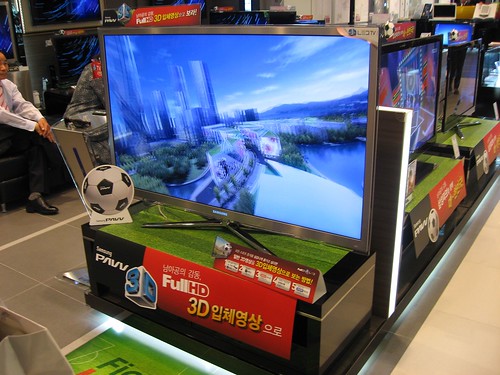
Apparently it was the dream of many Korean men to watch the World Cup on a 3D TV. I thought that was a little optimistic but then I found one in Lotte Department Store near us, proving at least that the technology was really out there as opposed to 'coming soon'. However, at around 2.5 million won (£1,400/$2,100), for many it may have remained a dream for now, although Samsung claim to have sold 26,000 3D TVs in Korea, so evidently some had the money to make the leap of faith.


Watching a 3D match live in the cinema seemed much more attainable, but it was so popular we were unable to get tickets. It was remarkable really, considering that at almost any other time football barely seems to register on the Korean sporting radar. I guess that's national pride for you. Despite working full-time during the day, two friends of ours - one of whom never watches football otherwise - arranged their limited sleeping schedule around South Korea's matches and somehow still managed to function at the office the next day.

Perhaps unfortunately for the 3D viewers though, some were quite disappointed by the quality of the 3D coverage. What I saw in the Lotte Department Store through 3D glasses was quite impressive, but it was a demonstration video which I'm sure is optimised to sell televisions. As always, real life may vary from the promises we are sold.

Even 2D television coverage was problematic. SBS won the exclusive rights to broadcast matches in Korea much to the anger of their competitors, but the practical upshot of this seems to have been that when matches occurred simultaneously SBS only showed one, because they were only using one channel to broadcast coverage. Which meant if you happen to be a foreigner wanting to watch your own team, or a Korean with a particular foreign interest, apparently you were out of luck.


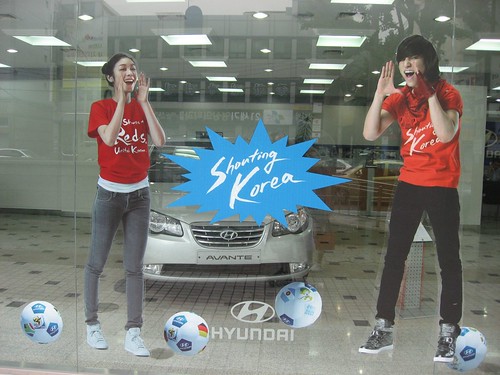
The standard line of encouragement to almost anything requiring strenuous effort here is Fighting!, although admittedly due to the linguistic challenge of pronouncing this English word it is often heard as Whiting!, so I hear Korea Fighting! - or Korea Whiting! - rather a lot when the country, or anyone within it, is doing anything remotely competitive. The tag-line for the World Cup though, appeared to be Shouting Korea, or Korea Shouting - a potentially noisy yet welcoming toning down of the rhetoric. When the matches were shown, the highway outside our apartment went eerily quiet - somewhere out there, an entire nation were glued to their 2D and 3D screens.

And now it's over - for Korea at least - and presumably an entire nation will go back to the status quo ante as far as football is concerned until the next major championship. I keep meaning to go to a football game here, but they seem so far off the radar normally that I've never managed it, despite having a friend who is a referee with the Korean Football Association.

Saturday, June 05, 2010

Primary Colors

"The test of democracy is freedom of criticism." - David Ben-Gurion

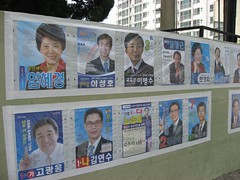
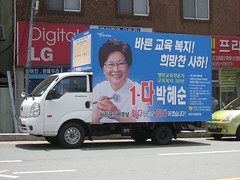
Elections were held this week in Korea, and while democracy is a great thing, I'm glad to see the back of the campaign for one reason alone. I work until 1am and I don't always get to bed until 2am. So I haven't appreciated the election candidates who seem to think it helps their cause to drive up and down or park outside my apartment building at 7.30am in the morning with loudspeakers featuring vacuous patriotic tunes on a two to three bar loop, or speeches from candidates delivered so emotionally one wonders if they are actually pleading for their lives.

Personally, it mystifies me as to how shouting hysterically at passers-by or playing loud annoying music would, in any way, persuade me to vote for a candidate in this country, because it seems to me it would specifically provoke me into not voting for them. Evidently I'm not the only one who is thoroughly fed up with the candidates' antics. Perhaps they are making so much noise to hide the fact that they don't have many policies - well, except for promising people free WiFi.

Annoyingly, recorded speeches are only allowed from 8am, so those candidates who have been waking me up before this are breaking the law and supposedly run the risk of prison terms of up to two years. That's the theory anyway.


My wife floated the idea of actually complaining to the police, but I didn't think trying to get a candidate jailed was exactly the kind of introduction to Korean politics I wished to have as a foreigner. Foreigners are allowed to vote – if they've been resident long enough which I haven't – but they are 'prohibited from engaging in campaigning', which seems like something of a paradox.

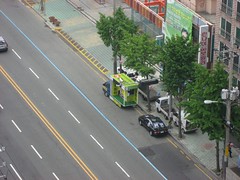
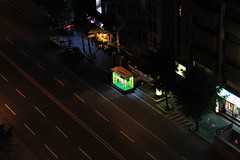
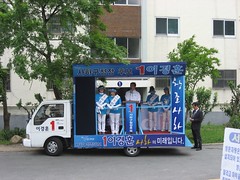
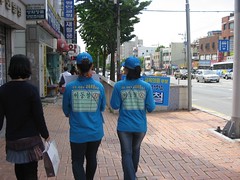
So the streets then are thick with Korea's ubiquitous Bongo trucks converted for political campaigning, coupled with large numbers of election campaigners which makes you marvel at the spirit of campaign volunteerism in this country... until you realise it's actually a popular form of paid part-time employment. Two trucks were almost parked in close proximity to my apartment building on a near permanent basis, which was not a lot of fun after the first couple of days.


I chanced upon an election bongo parked outside an apartment block in a relatively quiet backwater of our neighbourhood. There was nobody to be seen, but it didn't stop the candidate delivering an impassioned speech at full volume to... well, just me actually.


But this is how it's done, and it's sometimes such an efficient system that they don't even bother taking the candidate off the bongo before moving on to the next location. Yes, I've seen candidates bravely hanging on to their lecterns with their token supporters behind them while the vehicle they are standing on has driven down the bumpy highway outside our apartment at around 40mph. It's all rather absurd, but with bribery and vote-buying possibly down in this election (depending on who you believe) – this appears to be one of the best ways candidates can think up to engage people, although one suspects if this is indeed the best idea they have, they probably won't make very good politicians.

I shouldn't complain too much about the noise though, because at least there are elections, even if noise seems to be the main outcome rather than serious debate. And the candidates can't necessarily be completely blamed for the low-tech and apparently policy free approach, since the National Election Commission curiously banned political parties from engaging in public debates over 'hot election issues' (aka Government policies), in a move which seems straight out of the Hugo Chavez playbook. So candidates have numbers, colours and perceived political positions they're not necessarily at liberty to discuss in public. What can people vote for, and how can politicians differentiate themselves in this kind of environment?

There has been innovation though. Twitter is a rapidly growing phenomenon in Korea. and some candidates have used Twitter heavily. But perhaps I shouldn't be so willing to see candidate leave behind the low-tech Bongo-truck approach; I made the mistake of following a couple of candidates on Twitter who, in an act of presumed ignorance or desperation, followed me. I soon learned that their determination to annoy the public on the streets extended into the online world, and I was deluged with tweets every few minutes.

And this is how the election results were shown on TV - with candidates raising their fists. Korea fighting! Candidates fighting! Or something like that.

Sunday, November 22, 2009

Off Screen

We travelled all over Busan looking for a television, but it rapidly began to feel like there were only three types of stores - the official manufacturer outlets of Samsung and LG, the second-tier electrical stores Hi-Mart and Etland, and the third tier volume discounters E-Mart and Tesco Home plus (sic). And this pretty much summed up the price differences as well, so inevitably it wasn't long before we had worked our way down the pricing scale and were honing in on buying from 'Home plus'.

Not that price was in any way a fixed concept as it turned out. It's understood where I come from that while there is some scope for negotiation in the large 'high street' electrical chains, it might be considered lucky to shave 10% from the advertised price - and negotiating in a Tesco supermarket is normally out of the question. By comparison, it didn't take long to realise that the prices on the store stickers in Korea bore no relation whatsoever to the price one might actually be expected to pay, with staff discounting the advertised prices by up to 40% without batting an eyelid. It reached a point where I started mentally discounting everything I saw by 30% as a rough guide before converting it into British Pounds - which I'm still given to do in order to consider its attractiveness, and we rapidly learnt to enter a store and immediately ask what the 'real price' of a particular model was

Presumably having sticker prices which bear no relation to the actual price is meant to encourage the notion of having found a bargain in Korea, but I just found it annoying; every now and again there would be a price that would look genuinely good, but the staff would go on to explain that as this was a special offer they could only discount a little from the sticker price. If there was consistency in advertised pricing and the discounting, it would have been much easier. I was left wondering what the point was. At least it explains why Samsung and LG TVs appeared to be more expensive in Korea than the UK - something which has always mystified me; they probably weren't - it just looked that way. Hefty discounting was rampant from the manufacturer's branded stores down to the likes of 'Home plus'.

There's another thing which they all had in common - the range of manufacturers to choose from - Samsung or LG. Yes, you might spot the occasional rather neglected-looking Sony Bravia LCD here or there desperately trying to undercut the domestic brands - but otherwise, you were choosing one or the other. Confusingly, not that Samsung and LG TVs are actually branded Samsung and LG. No, on the whole, for Samsung read PAVV, and for LG read Xcanvas. You might very well wonder why, when you've invested a considerable amount in creating brand names like Samsung and LG, you'd want to hide it from your products, and so do I, but that's the way things are here. LG is Xcanvas for TVs, and DIOS for refrigerators, whereas Samsung is PAVV for TVs, Hauzen and Zipel for refrigerators, and so on. I'm sure there's some method to it, and to be fair I can see it creates the (false) sense of living in a more diversified society with more consumer choice, rather than a two-horse town (as my American cousins would call it) or more appropriately, a duopoly. And perhaps, if you're living in a rather shoddily constructed LG apartment block (for instance), you might be less motivated to go out and buy an LG TV because there's that logo again from your ill-fitting window frame (yes, I do live in an LG-built apartment block and yes, the logo is everywhere).

If by some chance we wanted to live the LG life any more than we already did, we could buy an Xcanvas LCD with a built-in 'Time Machine' hard disk and IPTV system to deliver video on demand. In principle, this seemed like an option because we hadn't yet decided which cable TV provider to subscribe to. However, this was discouraged by one particularly knowledgeable and younger store assistant, who pointed out the redundancy of paying for video on demand when 'everything is on the Internet (in Korea) within fifteen minutes of it being broadcast'. Good point.

Everything may be on the Internet in Korea, but surprisingly, shopping for TVs online proved more complicated than in the UK, where it is a given that the likes of Amazon, Play.com and Ebuyer would offer the best prices. Yes, there are large 'online malls' such as Auction and Gmarket, but these really serve as venues for a style of peer-to-peer trading which has more in common with the eBay model. Consequently, there are real trust issues involved, and potentially scant protection from fraud in a country that - as far as I can tell - thanks to the power of the Chaebols was never big on consumer rights in the first place.

So when we chose to buy our 42" Xcanvas LCD from 'Home plus', it was in the full knowledge that the cheapest Internet price was almost 15% less. As it turned out though, it was about this time that our friends who were getting married wanted to buy a TV for their new apartment, and through a personal contact of theirs who worked at a 'Home plus' store, coupled with an additional discount for buying two TVs together, we actually ended up getting a better price than on the Internet. Buying locally also meant that we had an engineer come round from the store and set it up and test it for us, which might not sound like a big job, but did involve the annoyance of extending an existing TV socket which saved us some work. He gave us his card before he left as is the norm here.

And as it turned out, for the first time we actually came to use one of these cards for an after-sales enquiry. Our three-year old PCs don't have HDMI outputs, but I did bring a DVI-to-HDMI cable with me from the UK, which I'd been using to link to a TV there. Since DVI doesn't carry sound, this requires an additional audio cable, but I was unable to get this working with the Xcanvas. The engineer was able to suggest a solution over the phone which worked. Another win for Korea's customer service ethic. So once again we are able to watch Hulu properly...

Monday, September 28, 2009

We the People

"You know what? I know we have a dangerous job to do here but... I'm taking this. I'm taking this couch" - Peter Griffin, Family Guy - Blue Harvest

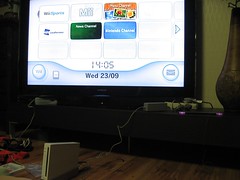
About three weeks before the attack on my car which led to our sudden volte-face decision to return to Korea, we bought a Nintendo Wii. It's clear to me from people I know that Wii's are used for one of two things, either to provide an interactive gaming and exercise system, or gather dust in closets. It was soon clear that ours was going to fall into the former category.

This presented a problem because a UK Wii is a PAL output system and Korean TVs run on NTSC, which meant that even if we were prepared to ship it out to Korea, to my mind it wasn't going to work unless we could find a Korean TV that accepted PAL inputs. I may be a former software designer and one-time computer geek, but I'm no expert on audio-visual equipment and everything I read on the subject could basically be summarised as 'forget about linking a PAL Wii to an NTSC TV without a heck of a lot of messing around or some special connectors. My wife scoured the Korean Internet and couldn't find any TVs claiming to take PAL inputs - whereas in the UK NTSC capable TVs are quite common.

So as reluctant as I was to probably lose a hundred pounds in three weeks on a console that we would have to dump quickly, I saw little choice but to write it off as a transition cost and start again in Korea with a locally purchased Wii. Then my wife had her Peter Griffin moment - "You know what? I'm taking this. I'm taking this Wii to Korea". And because as traders neither of us like losing lots of money on a position we've just entered, I found myself seduced by the idea of going along with it.

It logically follows that if you're going to take a PAL Wii to NTSC country, maybe you have to have a PAL TV to use it with if all else fails, and that's how - along with a few other boxes of possessions we arranged to have shipped to Korea, we came to have a cheap 19-inch TV shipped along with them. But the Wii itself along with its accompanying software was not going to be shipped - instead my wife resolved to use about a significant part of her suitcase to bring them with us on the flight. I could only do what any husband would in this situation, which was to offer words of support such as "You're crazy", "Customs are bound to go through your cases", and "I'm really not sure this is going to work anyway". I think it's important to see a marriage as a real partnership.

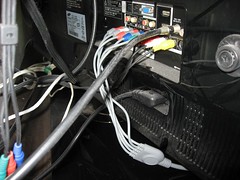
Despite my disturbing lack of faith I made sure we brought all the connectors and two days after we arrived I'm finally crawling around the back of Korean Mother's 52-mile wide PAVV (i.e. upmarket Samsung) TV looking for a SCART connector, which is what we used to use to connect just about every piece of equipment in the living room to one another before HDMI came along. This exhibited a complete lack of research on my part, because despite having a couple of dozen different connectors in the back - including an Ethernet port of all things - a SCART socket was conspicuous by its absence. I checked the old TV we'd bought when we came to Korea the first time - it's so old it's actually a CRT rather than LCD, and that didn't have a SCART either, which is when it became obvious that Korea doesn't use SCARTs and probably never did. Well, the Wii cables running into the SCART convertor were a left and right audio, and a video cable, so I figured I'd just pull them out and see if I could stick them somewhere else directly - my trademark scientific approach to almost anything technical. There was some colour-coding but since half of the ports seemed to be red it wasn't as helpful as it might have been.

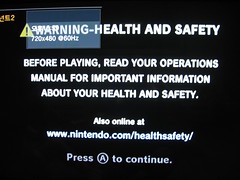
It didn't take long to figure out that the Mega TV set-top box was using the same type of cables to connect to the TV, and by replacing them with those from the Wii we might be in business. And then it just happened - the picture came on - the standard Nintendo warning that their consoles can be dangerous to use or some such thing - and what's more, it even had a splash of colour in the right place despite the cautionary Internet tales that in the unlikely event we had any success, the picture would probably end up being monochrome.


Later I got even more ambitious and succeeded in connecting the Wii to the Korean TV via a non-Nintendo Component Cable I'd bought in the UK, so now it can remain connected without the need to cut off the Mega TV box. And with that we were set up. Admittedly, we can't buy Korean Wii games because they will be NTSC format, so if we want to add any more software to it we'll have to try and find PAL titles from somewhere. But even if we don't, we feel like we really achieved something somewhat against the odds.

I'm not sure that 10.30pm on an uncomfortably humid evening is a good time to be reacquainting oneself with Wii Sports, but we were soon back into the swing of things, and the great thing about Korean Mother's apartment was that we actually had space to move around, unlike our home back in the UK.

Korean Mother came home to discover that we'd seized control of the strategically important lounge area, and her 52-mile wide TV with it, and rushed off to her room to watch the soap opera she'd come home for. But curiosity soon got the better of her, and she was back outside watching with fascination. In fact, she'd been out exercising at a local school, at 9pm, and was intrigued by the idea of exercising in her apartment using a console when we showed her EA Sports Active. After that, it wasn't long before she was playing Wii Sports Resort's table tennis, and unexpectedly discovering she was rather good at it.

But nothing prepared me for what was to follow. Korean Mother discovered Wii Boxing, and suffice to say while I have video of her playing this which I'm sure could be a YouTube sensation if there wasn't a going to be a very long statute of limitations applying to it, I will instead merely have to relate that nothing in life quite prepares you for the sight of an ajumma knocking the hell out of a Nintendo character while angrily suggesting with each punch to the character that his mother might have the characteristics of the son of a fornicating female dog who isn't familiar with the father. What's even more inexplicable, is that having played first and exhausted myself entirely having once again failed to beat my next level opponent, Korean Mother took over my character and beat it on her first attempt. It's clear from watching Korean TV - which run programmes that I always imagined being called When Ajummas Attack - that an angry ajumma is a dangerous animal - but seeing it up close is truly a sight to behold. I tell you this - if Wii Boxing ever catches on in the ajumma community, on the evidence I've seen the rest of us are really in trouble.

Friday, September 25, 2009

Liang shang jun zi

Last time I lived in Korea there was little purpose in buying anything substantive, so while I browsed around the electrical stores with interest, we were never destined to own one of those exciting consumer items, which made the act of looking somewhat academic. We can't say what the future will bring, but it's time to try and cast off our semi-nomadic lifestyle and start to create some kind of real home for ourselves, obtaining some of the trappings of a more permanent existence. To that end we have a list of items to buy, and one of our first priorities is to find mobile phones, a task which had been made more pressing by the news that my mother had fallen ill with food poisoning the day after we'd left the UK.

It is of course almost unthinkable to be without a mobile phone in Korea, where they are called 'haendeu-pons' ('핸드폰') or hand-phones - which always struck me as a subtle semantic distinction - you have a hand, therefore you have to have a hand-phone. Whereas back in the UK, you may well have a mobile phone, but you aren't necessarily that mobile, so maybe you don't need one. In Korea the message seems to be at some level - have hand, have phone.

So my hand has been phone-less for the duration of my life in Korea, but I've resolved to change this. I know what I want and while my needs are somewhat specific I had no doubts they could be met in a country where spurious communication is so ubiquitous it is often referred to as the Land of the Morning Call. So I set out to find the kind of keyboard-touting smartphone which I'd helped to pioneer back in the Symbian days through a series of spurious investments. I wasn't expecting to find the latest Nokia Communicator, but searches of Western web pages suggested the existence of devices like the LG VX10000, which aside from the curiosity of being named after a deadly nerve-agent, fitted an important theoretical availability criteria in Korea, in that LG is Korean.

How wrong I was. The first clues came from friends who asked why on Korean Earth I wanted a device with a keyboard. I thought my rationale was simple enough - I'd decided to write more (though not necessarily on this blog and not necessarily about Korea) and now that I've realised that Korea is my muse, when my muse speaks to me I feel the need to put those thoughts down as quickly as I can. The alternative is to go back to the life I had before, when it seemed that the perfect words to describe a situation often came immediately to mind, but by the time I had the time to make an account of what I had experienced, it was in the hack style I gravitate towards in times of haste, apathy and failing memory.

Well I carried a Psion Organiser around for years at university, and while technology might have moved on every new mobile device I've owned since then has represented a significant usability downgrade - and now I wanted my usability back. But I'm beginning to seriously doubt I'm going to get it. The LG nerve-agent phone was nowhere to be found in its homeland, and neither was anything else comparable. At a branch of SK Telecom yesterday morning, a bemused sales assistant insisted that keyboards were unnecessary since 'everyone' could type fast with predictive text on a numeric keypad, missing the obvious fact that as a non-Korean my fingers are not genetically evolved to move faster than a politician through a tax-payer's wallet. If they had human rights laws here I might have explained how I considered forcing me to use predictive text a breach of mine, and how I'm sure the Geneva Convention has specifically outlawed the use of Windows Mobile in communication devices. Further searches since have suggested the admittedly very limited availability of devices such as the new Samsung Omnia Pro and the older Sony Ericsson Xperia X1 in Korea, both of which I am now considering.

Meanwhile a friend has kindly loaned us a 10-month old and therefore 'outdated' Samsung 'Anycall' phone complete with Windows, and to be fair to it I can at least use Word Mobile to make notes using the on-screen keyboard - which works when the screen picks up the pen-presses, which is not always. It remains tediously slow though, and switching the interface from Korean to English inexplicable only translates about 30% of the Windows interface, and not the rest. Which means 'Word Mobile' is 'Word Mobile', but 'Tasks' stubbornly remains '작업', and most of the critical sub-menus aren't translated either. I'd normally persevere - my Samsung NC10 uses Korean Windows as did the desktop I had last time I was here - but I don't really want to be trying to figure out Korean menu options on my phone while I'm moving around trying to accomplish other things while not getting run over my pavement-mounted motorcycles.

While Korean phones have been surprisingly disappointing in many respects so far, there are at least some hints of greater technical accomplishments than their Western counterparts, I can watch TV on it while wandering the streets, or on the subway if I don't want to sleep. But really I just wanted a keyboard and an application to type my notes into that worked - I'll probably find something eventually, or give up in the face of an overwhelming flood of bemusement, and opt for the predictive text approach. Now I come to think of it, it's no wonder the Koreans are so good at Kartrider.

Wednesday, November 07, 2007

Switching Channels

I haven't watched a lot of television here. There are a handful of channels on our basic cable service which show some English-language movies, but even if you can find their websites, working out what's on every day is an effort in itself, given that Western film titles are transliterated into Korean. Even though I can read Korean, reading the words quickly enough to make some kind of sense in American-English - as opposed to the English-English way I read the language - as well as taking that extra leap that some titles require, is a bit of an acquired art. Sometimes, just to throw you off, they actually translate titles into the equivalent Korean words, leaving you trying to hopelessly figure out what English word they were trying to make, and a couple of times they've just made things up - I was half-way through watching some random movie one day when I noticed the title in the top corner read When Harry Met Sally 2, presumably because the plot had some similarities.

These are the Korean TV channels which show a fair number of English programmes - this being Korea they are very Internet Explorer centric so they might not work in other browsers:

Story On
OCN
CGV
On Style
Super Action
Fox
XTM
Cinema TV

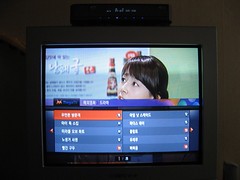
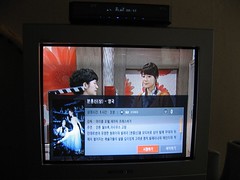
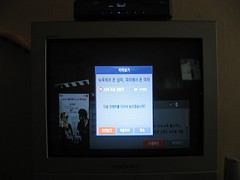
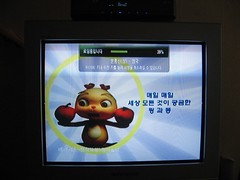
A few days ago one of our Internet providers, Korea Telecom's Megapass, phoned us. They had a new video on demand (VOD) service called MegaTV and we could trial it free for three months, so we agreed to take the service. The engineer turned up yesterday, and half-an-hour of wiring and configuration later, we had a new set-top box on top of our small television.


After initially agreeing to try it, we regretted the decision as we believed from what they told us it would offer little more than a few repeats of Korean dramas. We had a VOD service back in the UK along with a PVR, and while the PVR was good - when it worked properly - the VOD had the kind of variety of content Chairman Mao would have approved of - when it worked (spot the pattern here). But KT undersold MegaTV - because in addition to the endless dramas it seems to have a couple of hundred movies as well as an assortment of other content from sports events like Major League Baseball to English language teaching programmes. And it works rather than crashes at every available opportunity, with just a slight pause for the video streaming to begin. From the on-screen displays, there's clearly scope for MegaTV to charge for content, but most things are free and the films which carry a cost are charged at 1,800 won (about 95 pence). After the trial, the charge for the set-top box rental is 8,000 won (about £4.24) per month if we sign up to a three-year contract, which is a bit of a catch because a lot can happen in three years, and we weren't planning to be here actually, although with the way things are with the British Embassy, perhaps I can't be so sure.

So it seems I now have about four weeks to learn as much Korean as possible, catch up on a huge backlog of things about Korea I wanted to write about, say my goodbyes while simultaneously watching as much free TV to take my mind off things as I can. I will now be working my way through the MegaTV website along with Naver trying to work out the titles.

Korean tags: 텔레비전, 티비

Tuesday, November 06, 2007

The Big Picture

It may not be coincidence that the arrival of a new Hi-Mart in the area coincided with Korean Mother's decision to replace her old TV with its washed out picture created by technologically uncertain means, which is why I took to hanging around at electrical stores recently taking pictures of dancing girls while there.

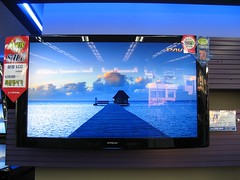
This being Korea, it's probably no surprise to find that if you're in the market for a new TV, you're probably buying a Samsung or an LG. But in the first of many oddities which is the Korean TV shopping experience, don't expect them to be branded as such. Samsung's TV brand is 'PAVV' and LG's is 'Xcanvas'. When I first got to Korea I wondered whether these might be cheap Chinese imports - and couldn't understand why the Koreans weren't buying local - I really should have known better even back then.

Another mistaken notion of Korea I had back in those days was that it would prove to be a land of milk and honey as far as technology was concerned. I've long since resigned myself to having, what is these days, a slower Internet connection than I had back in the UK, and now the TVs provide another disappointment. It's unscientific but comparing prices in Hi-Mart with prices from a similar type of store in the UK, called Comet, has tended to suggest that Korean prices are 10-20% higher than for equivalent models back home. This is even more surprising considering the UK's VAT sales tax is 17.5% compared with Korea's 10%, and UK TVs tend to have teletext and digital terrestrial tuners built in which Korean TVs don't. The TV in the picture above - a PAVV 52" LCD - has a price of 5,000,000 won, about £2,649, whereas a 52" Samsung is currently £2,300 from Comet. It may be the case that Korean retailers are more open to haggling than British ones, although the latter aren't necessarily adverse to it either, but as things stand you'd have to be talking them down by quite a margin just to get to British prices. It's really not what I would have expected at all. On the other hand, the iPod Touch is cheaper here, but then that's American. Why do Koreans have to pay more for Korean products?

In addition to Hi-Mart, we also browsed round LG and Samsung stores, where of course, they only sell their own products, and if anything, at even higher prices. I am told there is a school of thought here that the PAVVs or Xcanvas TVs in Hi-Mart are not perceived to be the same quality as the same models sold by Samsung and LG stores respectively, and I suspect there's a marketing department somewhere not so far away from here patting themselves on the back for getting that rumour started.

Salespeople back home do not have good reputations, but compared to some of the sales staff we met in our travels they are evidently experts in their field. Knowing little of the world of flat-panel TVs we'd done a little research beforehand and arrived in the Korean stores asking what seemed fairly basic questions about contrast ratios and scan types, to the blank looks and occasional alarm of staff who had, moments earlier, enthusiastically approached us. Eventually we usually found someone we could talk to, but in one store a resident 'technical guy' insisted that the black glossy LCD panels don't really suffer from reflections these days - while we were standing next to such a panel happily displaying its HD image along with a pretty good mirror image of the stores lights. I was amazed by his sheer audacity.

I've written before about ajummas andajeoshis, which are more than merely terms, they are almost definitions of a type of behaviour. Within the ajumma section of society there is something even more eye-opening - the phenomena of the rich ajumma - or at least, the reasonably well off one. Korea isn't quite Japan, but while the economy's rapid rise in the last few decades hasn't been to the benefit of all, there is retired class of people, especially women, who have a lot of leisure time and money to go along with it. So the stereotypical story goes something like this - ajumma walks into a TV store, parks herself in front of the screen which most takes her fancy, possibly haggles a little for old times' sake, and then buys it. She likes the picture and the design of the TV and hasn't the first idea about any of the specifications, which of course, suits the salesperson perfectly because that means they don't have to either.

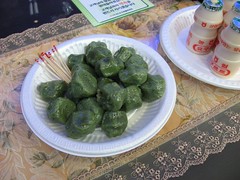
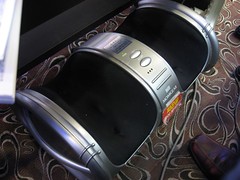
So the staff of various stores found they had to talk details to us, and we were ploughed with drinks, strange green rice sweets and foot massagers while they consulted sales leaflets or disappeared off to find someone who knew the answers to our questions.


Eventually we failed to persuade Korean Mother to buy an Xcanvas with a PVR, as she instead opted for a similarly-priced PAVV without one, on the grounds that she didn't like the Xcanvas bezel design, though she did end up getting a free vacuum cleaner and digital camera - Samsung of course - with the deal. And in a final reflection that some things don't change in Korea, she found someone in the extended social network who worked in another Hi-Mart somewhere else in Busan to do a better deal that we'd found locally.


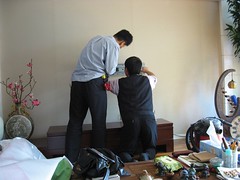
I'm sure it says something about Korea's service culture that it's not uncommon to see trucks with pictures of their drivers displayed on the back, somehow serving to put a human face on an otherwise faceless corporation. It says something else that it's taken as read that the people who deliver your new TV will install it even if that requires a wall mounting. If there are any problems, we should give him a call - and specifically him rather than the company generally, because now in some small way it's his responsibility and he's our TV support person.


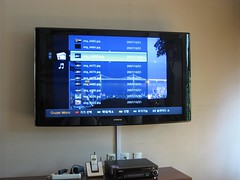
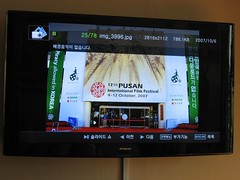
As for the TV itself, there's still nothing on worth watching, but we did find a USB port on the side which now enables us to show Korean Mother our photos in an alarming amount of detail in the comfort of her own home. And Korean Mother's happy because now she watches her period dramas in high definition on KBS, although for me the ability to suddenly see the actors' dental work and contact lenses somewhat destroys the historical image for me.

Korean tags: 가게, 사다

Wednesday, September 05, 2007

420

About two months after I arrived in Korea I was on the subway line 2 somewhere near Seomyeon - when I noticed a wall near the track with small yet perfectly legible graffiti which read, in English, "Legalise Free Hemp". I've seen it again a couple of times since and always meant to take a photograph of it but so far the opportunity has eluded me. The longer I stay in Korea the more remarkable that graffiti becomes, even if it turns out to be part of some kind of strange free-speech art project, because graffiti is virtually non-existent here and Korea has a zero-tolerance policy towards drugs. In fact, I've read one or two articles - written by Koreans - that boldly state that there is no drug problem here, unlike in the West.

I have an interest in Japanese history, but I've never developed the same taste for that of Korea. Whereas much of the former's domestic history is what is it, one gets the feeling that a good portion of the latter's is presented to make points about present day ideological and territorial struggles, and while I sympathise with Korea's problems, there's often a fine line between history lessons and modern-day indoctrination. So in my travels around Gyeongju amongst other places of historical note it's a distinct possibility that I was exposed to information about Korean crafts of the past, and let it wash over me with all the other things I was being told at the time. Or maybe the fact that country-dwellers made their clothes and bedding from hemp got lost in the translation.

So the notion of 'legalising free hemp' seems to be a moot point, because it transpires that there's still rather a lot of it growing in the countryside here. Fortunately or unfortunately for the country-dwellers, depending on how you look at it, the concept of smoking the product of this plant simply didn't occur to them - allegedly anyway. Although this is not to say that there wasn't any smoking of substances going on - it seems that there was - but perhaps it genuinely wasn't widespread.

As for the truth of the existence of drug problems in Korea, Korean Father has told some stories about the addicts he used to arrest and the extent of their problems which reveals that at least for some individuals, the problem is a very real and severe one.

Tonight KBS 2 (KBS is a bit like the BBC here) will run an hour-long 'expose' of how foreigners are faking their degrees to teach English in Korea, and smoking pot when they're presumably not working illegally or, prepare yourself, having sex with different partners. Unfortunately, recent scandals revealing the extent to which a lot of Koreans have faked their educational qualifications tends to smack of the pot calling the kettle black, and not just because of the degrees. This is generally not going down too well amongst foreigners here.

Korean tags: 마약, 외국인, 자격

Monday, September 03, 2007

Rumble Fish

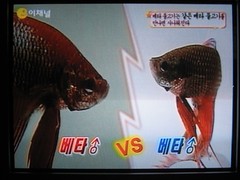
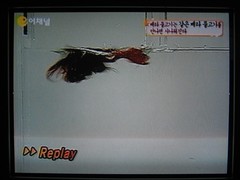
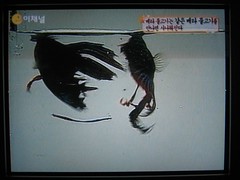
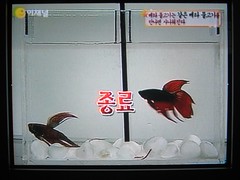
Can anything surprise you after witnessing Korea's ESPN showing a fight between two bulls for entertainment? Possibly, how about a Saturday evening televised fish fight?


Allegedly this is supposed to have some educational value, but the on screen graphics, slow-motion replays, dramatic build-up and a hundred young Korean women voicing their 'wooos' and 'ahhhs' in unison suggests that this may be more for your viewing pleasure than anything else. Actually, I say that you can hear a hundred perfect young female 'wooos' and 'ahhhs' but I hear these on so many programmes I'm beginning to think it's either an audio track, or all Koreans - including the men - sound like this when sat in TV audiences.

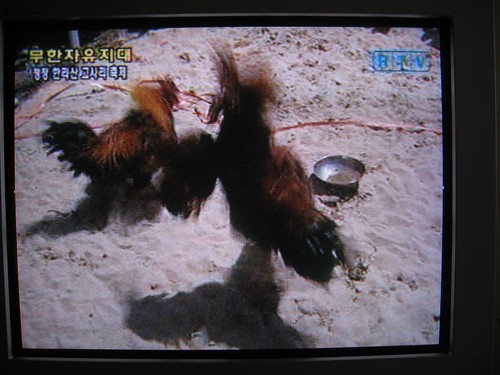
And today I woke up to a cockfight:


The fact that this is shown at possibly more educationally-compatible 09:15 on Monday morning as opposed to 22:30 on a Saturday night might provide some hope that this is not just some spectator sport, but unfortunately the camera panned out to reveal a Korean country fair of some description, and the cockfighting was evidently one of its entertainment features. I half-expected to see Borat commentating.

Korean tags: 교육, 싸움, 동물