Showing posts with label pride. Show all posts

Saturday, August 11, 2012

Under Siege: Dirty and Smelly and Fusion Babies

"I'm not just saying this because you’re related to me, but I used to think that all foreigners were dirty and smelly... but you're not." - a close relative who I am not permitted to name by title until the statute of limitations expires.

Does this mean I've pushed down the barriers of prejudice in Korea by just a little? Perhaps not, because this close relative went on to expand on that thought by adding "When I pass them in the street, I can smell their bad smell, they look unkempt and their clothes look years old. But you always look neat."

And apparently I don't smell that bad either. If only foreigners could smell as wonderful as Koreans.

Filed under 'accidental truths close Korean relatives tell you when they finally let their guard down after five years'.

The observant among my two remaining readers will have noticed that I don't often write this blog any more. This is a function of many things such as my work as a writer elsewhere, aching fingers, a bad keyboard, my hatred of the updated Blogger interface that often no longer lets me post comments on my own blog, and the increasing amount of time I spend with the underground railroad here in Busan.

It is also - as I have previously mentioned - in no small part connected with the extra work and frequent interruptions that come with having a 22-month-old child, who is, shall we say, high maintenance. For example, this morning the wireless landline phone handset in our apartment was nowhere to be found until I finally spotted it in our aquarium, which led to a couple of hours of disassembling, drying, cleaning and re-soldering (it was not disassembly-friendly). This is the tip of the iceberg.

All small children can be a challenge I'm sure, but one of our close relatives evidently arrived at the conclusion that my son represented significantly more of a challenge than any Korean child they had previously experienced, prompting them to pose the following philosophical question:

"Do you think his temperament is the way it is because he has mixed blood?

Tuesday, May 29, 2012

Under Siege: Racial Abuse on a Bus

So I promised to tell you the racial abuse on the bus story. It happened two days after I’d been kicked out of a taxi when the driver saw I was a foreigner. It wasn't a good week for me in Korea.

I was sat right at the back of a bus with a Korean colleague heading back to civilisation from Gijang after work. My colleague’s English is good but buses are noisy and you have to talk above it for comprehension.

There’s a sort of unspoken rule on public transport in Korea although actually sometimes it’s spoken very loudly – which is that you shouldn’t speak very loudly on public transport. I like it, because it’s based on the fine principle of not bothering anyone else, and if Korea could see fit to similarly purge the stench of alcohol-sodden old men and women, men who want to sit on narrow subway seats with their legs wide apart and elderly professional jostlers from its public transport I’d be even happier, but of all the aforementioned things only public speaking is apparently deemed socially unacceptable enough to be publicly frowned on.

But wait a moment... this just coming in – no, apparently you can also talk very loudly on public transport if you’re over 50. Because once you turn 50 in Korea, statistically you turn into the kind of insufferable asshole who can literally push your way to the front of a subway queue, steal your taxi, and talk loudly on public transport while telling younger people to shut up. I’m told it’s something to do with Confucianism – apparently he was some old guy a long time ago who said it was OK for old people to behave like insufferable assholes, especially if they were men.

Every so often, you’ll see a story in the media here which will typically take the form of a young person – often a female I think for some reason – suddenly turning on an old person in the subway while a dozen passengers video the scene with their mobile phones. And we all act shocked and say “what is society coming to?”, but secretly I imagine that they probably deserved it. There, I said it. Legions of ‘ajeoshis’ and ‘ajummas’ - older men and women – in Korea are actually completely self-centred and insufferable, everyone secretly knows it, but times have changed, and those younger than them are mad as hell, and they aren’t going to take it any more. I imagine Korea has serious problems on the horizon – think ‘social breakdown in Japan’, but with very much more anger and compulsory military service.

So this particular insufferable ajeoshi gets on the bus and let me tell you, this does not even figure on my radar because it’s nothing more than a flock of birds – common background noise here. But the insufferable ajeoshi is either particularly insufferable today or also drunk, because he gets up from the seat mid-way down the bus where he’s been complaining loudly to himself and presumably anyone who will listen, and moves to the front of the bus while becoming more agitated and animated. He starts treating the driver as something akin to his co-conspirator or drinking buddy, and while he’s now appeared on my radar, it’s the next sentence from my colleague that shocks me.

“I think we should stop talking.” What? Why? “He doesn’t like foreigners.” So I sat there in with my clearly worried colleague in stunned silence. On the noisy bus. And all the Korean passengers had stopped talking too – oh except one, the insufferable ajeoshi that hates people talking on the bus, who spent the next five minutes shouting on the phone to someone about something else. And I do mean shouting.

With the insufferable ajeoshi now distracted, my colleague explained in hushed tones what he had said, namely that:

1. “He doesn’t like foreigners talking loudly on a bus.”
2. “He doesn’t want to hear foreign languages in Korea.”
3. “He doesn’t know what foreigners are doing in Korea."
4. “He doesn’t want foreigners in Korea.”
5. “Yankee go home!”

Nice. And that’s only what he told me. I can’t help thinking there was a lot more to it than that. So as the only foreigner on the bus, apparently he’d been shouting all this at me but of course, I’d been wonderfully oblivious to it all.

I know I should study Korean more, but sometimes I’m afraid of what will happen when I understand them and worse, what will happen when they can understand me. Douglas Adams said the discovery of the Babel fish "effectively removed all barriers to communication between different cultures and races" causing "more and bloodier wars than anything else in the history of creation." My not learning Korean very quickly might simply be a subconscious manifestation of my self-protection mechanism.

Ironically though, I’m open-minded about all this 'Yankee go home' business, because if they did maybe Koreans would stop posting job adverts for North-American-passport-holders-only on the principle that apparently a native English person teaching native English in Korea is no good. Not that I teach English, but in principle, the idea that I’m lower down the English-ability and employability scale than an American community college graduate speaking in a local accent that even other Americans can’t understand is kind of annoying. British people are already second-class citizens in Korea compared to ‘North American passport holders’, and yet when it comes down to it, we still get caught up in Korea’s random bouts of anti-Americanism.

When Korean Mother found out about what had happened, she was actually ready to head up to Gijang to mount an improbable search for the insufferable racist ajeoshi on the bus. But other people in Busan simply said “Well, that’s Gijang for you.” (#visitgijang)

Do you know what bothered me the most about the incident though? Foreign children from our school travel those buses.

Wednesday, May 25, 2011

Busan e-FM Week 30: Family Month

The english waves come inAbout 'Open Mike in Busan'

Background

I prepare notes for my radio segment; I always felt that to be my best on the show I had to construct a narrative. Like most of the things I write, it’s more time consuming than the result appears to suggest or justify; I tend to debate each word and nuance in my head. Sometimes it turns violent. This week was a new low; the preparation time for my ten minutes on air was nine hours.

My topics are sometimes purely anecdotal experiences and while there may be deeper points to be made, the intention is primarily to entertain. But other times there are serious issues to discuss, and this seemed to be one of those times. I feel there are a lot of stereotypes of foreigners in Korea, often perpetuated by the media. One of the reasons I agreed to do a weekly slot on Busan eFM – and then sign on for a second season – was the notion that in just being out there and talking to a Korean audience – albeit one that is learning or already speaks English – it might provide more of an insight into the deeper thoughts and fears of a foreigner living here. I wanted to speak out. I think if you don’t, Korea is something which just happens to you.

But after kicking the ideas around in my mind for a long time, forming structure and writing sound-bites, I felt the result I wanted had eluded me. Writing to me feels like a game of chess, where the paragraphs are pieces and the various parts have to be carefully choreographed into a winning position. Except it’s not so much chess as blitz chess, played against the clock for suboptimal results. This week I really felt the need to win the game, but as it wore on I realised I’d forgotten how to play.

The powers that be at the station seemed to like it, but I’m not under the illusion that anyone really cares. In the end, my writing is as much about getting my own thoughts in order and understanding the confusion of contradictions that is myself, as much as it is about anything else.

Introduction

May is kind of family month in Korea, because of the close proximity of Children’s Day and Parents’ Day. So the TV channels are running lots of family-related programmes. Inevitably this includes the vaguely self-satisfied ‘foreigners integrating well into Korea’ genre of programming, and there are two main types of show – women from South-East Asian countries brought here via marriage brokers for older Korean men, and Western foreigners married to Korean women.

Reality and unreality

I find the programmes featuring the Western men fascinating. Some are obviously willing collaborators, but sometimes I feel that others have a kind of haunted look about them – the look of men who are trapped. There’s something in the body language and the tone of what they say in English. It’s a subtlety I suspect is lost on most of the Korean audience; it’s easy to focus on how well foreigner is eating kimchi or speaking Korean.

I suppose I don’t find these programmes realistic – certainly at least, they don’t match my experience. But then I’ve read a lot of foreigners talking on the Internet about their Korean lives, and these programmes don’t often seem to match their experiences either. They tend to create a positive image, but perhaps that’s not the reality. My wife actually said to me that she hopes her mother doesn’t watch too many of these shows, because they make me look bad in comparison.

Unfortunately she does watch them. In fact we were in a taxi a few ago and the female driver watched these programmes too. “Living with him must be ‘fun’” she suggested. My mother-in-law smiled, but gave no answer, which I think tells you the truth.

So I think these programmes make my life more difficult – I can’t live up to the snapshot positive image they create. I suspect that if I were on one of these programmes, even I’d look better than I am on them; I’d look integrated because I live with my mother-in-law, and now brother-in-law (again), but it’s not the reality.

It can be difficult marrying someone from another culture and living in that culture. It’s easy to feel isolated because of the cultural barriers and language barriers. There’s the pressure to integrate, to learn Korean, to conform, and it can create a lot of stress. My life’s pretty messed up really. Don’t get me wrong, I like living in Korea, but my living here is full of problems – and that’s the reality.

International Marriage Damage and Prevention

There’s been some controversy about these TV programmes in the last week, which stems from the rise of ‘anti-multicultural groups’ in Korea.

One group, the wonderfully titled International Marriage Damage & Prevention Center, plans to hold a rally outside KBS headquarters in June to urge the broadcaster to stop airing the programmes which they accuse of ‘beautifying’ multicultural families by creating ‘illusions’ about them. That’s basically the same thing I said, but the difference is that my concern is purely the portrayal on television of these relationships – I think it’s clear what these anti-multicultural groups really want is just for certain types of foreigners to be kept out of Korea.

I find it fascinating that they are mainly targeting migrant workers and imported foreign wives – not Westerners – even though we’re all part of multiculturalism here. Their argument is that migrant workers are taking away jobs from Koreans and ‘committing crimes’, and immigrant wives are coming here as part of marriage scams to ‘earn money’.

I think this ‘committing crimes’ thing is a huge clue as to where they are coming from. There’s always been a strong nationalistic streak running through Korean society, and there’s nothing wrong with being proud of your country, but there’s a narrow line between pride and hatred. The English author Samuel Johnson said that “Patriotism is the last refuge of a scoundrel”. I don’t think he meant that all patriotism was necessarily bad, but he was highlighting how common it is for people who have no intellectual argument – or no intellectual ability – to dispense with rational debate in favour of appealing to people’s fears and hatred. I think Europeans like myself are especially sensitive to this kind of behaviour because of what happened in 1930s Germany and other European countries in history. Nothing good ever comes out of trying to make an entire country irrational and angry by lying to them, and it scares me when groups start trying to manipulate people by creating fear.

All Foreigners in Korea are (Potential) Criminals*

I don’t agree with these criminal accusations. I’ve said before that National Police Agency figures show that foreigners in Korea commit fewer crimes per-person than Koreans, and it makes sense if you think about it; if you’re an economic migrant – or any kind of foreigner here – the last thing you want to do is commit a crime, get caught, thrown out of the country and lose it all. Of course, a few foreigners will commit crimes, but these groups are trying to create the fear among Koreans that all foreigners are criminals – it’s certainly the implication of the statements they are making – and that’s just simple racism.

Even though they aren’t targeting Western foreigners, we’ve had these accusations ourselves in the past of course. A few years ago the newspapers were full of suggestions that foreign English teachers were coming to Korea and spreading HIV and AIDS. This time, these hate groups are attacking ‘economic migrants’ from countries perceived to be ‘inferior’ (i.e. poorer) to Korea, which is another thing that tells you this is racially motivated.

The odd thing is if you think about it – given the poor job situation in my country and especially America, many Westerners here are really economic migrants too. It’s not uncommon to hear native-English teachers here say they can’t easily go back home because there are no jobs. But these anti-multicultural groups aren’t attacking Westerners - strangely only people from other Asian countries seem to have this stigma attached to them - although if they aren’t stopped they’ll probably come for us next.

Of course, Koreans in the U.S. have committed crimes – some very high profile like the Virginia Tech Massacre. But how would Koreans here feel if American groups started campaigning for Koreans to be kept out of the country? For that matter, people from Busan have committed crimes in Seoul – how would Busan citizens feel if groups in Seoul said people from this city shouldn’t be allowed to move to the capital because people from Busan are ‘criminals’ or only going to Seoul as part of ‘scams’. It would be ridiculous, but then why should foreigners in Korea have to be treated like this?

Fairly unbalanced

I think these TV programmes are actually part of the problem. By making multicultural families look more positive than they are they are feeding these hate groups. I don’t know if there’s a solution, but it’s clear that migrant workers have lots of problems with discrimination and working conditions, and there have been numerous cases of immigrant wives being abused and even murdered by their husbands in recent months alone. Even as a Westerner, I have problems here. Of course, these groups are probably pretending that these things don’t happen, unless they are particularly ignorant – which is always a possibility.

But perhaps if these programmes showed more of these problems then maybe – like my mother-in-law has realised, and that taxi driver hasn’t – multicultural families are not necessarily as much ‘fun’ as they are made to look on TV.

Links
Busan e-FM
Inside Out Busan

Air date: 2011-05-18 @ ~19:30

Thursday, November 11, 2010

The Battle of Tsushima

Korean Mother went on a two day trip to the Japanese island of Tsushima – which is called Daemado in Korea. You shouldn't read too much into the different naming – it doesn't necessarily make it another Dokdo/Takeshima/Liancourt Rocks situation.

However... in March 2005 the local council in Korean city of Masan designated June 19 as Daemado Day, claiming that this was the date in 1419 the island was annexed by the Korean Joseon Dynasty. Therefore, Daemado is Korean territory. But this isn't necessarily just some Tea Party-style fringe movement; in 2008 50 members of the Korean parliament stated their support for the territorial claim over Tsushima, and an opinion poll at the time showed 50.6% support amongst Koreans for the claim. Read on for a little more plot thickening.

So Korean Mother went to Tsushima – or Daemado - and it was meant as a short holiday, not the advanced recon party for a future invasion. Apparently Korean trips to Tsushima are quite popular. I once read that back in the 1980s the best slogan the Korean tourist authorities could come up with for a Japanese campaign was the rather weak but technically correct “Korea – the closest country to Japan” - which is practically apologetic in its lacking of ideas regarding what was attractive about Korea at the time. Now the roles are reversed, because – to paraphrase - Tsushima is the closest part of Japan to Korea.

Unfortunately Tsushima rather projects the image of being the Japanese version of Namhae. Rural and, what the tourism brochures might describe as 'contemplative'. Perhaps Tsushima isn't like that, but if not, the official Korean tour did little to sell it. The tour itinerary included – and I'm not making this up – a primary school and two banks, in addition to two very small temples. At least the latter is more fitting with a trip to another country, I'm not so sure what a 'cultural visit' to a bank really gives the tourist.

Then there's the Japanese hotel experience. It had no toilet paper or anything else which couldn't be screwed down (to be fair I've stayed in a Japanese hotel and it wasn't like this – but then I wasn't on Tsushima). And the meals were apparently minimalistic – even by the minimalist standards of the Japanese. Hunger became the Koreans' constant travelling companion. It made me wonder whether, given the festering animosity the Korean territorial claims have created on Tsushima, these two facts were entirely disconnected.

So when Korean Mother got back, the first place she and her friends visited was a Korean restaurant near the ferry terminal. The manager saw the terrible hunger writ large across their faces and said “You've just come back from Daemado haven't you?”

Oh, and that plot thickening I promised? While they were being shown around Tsushima the Korean tour guide told the assembled visitors... “Daemado was Korean territory you know, but now Japan claims it is theirs, so we have to get it back...”

Monday, June 28, 2010

Shaolin Soccer

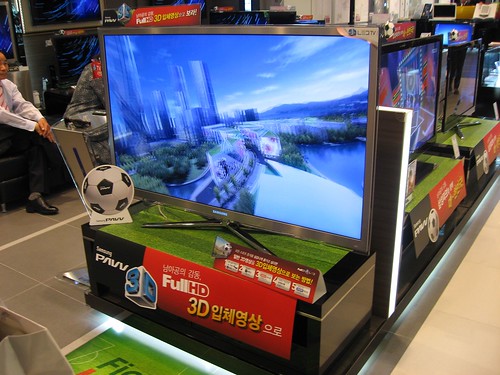
Apparently it was the dream of many Korean men to watch the World Cup on a 3D TV. I thought that was a little optimistic but then I found one in Lotte Department Store near us, proving at least that the technology was really out there as opposed to 'coming soon'. However, at around 2.5 million won (£1,400/$2,100), for many it may have remained a dream for now, although Samsung claim to have sold 26,000 3D TVs in Korea, so evidently some had the money to make the leap of faith.


Watching a 3D match live in the cinema seemed much more attainable, but it was so popular we were unable to get tickets. It was remarkable really, considering that at almost any other time football barely seems to register on the Korean sporting radar. I guess that's national pride for you. Despite working full-time during the day, two friends of ours - one of whom never watches football otherwise - arranged their limited sleeping schedule around South Korea's matches and somehow still managed to function at the office the next day.

Perhaps unfortunately for the 3D viewers though, some were quite disappointed by the quality of the 3D coverage. What I saw in the Lotte Department Store through 3D glasses was quite impressive, but it was a demonstration video which I'm sure is optimised to sell televisions. As always, real life may vary from the promises we are sold.

Even 2D television coverage was problematic. SBS won the exclusive rights to broadcast matches in Korea much to the anger of their competitors, but the practical upshot of this seems to have been that when matches occurred simultaneously SBS only showed one, because they were only using one channel to broadcast coverage. Which meant if you happen to be a foreigner wanting to watch your own team, or a Korean with a particular foreign interest, apparently you were out of luck.


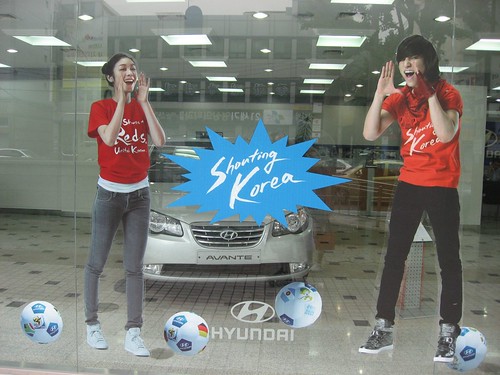
The standard line of encouragement to almost anything requiring strenuous effort here is Fighting!, although admittedly due to the linguistic challenge of pronouncing this English word it is often heard as Whiting!, so I hear Korea Fighting! - or Korea Whiting! - rather a lot when the country, or anyone within it, is doing anything remotely competitive. The tag-line for the World Cup though, appeared to be Shouting Korea, or Korea Shouting - a potentially noisy yet welcoming toning down of the rhetoric. When the matches were shown, the highway outside our apartment went eerily quiet - somewhere out there, an entire nation were glued to their 2D and 3D screens.

And now it's over - for Korea at least - and presumably an entire nation will go back to the status quo ante as far as football is concerned until the next major championship. I keep meaning to go to a football game here, but they seem so far off the radar normally that I've never managed it, despite having a friend who is a referee with the Korean Football Association.

Tuesday, September 22, 2009

The Hangover

When I first arrived in Korea three years ago everything was new, and my first few hours in the country were an overdose of sights and sounds which are still as potent to me today as they were when I first experienced them. But you can only do something new in your life once, so my return to Korea yesterday was never going to be the same as it was the first time.

I stepped out of the airport, and the smell of diesel mixed with cigarettes was just how I remembered it, but no longer in any way surprising. The heat mist that had once hung over Incheon had been replaced by the murkiness of rain clouds and pollution from China, but while the weather might have changed the place itself had not. So this time it was not with a potent sense of anticipation that I stood there amidst the chaos of the exit to Incheon Airport, but rather a sense of grim resolution. Is the future truly unwritten or are we condemned to live our lives in patterns, the words and the actors may differ but the play remains the same? If the latter is the case then here I was, Korea Act I Scene I, not the original but the re-imagined version.

In fact, my re-introduction to Korean society had begun earlier in the day on a plane out of Frankfurt. Struggling to get a case into an overhead locker a Korean man had demanded to know of my wife – in deliberately disrespectful plain form language - why she couldn't have waited until he'd passed to do that. English people might be ready to commit unspeakable acts of rudeness and violence at a moment's notice, but we hide it behind a thin veneer of politeness which to the untrained eye might appear to make us rather affable. I'd forgotten that Korean men in my experience often seem to hide behind no such pretence, especially towards Korean women.

I don't sleep on planes, even if Lufthansa were only going to offer a selection of 12 movies, and by the time we landed at Incheon I'd been awake for almost 24 hours and I had lost my sense of time. So as we walked from the coach stop to Seoul Station I saw a lot of homeless people who I assumed were bedding down for the night, before realising it was about 2pm in the afternoon, emphasising the reality that they were not only lacking proper shelter, but any sense of purpose as well. I'd been away for 16 months during which the global economy had collapsed. Every indication was that Korea had been less affected than some other countries, but on this evidence it didn't appear to have escaped unscathed. There was definitely a story here.

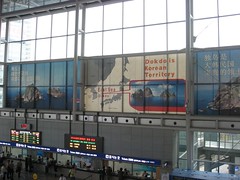
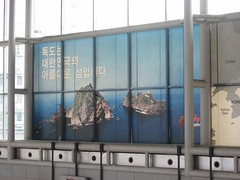
Seoul Station was just how it always was. Military personnel wandering around with Mickey Mouse shopping bags reminding us that one of the world's largest consumer-driven societies is still technically in a state of war with its starving neighbour to the North, and in a new addition large Dokdo posters – or Dokdo-Is-Korean-Territory to given them their full official title – adorned the walls of the station to remind us that there always has to be an enemy, even if we happen to be going through one of those bi-monthly periods of non-hostile relations with 'the other Koreans'.


As I boarded the KTX I was into my 25th hour without sleep, making the task of lifting two 20kg bags above me onto the overhead shelves all the harder. Predictably and despite the near empty carriage, an ajumma saw no reason to await the conclusion of my struggle and pushed past me shoving me unexpectedly forwards and almost pivoting the bag clean over my head to drop dangerously behind my back. With a strength I didn't know I had in me I just managed to bring it back the right way. "Don't mind me, just push by, it's perfectly OK!" I burst out angrily as I turned around to see the face of my nemisis, but all I saw was the back of another oblivious Korean who evidently thought it desperately urgent to get to their seat. Were the people here always like this and I just got used to it before? In fact, last time I was in this situation I recall a group of young heroes of the Korean Military who were laughing their bottoms off at my wife struggling to get her suitcase on the train so maybe it really was deja vu all over again. This really wasn't going the way I had expected.

When I first rode the KTX down from Seoul I was transfixed by the landscape as it whizzed by at almost 300kph. Now the train seemed slow and I barely looked out of the window until we reached the outskirts of Busan. As it happened my MP3 player shuffled itself to an instrumental track by composer Richard Gibbs called 'Reunion', and so it was this somewhat melancholy piece which provided the musical backdrop to the familiar images of unimaginatively functional square office blocks as we moved further into the city and the full weight of a growing realisation finally hit me – this is home now. Home – a small word with a big meaning – and one which carries a huge significance for me this day.

Monday, May 12, 2008

Exit Napoleon Pursued by Rabbits

I am of course an actor, playing a part, and I have been since I got here. I always knew this was the way it would be, and it's one of the reasons I chose to title every entry in this blog after a dramatic work. Free will or fate? You know my answer, and as Laplace's demon has inevitably revealed itself as my time in Busan unfolded, I have followed the script as it has been delivered to me, trying my best to fade into the background as an extra, but all the while feeling I was being watched as though I was walking centre-stage.

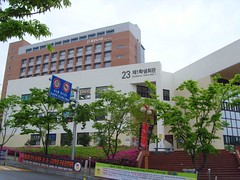
Standing outside the theatre on the Kyungsung University campus where a film crew is hovering, I felt the inevitability of them being drawn towards me, and a minute later I am once again stood next to a student union building giving an interview - different country, same modus operandi - smile, be diplomatic, don't start a riot.


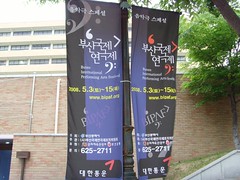
What do I think of the festival so far? Let me explain how my life works here - "There's a mime, do you want to go? OK." Context often comes in retrospect, and I'm usually far too busy to worry about something until it happens. So I've seen some banners for the Busan International Performing Arts Festival, quickly put two and two together, and explain how this is my first event so I really don't have a view yet, but how I'm sure it's great for Busan and a good way of promoting the city internationally. Please don't ask any deeper questions about what I'm here to watch because the first time I glanced at the script was a couple of hours ago and I certainly haven't studied it in any detail.

We are here to see Exit Napolean Pursued By Rabbits, performed - I discover once I get home - by Nola Rae, or rather, Nola Rae MBE - making her a Member of the Order of the British Empire, which is more than I'll ever be, particularly if I keep taking the Empire to court. Which is all to say that Nola Rae is moderately well-known, and certainly well-respected back home in the Empire, so this then, is no ordinary mime.

Before this revelation I'm just hoping that attending doesn't transpire to be a mistake. I've arrived in a group with twelve other people and I've been told the mime is British. so even though this wasn't my idea I can't help feeling that like everything else which is British in Korea, it reflects on me to some extent. I needn't have worried though, because the Koreans apparently loved it, despite some finding themselves dragged onto the stage. They should be used to it anyway, because I have yet to attend anything here where there members of the audience weren't conscripted as part of the entertainment. I always try my best to appear invisible at these points; I'm already on the stage in Korea without being on it literally, and I only want to carry the metaphor so far. But here's a tip if you don't want your fifteen minutes of fame here, don't sit on the front row. I suppose that's life all over. Participation eventually extended to the whole audience, which evidently wasn't to The Times of London's liking, but as Ms. Rae made puppets of us all from the stage, I thought surely this was the point. Did we refuse to stand, to gesture, to make fools of ourselves or was it easier to go along with arbitrary and illogical diktats of someone commanding the majority? After the show, it was our hosts turn to be on the spot as an audience member suddenly burst out that it was Children's Day in Korea the next day and 'requested' that the performer pose for pictures with all the children in the audience. Exit Napoleon had demonstrated how quickly one dictator can be fall and be replaced by another, perhaps in more ways than one.

I've never sat through 75 minutes of mime before, unless you count two years I worked under an old boss, so I wasn't sure it would appeal to me, although it held my interest - and not just because the material seemed vaguely autobiographical. But while we cycled through various European dictators some uncertainty was voiced to me afterwards as to how many of the references the local audience picked up on. It's easy to grow up with a Euro-centric view of history and not appreciate how the 'important global events' taught in school turn out to be merely important European ones, with little coverage of, or meaning to, our Asian peers. In the question and answer session which followed the performance someone asked about the genesis of the work and Nola Rae commented on the importance of opposing dictators, a message which does, however, have a particular resonance here.


On the way out the film crew caught me again and once again I offered my diplomatic answers. For some reason, this time they were quite keen for me to say 'something unknown... fighting!' to the camera, where the something unknown is presumably the name of whatever group they belonged to. So one moment we are condemning dictators and the next we are shouting 'Korea Fighting!' or whatever other cause you want to rally people's base emotions to. It seems we walk a fine line indeed. I did it of course; it was in the script.

Wednesday, November 21, 2007

Meet the Fockers

It's a fact of living in a Korean family that there are times when you get summoned unexpectedly and at short notice. Korean Father had spent a day with some relatives and they had worked their way back to the family apartment, and it wasn't long before our presence was requested and required. So it was that rather late on a Sunday evening we had to drag ourselves away from our slumped positions in front of the TV, tidy ourselves up and make our way through the dark streets to meet our elder relations.

I hadn't seen these relations since the final ceremony marking Korean Grandmother's death back in May, so there was much curiosity as to the progress of my Korean language skills, and it seems, an expectation that I would now be able to converse fluently with them. They were, of course, to be disappointed. My progress with the language has been slow, and this has only been compounded of late by the vast quantities of time I am spending dealing with the problem of my Government preventing me from returning to live in my country with my wife.

One of the relatives is quite well known in his area for running a successful farm - I think he's received awards. His wife spent a great deal of time obsessing over my hands, which apparently look like they've never done any serious work in their lives, a fact I can't deny when they were compared to her own; she obviously works hard on the land. Ironic then, that it should be her husband getting all the public accolade.

And then, 'the talk' started. If you've spent any time in Korea I swear you can almost feel the moment coming, and I'm not even sure you have to understand any Korean language to recognise the body language that he's a senior imparting his great experience and knowledge to a junior. It only makes things worse that one of the little known effects of consuming soju is to confer vast intellectual insights on the drinker.

So we sat there, nodding our heads in fake shame as our relative reflected on my poor understanding of the Korean language, and the many ways in which this should be rectified. It was a hard lesson but one can not deny his expertise on the subject, given his considerable skills in Korean, even if it is the only language he ever learned. While I was largely oblivious to the specifics, it had what I refer to as 'a high Migug saram (미국 사람 - American person) quotient'. Or to put it another way, when a Korean starts a lecture containing multiple references to Americans, it's a fair bet they aren't singing the praises of the American Dream. The translated conversation was something along the lines of, 'I know 미국 사람 are terrible at learning languages, I don't know what British people are like, but you have to learn Korean quickly or else...' and so on. And therein lies another great truth about my existence in Busan - there aren't many people from my country here so I am the only British person many of them have ever met - therefore meaning that everything I do is not only invites judgement on myself, but judgement on my entire country. It's ironic that I am mindful of my position as a British ambassador here at the same time my Government makes war on me. I only wish I could speak Korean sometimes to tell them what a nasty and vindictive little country I really come from. Sorry, contrary to popular belief, it's really not the Hugh Grant stereotype at all.

My wife decided to break ranks with protocol and answer back. We had been very busy. There had been other priorities. As defences go, not the strongest but it happens to be the truth. This was not good enough for our self-appointed judge and mid-way into making yet another point about foreigners in Korea my wife unexpectedly stood up and announced we were leaving. It was unprecedented - a considerable breach of protocol. And a minute later we were in the elevator.

It took my wife a while to calm down - and I didn't really get the full story out of her. I get these 'foreigner lectures' from time to time but I don't really know what to make of them. I am a guest here and the longer it takes me to learn Korean the more I'm inclined to agree that perhaps I'm not a very good one. On the other hand, it touches on a certain attitude in Korea which I don't believe would be placated even if I spoke the language like a native, so while this relative signals his antagonism towards foreigners but with it waves the terms of his acceptance, I don't really expect to ever really be accepted by people like this. Anyway, I do blame myself for my slow progress in the language. If I had known I was going to end up being here for fourteen months rather than the three to six originally intended, I might have approached the whole thing differently. Now that my Government seems determined to make me live the rest of my life here, the language problem, and the foreigner problem, are things that I have to face up to more seriously.

Korean tags: 영어, 한국어, 한국, 공부, 미국인, 외국인, 영국

Sunday, October 28, 2007

Han

When I was learning the Japanese language one of the peripheral if intended consequences was gaining an understanding of the culture which sat behind it. Singular words such as tatemae and honne speak to a far greater psychology and collective experience than a simple dictionary definition can provide. Understanding that, while I have served other masters from time to time, I fundamentally gravitate towards a ronin existence - and this is before I got exiled by my government - allows me to stick a label on my subconscious motivations and understand the potential consequences; the realities of which are far removed from any romanticised notions.

In truth I've barely scratched the surface of the Korean language and the only word I've encountered so far similarly loaded with meaning is 기분 ('kibun'), which a dictionary will tell you translates as 'feelings/mood/humor' but which in reality means much more. Like tatemae and honne, it can explain a lot to a confused Westerner about why people here sometimes behave the way they do.

I had quite a number of Japanese friends to help me with my studies, and I soaked up everything I could about Japan, but I was hardly surrounded by material, and it was tough. I watched NHK news which used to broadcast its news programme unscrambled in Europe, and I read the Asahi and Yomiuri Shimbun web sites regularly. My language studies eventually stalled with a vocabulary of around 1,400 words - but I did learn a lot about Japanese politics.

When I came to Korea, I had the opposite of my Japanese experience - the quantity of material was overwhelming, and it was all I could do to make sense of that between trying to juggle my virtual life on the London Stock Exchange and running around Korea in a generally confused or bemused state. I had little time to take an interest in what was happening in wider Korean society beyond my own sphere of existence, but it would also be true to say that part of me was afraid to know; Korea can often project an image of being angry - angry at Japan, angry at China, angry at Americans, angry at the rest of the world, angry at foreign teachers, angry at history itself, which to be fair often hasn't really dealt the Korean people a good hand, although with no apparent statute of limitations on things that go back hundreds of years one wonders how justice can ever be seen to be done. There are times when ignorance is bliss, and I didn't want too many of my comfortable illusions about my temporary home shattered by the reality of the hatred that is out there bubbling away under the surface.

As I have slowly got my bearings though the time came when I had to start taking an interest in wider Korean society and developments, and in a sense, no study of the language - something which I've been taking more seriously of late - can be complete without this understanding. To this end I now read the English-language newspapers here every day and bookmark the stories I find interesting using Delicious.com, which should help me to build up a better picture of this society.

The Korea Herald has recently started a thirty part series on huge topic of social change in Korea. Here are parts one and two. Amongst other things part two discusses the 'psychology of han', which I think bears quoting here, because it speaks to so much of the Korean experience:

"The psychology of 'han': One aspect of the human element that cannot be omitted in the discussion of Korean behavior relative to modernization and economic growth is the psychologically motivating factors. Outstanding and unique in Korea is the psychology of han. This word cannot be literally translated into English, but it involves a sense of frustration, remorse, and revenge which are caused by certain unjustified deeds. When such feelings are accumulated in the psyche, one has to release the tension in some way, and, if unleashed in a negative way, this can cause "frost even in the middle of summer," especially for women, as the old saying goes. Channeled in a positive direction, this psychic force can lead to very productive results. The Korean nation has historically accumulated a strong sense of han, owing to so much bashing by powerful neighbors. Yet we have retained a unitary national identity so relentlessly that when this han feeling was directed into the positive channels of economic growth and modernization, it was able to lead to miraculous development in a short period of time, and has played a central role in restoring Koreans` national pride."

- Korea Herald, 2007-10-26


Korean tags: 신문, 언어, 공부, 기분, 심리학

Thursday, October 25, 2007

Thus Spake Zarathustra

It seems that ever since the term 'Silicon Valley' came into popular use in 1971, politicians around the world have been trying to emulate this success story by designating an area within their own region for targeted growth and selecting increasingly silly names to invoke international enthusiasm or bemusement (winner: Malaysia's Multimedia Super Corridor). Not to be excluded, Korea's government has set a goal for the country to become the 'Northeast Asian Financial Hub' by 2015, a project run by 'fn HUB Korea', presumably so named because the origina bureaucrat was having serious problems with their keyboard at the time. Sadly, Seoul's desire to become the regional fn HUB is somewhat complicated by the geographical proximity of Tokyo to its right and Shanghai to its left, or East and West if we're trying to keep politics out of it, and the tide of history that is China becoming a global superpower.

A survey of 103 foreign companies ranked Korea as the least likely to become a fn HUB, causing the Chosun Ilbo newspaper to lament that the fn HUB dreams were 'all talk and no action' while extensively quoting from an Economist article which had, amongst other things they claimed, identified anti-foreign sentiment as an impediment to international investment and relocation within the country. Certainly, the government passing laws such as the one which prevents foreigners from opening bank accounts and using ATMs within three months of entering Korea doesn't help foster an economically conducive atmosphere, and some local attitudes can be forthright, but it's often the media itself which seems to contribute to the sentiment; a couple of links later the Ilbo runs an otherwise largely uncontroversial story about forbidding work permits to unqualified teachers when it suddenly feels the need to remind its readers that some teachers 'have even been found to have taught under the influence of drugs'. They do not comment on their position on writing under the influence of them though we may be able to guess. They ran this story last year although if you read it carefully you'll realise that the 'foreign English teachers' in question were ethnic Koreans who had been deported from the U.S.

The news goes on to make a passing reference to the fact that the new law will see the scrutinisation of education visa applicants' criminal and medical histories, and while the former might be considered reasonable enough, the implications of the latter might raise some eyebrows among those who consider their medical history to be their own, and not something for any government to pry into with a view to categorising and potentially discriminating against them in some way. Whether it represents the thin end of the wedge or not along the road to a Gattaca-style society is largely beside the point; the fn HUB dream of creating a global market requires more of a global perspective, and not an environment where foreign residents are afraid to read the news every day.

Korean tags: 정부, 정치, 경제, 신문, 외국인

Friday, October 12, 2007

Thoughtcrimes

"Bad laws are the worst sort of tyranny." - Edmund Burke

In my unceasing attempts to extract my own surplus value, I trade stocks and occasionally invest for the longer term. Last week's unexpected détente between South Korea's President Roh Moo-Hyun and North Korea's Kim Jong-Il raised the possibility that there may in fact be peace in our time after all, which in turns means that my previously mainly dormant North Korean investment otherwise known as Aminex might wake up from its slumbers. This only seemed to be further confirmed by the announcement that oil exploration had been one of the summit discussions. And there was me thinking that these meetings mainly degenerated into arguments about who sits where and which country makes the best kimchi.

When I saw another news story stream though my Dow Jones newswire it seemed like another piece of good news - the North Korean News Agency was reporting that the US was lifting sanctions against them (there is a bit of a reality distortion field up there though). Since the 'news' was nothing more than a headline I tried to go to the Agency's website to get some more detail, and was confronted with this:


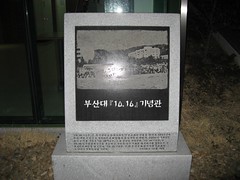
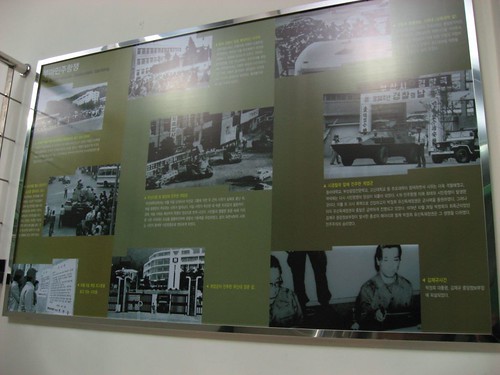
And what this basically means is that you can't access the North Korean News Agency's website because South Korea is the kind of democracy where freedom of information is controlled by the government. Although to be fair, this seems to be something of a developing trend globally in some of the world's oldest democracies which should know better. But it wasn't so long ago that I was in the '10.16' Building on the PNU Campus which commemorates a failed student uprising against the military government 28 years ago. It seems that when freedom finally arrived nine years later it came with a large dose of realpolitik built in as far as the North was concerned.


Last time I had a problem accessing this website I was using LG Powercom as my ISP and simply couldn't load the page, but I couldn't load a lot of pages, so I wasn't certain whether it was by accident or design. Later the North Korean site became available while some other sites, including that other well-known hotbed of Marxist radicalism, Barclays Stockbrokers, got blocked, so I had to switch to Korea Telecom's MegaPass service. Evidently, this is the very obvious way they deal with information the National Police Agency and Korea Internet Safety Commission don't approve of. But it begs the question why one major ISP is trying to censor the site while another wasn't (unless it was a mistake - the site is now inaccessible again via Powercom). Whatever the case, surfing around the web and suddenly being confronted with a warning messages with the National Police Agency logo on them is the kind of more associated in the popular mindset with China than South Korea.

One of the concerns over the Irish Aminex is that the day may come when the relationship between North and South will become strong enough that in a burst of national pride both governments will conspire to ensure outsiders are kept out, and that in some way the company's contract will be declared null and void, despite being made under Swiss law. I think anyone who's spent time in Korea knows what the score is as far as social and economic protectionism is concerned, so I'm under no illusions over what may eventually transpire. On the other hand, the continued blocking of what the North Korean government have to say may tell us a lot about how deep rooted the mistrust between these countries are, and it cuts both ways because by some accounts defectors from the North are so indoctrinated and traumatised by their experiences that they have huge difficulties integrating into Southern society. There may be a very long way to go before the Koreans can truly call themselves one people again, if they ever can.

Korean tags: 북한, 범죄, 자유, 정보, 경찰

Wednesday, September 05, 2007

420

About two months after I arrived in Korea I was on the subway line 2 somewhere near Seomyeon - when I noticed a wall near the track with small yet perfectly legible graffiti which read, in English, "Legalise Free Hemp". I've seen it again a couple of times since and always meant to take a photograph of it but so far the opportunity has eluded me. The longer I stay in Korea the more remarkable that graffiti becomes, even if it turns out to be part of some kind of strange free-speech art project, because graffiti is virtually non-existent here and Korea has a zero-tolerance policy towards drugs. In fact, I've read one or two articles - written by Koreans - that boldly state that there is no drug problem here, unlike in the West.

I have an interest in Japanese history, but I've never developed the same taste for that of Korea. Whereas much of the former's domestic history is what is it, one gets the feeling that a good portion of the latter's is presented to make points about present day ideological and territorial struggles, and while I sympathise with Korea's problems, there's often a fine line between history lessons and modern-day indoctrination. So in my travels around Gyeongju amongst other places of historical note it's a distinct possibility that I was exposed to information about Korean crafts of the past, and let it wash over me with all the other things I was being told at the time. Or maybe the fact that country-dwellers made their clothes and bedding from hemp got lost in the translation.

So the notion of 'legalising free hemp' seems to be a moot point, because it transpires that there's still rather a lot of it growing in the countryside here. Fortunately or unfortunately for the country-dwellers, depending on how you look at it, the concept of smoking the product of this plant simply didn't occur to them - allegedly anyway. Although this is not to say that there wasn't any smoking of substances going on - it seems that there was - but perhaps it genuinely wasn't widespread.

As for the truth of the existence of drug problems in Korea, Korean Father has told some stories about the addicts he used to arrest and the extent of their problems which reveals that at least for some individuals, the problem is a very real and severe one.

Tonight KBS 2 (KBS is a bit like the BBC here) will run an hour-long 'expose' of how foreigners are faking their degrees to teach English in Korea, and smoking pot when they're presumably not working illegally or, prepare yourself, having sex with different partners. Unfortunately, recent scandals revealing the extent to which a lot of Koreans have faked their educational qualifications tends to smack of the pot calling the kettle black, and not just because of the degrees. This is generally not going down too well amongst foreigners here.

Korean tags: 마약, 외국인, 자격

Saturday, June 23, 2007

Fantastic Follies

“If you tell a lie big enough and keep repeating it, people will eventually come to believe it."
- Joseph Goebbels, Nazi Minister for Public Enlightenment and Propaganda, 1933-1945

As we were leaving the apartment yesterday my wife asked half-jokingly if I thought our hamsters would die if we forgot to turn the air conditioning off before going out. For a moment I thought she'd developed an overly high opinion of the machine's ability to freeze our one-room living space, but it turned out the perceived danger was 'fan death'. Fan death? Yes, it seems that leaving your aircon on, or even a simple fan, while you sleep in a sealed room can result in death from asphyxiation, poisoning, or... certainly something anyway.

I find there are times in Korea when I don't know whether to just laugh at the absurdity of some of the facts I am told, or just get angry and grind my teeth together as I dare to suggest that perhaps, just maybe, people here are not the arbiters of all that is true, and just because everyone believes something it doesn't make it right. I think in any country there's often a prevailing opinion, but in a more homogeneous society where the 'group' is more important than the individual, it becomes especially difficult to challenge established notions.

And what a notion it is, with the news media regularly updating the grim fan death statistics, and fan manufacturers careful to design auto shut-off timers into their products to avoid killing you. In fact, a forty-seven year old man died of fan death a couple of weeks ago - it's true - it was on KBS News. As Wikipedia's fan death page documents, some people go so far as to ensure they leave their car window slightly open when their vehicle's aircon is on to avoid the dreaded fan death (so why don't people die from the aircon in the sealed environment of aeroplanes?) The more you read, the funnier - or more infuriating - it gets.

So, and not for the first time, a lively debate between my wife and I followed as I attempted to find a diplomatic way of explaining that this apparent urban legend was possibly the silliest thing I'd heard all year, and the topic ended with me accepting the challenge to find evidence contrary to the accepted truth as propagated by the Korean media and society as a whole. Fortunately, this was not a task which proved particularly challenging.

But is my wife, a graduate from a fairly prestigious Korean university and the holder of a second degree from a British institution, really convinced? Naturally everything I found debunking the myth of fan death was from a non-Korean source, and herein lies another thing I've learnt while I've been here - if the rest of the world believes one thing, and Korea believes another, the people who are correct are...

Tuesday, June 19, 2007

The Four Seasons

Apparently today is the start of summer in the Korean lunar calendar, but aside from an unseen monk loitering somewhere near our apartment chanting and banging his mogtag ('목탁') there was little to mark the occasion and in any case, it's already been uncomfortably hot for weeks. There was a lot happening in Trafalgar Square in London though. Go figure.

As time has moved on my thoughts have turned increasingly to the question of where I might base myself in the next few years, and there are no prizes for guessing that Korean Family would probably like that to be here rather than the UK. So when I complained to Korean Mother about the heat lately, it set up a rather more robust defence of the Korean weather than one might have thought necessary without this increasingly important subtext. Apparently attempting to spin something negative into a positive, she delivered her reply with the conviction of a closing defence lawyer in a trial - Korea has four seasons - and stared at me for extra effect as though somehow I would suddenly realise what a truly remarkable place this was and how I should welcome the soaring temperatures as a triumph of Korean something-or-other. So I told her that in England - where our weather is notoriously changeable - we had four seasons as well, sometimes in the space of the same week. This didn't seem to go down terribly well, and maybe not just because of the brewing subtext battle.

Of course, I've heard that Korea has four seasons before, because it is something of a running joke amongst foreigners here, but the seriousness with which it's treated is somewhat inexplicable. I might have to be careful who I explain Britain's version of the four seasons to here. Or maybe I'll just go the other way with it and start telling people that we actually have five seasons back home. Decisions, decisions.

One thing we don't have - at least not officially anyway - is a monsoon season. The forecasters here have been telling us for a few days now that Korea's month of rain will start on the 22nd, after which of course, it gets even hotter...

Monday, April 02, 2007

Idiocracy

I used to subscribe to the second worst cable company in the known universe. Shortly before I left the UK, they merged with the worst one, possibly creating sufficient critical mass to collapse into a black hole of their own collective incompetence. In the months I've been in Korea, our local cable service, which has the virtue of being very cheap, has existed transparently in the background which is how it should be. Until today.

On the second of April - ruling out the possibility of an April Fools joke - they moved all the channels around without warning and for no apparent reason - a trick they may have learned from my old company. And the motivation may well be the same - an attempt to disguise the fact that some of the channels have dropped or replaced by new ones.

Most of the channels were Korean and therefore of limited use to me, and no use to Koreans trying to practice advanced English listening, but I took what I could get - most of the time the TV was stuck on CNN. We've lost CNN in the reshuffle and it's been replaced by... MTV. Or to put it another way, we've moved from a channel with an I.Q. of around 110 to one with a score of about 80. And amongst the other replacements in the small English language niche, we now have Real TV, which is a reality TV station, and pretty much what you'd expect content-wise. I can only hope that Koreans don't start trying to pick up their English from either of the latter two channels, because it's not recognisably English anyway - unless the future of English is to just grunt at one-another. A distinct possibility, I admit.

Curiously, we also appear to have lost Arirang, the Korea-to-foreigners channel, whose incessantly positive view of Korea rapidly grated but which nevertheless offered some Korean language learning programmes as well as some fascinating insights into Korean culture - even if they did have a rather high expectation that Korean culture would one day sweep around the world and have us all learning the language.

And the explanation from the cable company? They created an 'economy package' above the 'basic package', and moved five channels - including CNN there. If we want to upgrade the monthly subscription cost will double to 11,000 won and we'll need to install a set-top box for an additional 30,000 won. Since the only channel of interest to us in the 'economy package' is CNN (two of the other three being sports channels and the other cartoons), it's not really worth our bothering with, especially as if we did it would feel like we were giving in to the cable company's business practices.

Something which is probably unconnected to the change, but which I also noticed while skipping through the channels this morning, was that one of the channels which survived was showing 19-rated movies with liberal helpings of female nudity at 11.30am. I've been here long enough to be used to daytime channel-surfing revealing glimpses of bloody violence and dismemberments, but this is a first.

I'm two weeks away from reaching the half-year mark since my arrival, and I never got homesick, but I did like to have a more tangible link to what was going on back in the West than the Internet could provide in short articles and snippets of video, so the loss of CNN leaves me feeling a little more isolated in Korea today.

Saturday, March 10, 2007

Die Patriotin

It's a reality of life where we live that some of the local vegetable vendors, rather than set up in a fixed place, will tour around the neighbourhood in their blue vans advertising their wares through a loudspeaker. After a couple of hours this can get very repetitive and annoying, and it has a disturbing Orwellian quality; I feel as if I could step outside into a world where everyone wears grey and black helicopters watch the citizenry from above.

At least I have the advantage of not knowing what they are saying. I do occasionally get translations though, and today's vendor deserves particular mention for the following sales pitch: "Dear patriotic citizens of Busan, we are selling fresh squid for 500 won". So perhaps we're not so far away from that Orwellian State after all. I almost feel compelled to go out and get some of that seafood - after all, if national honour is at stake...

Saturday, February 10, 2007

Patriot Games

We have a lot of TV channels in the UK, but I think it has to be said that after the first twenty or so, it's niche, long-tail and lowest-common denominator entertainment all the way. So I admit, an entire channel of consisting of "The World's Scariest Police Chases" seems like overkill even if it's your thing. But despite the fact that a lot of people in the UK play video games, there's no games channel and I can't even recall ever seeing a specific gaming programme beyond an old TV show called Gamesmaster which was pulled off the air in 1998.

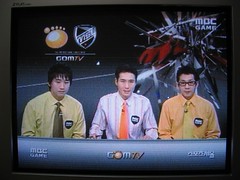
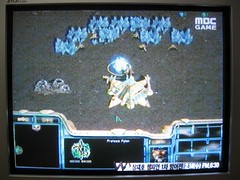
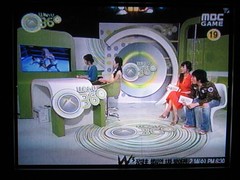
The Korean cable TV service we subscribe to for 5,000 won per month (about £2.72) in our apartment building is a fairly standard one which a lot of people have. Out of approximately 60 channels, three are video game channels, and a couple of the others feature hours of video gaming during the night. If you weren't convinced by the PC Bang experience already, this should tell you a lot about the prevalence of gaming as an activity and subculture here.

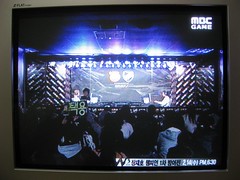
In fact though, merely labelling them as gaming channels doesn't really explain what they are. Their focus is online gaming, and the standard programme consists of tournaments between individuals and teams. Serious and haggard looking - and almost exclusively male - youths with slightly wild or vacant eyes hunch over their screens while commentators provide a running dialogue on the action. Meanwhile a crowded audience watches almost as intently. Girls scream when they show the players up close on the big screen. I never really thought of video games as a spectator sport, or gamers as high-school pin-ups, but here it is.


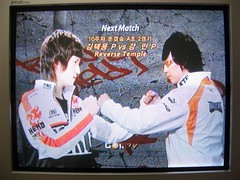
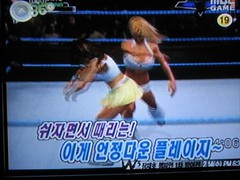
Oddly enough, three months of flicking through the various TV channels would lead you to the conclusion that there are in fact only three online games played in Korea. World of Warcraft, Starcraft and some first-person-shooter Doom-variant I've never really identified. I actually dubbed one of the channels 'World of Warcraft TV' in my mind because as far as I can tell that's all they ever show. In fact, I know from my own experience playing the hugely-popular Kartrider that there are others, but I've never seen any coverage of them. Very occasionally ordinary multiplayer games make an appearance, so I've seen coverage of a basketball game a few times and last night, bizarrely, a women's wrestling game on the MBC Game channel - with female gamers - rated 19 - adults only (note the logo in the top-right of the screen!)


I couldn't honestly say what the specific content of the Korean gaming channels is beyond coverage of the Korean World of Warcraft League and 'Star League' as I can't understand Korean, but Arirang - the English-language and ever-so-slightly foaming at the mouth Korea-to-foreigners channel (slogan - 'Korea for the World, the World for Korea'), started showing some of the tournaments late at night - especially between Korean teams and foreign ones. Having never played them, I just don't understand World of Warcraft or that genre of game, so I was no wiser despite the valiant attempts of the commentators to explain the battles as they unfolded, and it remains an unsatisfying spectator sport in my book - even in English. But the take home message from the game I watched was that the Korean team beat the Chinese team and there was much rejoicing which left me feeling slightly ill-at-ease.

I continue playing Kartrider because going round and round in circles as a cartoon-like figure is something I can relate to from my real life, and besides I only need another 1,000 points to lose my 'green-glove' status and progress on to the next colour (spot the sign of addiction here). Plus, now that I have Korean Windows I can actually talk with the other players in-between races - something I couldn't do with English Windows even though Korean input worked with normal desktop applications. Whether I will or not is another matter though, I can't type Korean fast enough and even if I could, I'm not sure how my nationality will go down, particularly when I'm winning...

Wednesday, January 03, 2007

Under Two Flags

Korean flags have appeared all the way along Busan's major road routes during the last week. I've no idea what this is all about but it all feels vaguely Orwellian. I guess a Korean flag company has done very well out of it though - unless of course, it turns out they were made in China.

Monday, December 04, 2006

Antz

I noticed that Korean Parents' apartment has an ant problem the other day - even though it's on the 13th floor, but Korean Mother isn't really bothered, because they don't do any harm and it seems that in Korea having ants is seen as a sign of wealth, so bizarrely, I think she's almost proud that they've moved in.

They are however, brown ants. Apparently had they been white ones, this would have been a very bad thing. Not another subtle manifestation of Korean pride though as it turns out - it's simply that the white ants eat into the structure of the buildings they infest. White people merely eat into the structure of Korean society, which is perhaps a less tangible thing to complain about, although the Chosun Ilbo does try quite hard.

Friday, November 24, 2006

The School of Rock

We'd been invited to a high-school event on Tuesday this week. It seems that schools in Korea have a kind of open-evening once a year, where students provide demonstrations of their field of interest or expertise to other students and visitors. Although partly a recruiting tool for prospective entrants, it is meant to provide a chance to relax and even have some fun.

So it was we found ourselves in a dark playground in front of a typically anonymous-looking Korean school building, watching a succession of high-school kids take to a stage in order to profess their desire to be singers or dancers before launching enthusiastically into their acts to the supporting screams of a few-hundred peers.

There were a depressing number of 'Korean' rap numbers which despite my occasional rap indulgences just washed over me in their genericness, so the stand outs were a girl singing soul in English who possibly had the most amazing voice I've heard since Norah Jones, and a boy who implausibly sang what seemed to me like the kind number which Sinatra would have done - had he been Korean. They could both easily have been professionals though - and if I'd have been a music agent I'd have been signing up the girl for a record contract afterwards. Maybe this is what comes of the Koreans' fondness for locking themselves in singing rooms on an evening for hours at a time.

It has to be said, one male power-ballad singer really didn't work out, and as he left the stage the professionally employed presenter said that it was possibly the worst act he'd ever seen. Near the back of the stage as I was, I expected to see the boy skulk away devastated but he appeared remarkably nonplussed by the critique. And presenter aside, that was a remarkable thing about the event. The crowd were supportive, no-one wanted anyone to fail, and when things got rough there would be attempts to join in with the words to drown out the imperfections booming out from the PA system.

The teachers also performed a few acts - although I'm told this is more unusual. One would have thought that even if the students didn't invite public ridicule on themselves, the teachers might by breaking down the barrier between them, but it was all remarkably good humoured. Personally, I'm not sure I'd have wanted to turn up to school the next day after doing some of the things they did but I guess it's just not the same here, where teachers generally command much more respect than their British counterparts.

While the stage-show was very professionally produced, we were a little surprised at the lack of other activities. This was a vocational high-school specialising in the hospitality industry, so their were a couple of stalls where students had cooked dishes and mixed cocktails, but otherwise that was it by the time we got there - it seems we'd missed more of the food and drink stalls though. Even so, apparently many other school events are much more extensive than this.