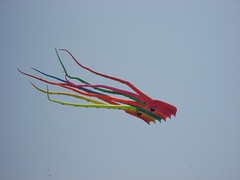
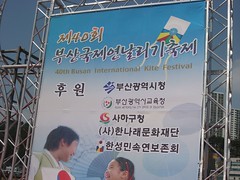
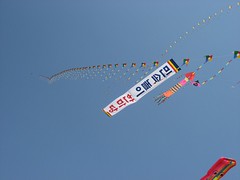
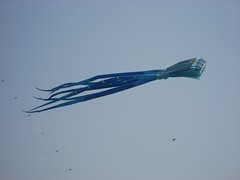
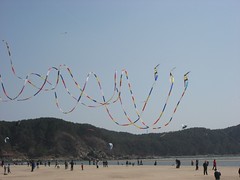
The 40th Busan International Kite Festival was held this weekend, so yesterday we went along to watch and fly kites of our own around the periphery of the event, which apparently is the done thing. This involved actually buying a kite first, but given that kite flying is a reasonably popular activity in Busan, it isn't that difficult to find shops selling them in appropriate locations.
The Festival was being held at Dadaepo Beach. During my first 18-month stay in Korea, and even though some of it was a bit of a blur, I'm fairly sure I only visited Dadaepo Beach once, and that was only in passing as a break between driving from one place to another. In the last three months, I've been back there for the Last Sunset Festival, the Jeongweol Daeboreum Festival and now the International Kite Festival. Suddenly, Dadaepo Beach seems to be a hive of festival activity.
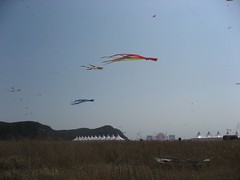
Like many things I experience in Korea, I had no few preconceived ideas as to what to expect, but having never seen one-hundred foot long kites before, I was in for a surprise when they swung into view over Dadaepo Bay. It looked exciting. There were festival tents and a large banner promised 'Folk Games Big Party'. But in truth, not a lot seemed to be actually happening - or not in an organised way at least. Dadaepo Beach was full of people flying their kites in a private capacity. Most were small but there were obviously a few more hard-core individuals controlling larger - and noisier - aerial displays. It seems I also hadn't realised that by fitting a kite with an audible device, the swooping and diving can be accompanied by a rather alarming noise.
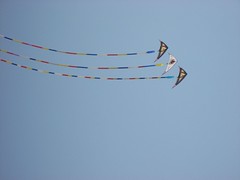
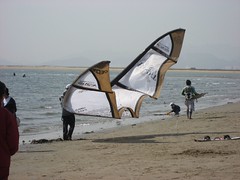
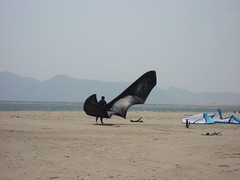
But while flying a kite may offer some interactivity, watching people keep their kites in the air wasn't much of a spectator sport, so I wandered down the beach where I thought I'd spotted Korean Batman, who actually turned out to be a kitesurfer getting ready to take to the water.
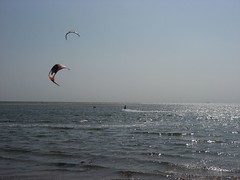
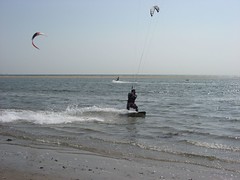
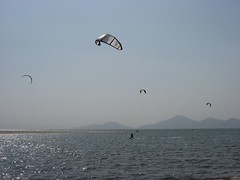
In fact, some kitesurfers were already in the water. It was unclear whether they had any connection with the Festival or merely happened to be doing what they always did on a Sunday afternoon. I rather suspected the latter. Dadaepo Beach seems to be one of those 'anything goes' type of places.
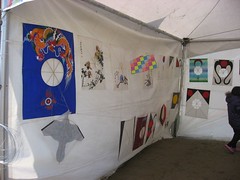
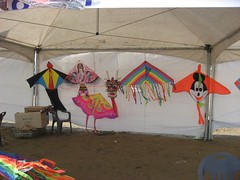
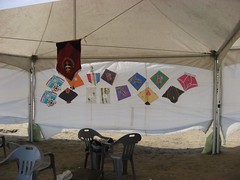
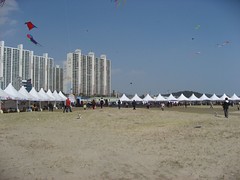
Back at the tents a few people were playing traditional Korean games, one of which involved throwing an arrow into a cylindrical tube. But generally, while there were a lot of tents, not much was happening in most of them. A few had kites on display, while many of the others were either empty or had been commandeered by people to sit down in.
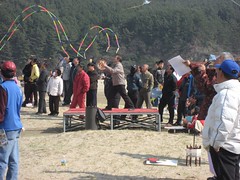
I understand that Saturday saw the elimination rounds of a kite competition and that Sunday would therefore see the finals. This might have explained the apparent lack of official activity. I can't say what stage of the final it was that eventually did begin, but two men took to different podiums on the beach and readied their kites. If the judge venting his anger at both competitors was anything to go by, this was a very serious business. Apparently this was to be a 'kite fight'. It wasn't at all clear what this involved but as I watched both kites in the air positioning themselves it seemed to have all the excitement of a slow game of chess. The friends we'd come with wanted to go and eat what would be a very late lunch so we left at this point. I didn't feel I was missing much, which is a pity because afterwards I learned that Kite Fighting is a proper sport in Korea and it certainly sounds like it gets more interesting than anything I saw. As we walked to our car, one of the men could be seen running to pick up his severed kite.
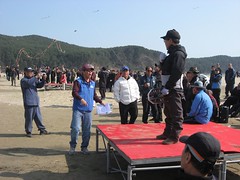
Generally, the 40th Busan International Kite Festival was interesting, but oddly anarchic.
Monday, March 29, 2010
Saturday, March 27, 2010
A River Runs Through It
A few years ago $900 million was spent creating a 6km recreational space along a stream in central Seoul. I've visited this urban renewal project 'Cheonggyecheon' ('청계천') and it is quite beautiful, although as its Wikipedia page suggests, it has not been universally welcomed.
It's possible that since then Korea has developed an obsession with rivers, streams and even canals, though perhaps it had one even before 'Cheonggyecheon' was completed. There's even a development proposed for our neighbourhood which involves creating an artificial stream with bridges running the length of the district. Everyone, it seems, wants a little bit of 'Cheonggyecheon'.
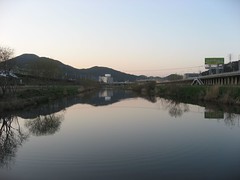
The Suyeong River ('Suyeongcheon'/수영천') in the Banyeodong area of Busan is not quite so picturesque, but this hasn't stopped part of the area around it being designated as a 'park'. A 'park' elicits certain imagery for an English person. The Victorians, stifled by industrial pollution and in a last gasp of the grandeur of empire, built quite a lot of them, generally squarish in shape, generally complete with ornamental ponds and statues of lions evoking notions of far off conquests and British dominance. These days, except on the sunniest of days, they're primarily the domain of drug-users and knife-wielding youths, and as such, have retained their national metaphor. In Korea, a park is a much more fluid term, seemingly covering almost any public area within a city that hasn't succumbed to urban sprawl. Which usually means they are to be found somewhere it would be too difficult or undesirable to build.
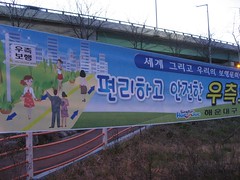
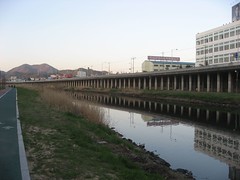
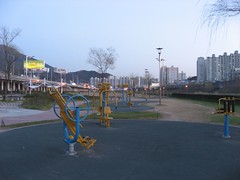
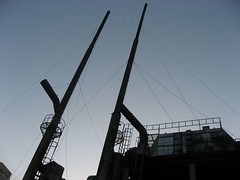
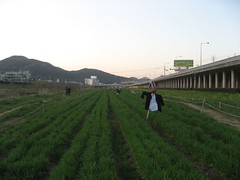
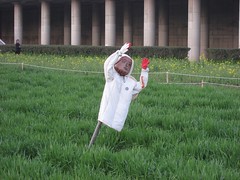
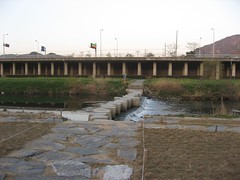
So to call the Banyeodong river development a park by British standards would be a stretch - it is essentially a couple of paths either side of a river nestled between two busy roads, featuring a small recreational area, some public exercise equipment, a vegetable patch, a decaying factory, and a couple of potentially dangerous river crossings.
But you have to take what you can get here I think. I used to enjoy running when I was younger and have often thought about taking it up as part of my efforts to keep fit, but it isn't really safe to go out running alone early in the morning where I'm from, and in Korea, it's a question of finding a place. Like most of Korea, Busan is quite mountainous so the flat areas between the peaks tend to be heavily built up. Running along the main roads never looks healthy because of the heavy traffic fumes, frequency of junctions, people, and motorcyclists treating the pavements/sidewalks as a road. Away from the major roads, there aren't even any pavements so you take your chances with the traffic weaving in and out of the streets. It's not conducive to picking up a sustained pace. So if I sound underwhelmed about the park in Banyeodong, you have to understand it is a small oasis of possibility in an unforgiving urban landscape, and I wish we had something like it near our apartment. Perhaps one day the local government will build a stream for us, as promised.
It's possible that since then Korea has developed an obsession with rivers, streams and even canals, though perhaps it had one even before 'Cheonggyecheon' was completed. There's even a development proposed for our neighbourhood which involves creating an artificial stream with bridges running the length of the district. Everyone, it seems, wants a little bit of 'Cheonggyecheon'.
The Suyeong River ('Suyeongcheon'/수영천') in the Banyeodong area of Busan is not quite so picturesque, but this hasn't stopped part of the area around it being designated as a 'park'. A 'park' elicits certain imagery for an English person. The Victorians, stifled by industrial pollution and in a last gasp of the grandeur of empire, built quite a lot of them, generally squarish in shape, generally complete with ornamental ponds and statues of lions evoking notions of far off conquests and British dominance. These days, except on the sunniest of days, they're primarily the domain of drug-users and knife-wielding youths, and as such, have retained their national metaphor. In Korea, a park is a much more fluid term, seemingly covering almost any public area within a city that hasn't succumbed to urban sprawl. Which usually means they are to be found somewhere it would be too difficult or undesirable to build.
So to call the Banyeodong river development a park by British standards would be a stretch - it is essentially a couple of paths either side of a river nestled between two busy roads, featuring a small recreational area, some public exercise equipment, a vegetable patch, a decaying factory, and a couple of potentially dangerous river crossings.
But you have to take what you can get here I think. I used to enjoy running when I was younger and have often thought about taking it up as part of my efforts to keep fit, but it isn't really safe to go out running alone early in the morning where I'm from, and in Korea, it's a question of finding a place. Like most of Korea, Busan is quite mountainous so the flat areas between the peaks tend to be heavily built up. Running along the main roads never looks healthy because of the heavy traffic fumes, frequency of junctions, people, and motorcyclists treating the pavements/sidewalks as a road. Away from the major roads, there aren't even any pavements so you take your chances with the traffic weaving in and out of the streets. It's not conducive to picking up a sustained pace. So if I sound underwhelmed about the park in Banyeodong, you have to understand it is a small oasis of possibility in an unforgiving urban landscape, and I wish we had something like it near our apartment. Perhaps one day the local government will build a stream for us, as promised.
Tags:
culture,
government,
health
Subscribe to:
Posts (Atom)